For a long time, digital health content has been shaped by keywords.
What are people searching for?
How often?
How do we rank for that phrase?
Those questions are still relevant—but they are no longer sufficient.
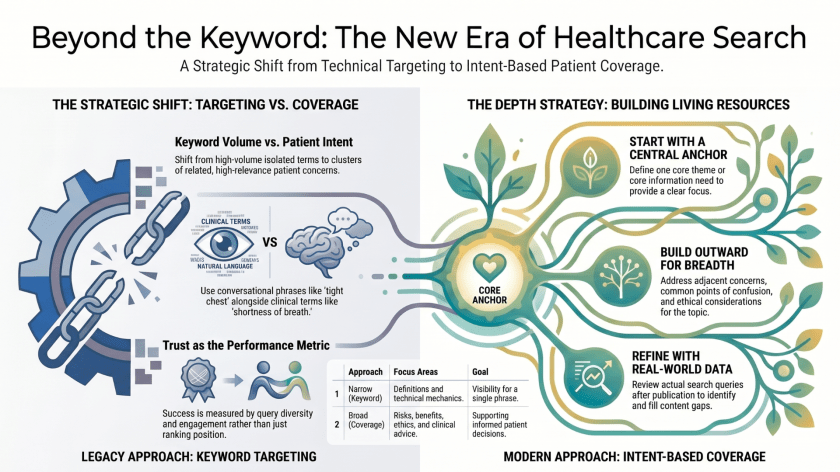
Search engines now interpret meaning and intent, not just wording. A single page is rarely tied to one search term. Instead, it becomes visible across a wide range of related queries—many of which may not have been anticipated at the outset.
For those working in healthcare communications, this is less about technical optimisation and more about how well content reflects the real questions people are asking.
Search technology is moving away from simply matching exact phrases and is increasingly interpreting the meaning and intent behind user queries. Rather than linking a page to a single search term, it now recognises how different questions connect through a shared underlying concern.
This shift exposes the limitations of traditional keyword tools, which tend to capture exact phrases rather than the broader landscape of related queries. As a result, content strategies have often over-focused on highly competitive, general terms, while underestimating more specific, lower-volume searches that reflect moments of uncertainty, personal relevance, or a need for clarity.
In this context, discoverability depends less on targeting individual keywords and more on how well content reflects the range of questions someone might ask on a topic. This includes recognising the different ways people describe their experiences—moving fluidly between clinical terminology and everyday language.
Discover more from Health Care Social Media
Subscribe to get the latest posts sent to your email.


