Posted in Uncategorized

Lorna's avatarWrite On Track

Do you want your website to be referenced on the first page of google? Do you want people to be able to find your online presence easily and quickly?

Why blog? Why spend time writing blog posts? How will a blog benefit my business?  To what extent will a blog help my business?

SEOIf you have a website, you want people to be able to find it easily and ideally, you’d like it to be on the first page of google.  However, unless you are prepared to pay  for google advertisements, your website will not necessarily feature on the first page throughout good website optimisation alone.  An effective blog is invaluable in improving your  SEO to the extent of achieving the top of page one.

When I started blogging in early 2008, there were two blogs that I became aware of very quickly.  Why? Because everyone (in related fields)…

View original post 779 more words

Posted in Uncategorized

Finding the Gamification Sweet Spot in Health

Dave Levy's avatarHealthyComms

Dave Levy (@levydr)

I don’t love the word gamification, but rather than fight the jargon, it’s much more interesting to spend the time figuring out exactly what the concept means and how it relates. I won’t pretend that I’m anywhere close to an expert on game theory, but if we boil it down to a simple concept – basic, clear objectives that match incentive with accomplishment – hopefully we can at least explore the application to health mildly-academically.

The example I always think of when it comes to general tech adoption of gamification was the initial appeal of Foursquare‘s badges and, of course, mayorship honors. Even in its earliest stages at SXSW at 2009, the motivation to get into using the app came a lot from these early, completely non-tangible rewards. Obviously, Foursquare has become a force to be reckoned within the LBS space since then, and…

View original post 498 more words

Posted in Uncategorized

there are now hundreds of apps that focus on various chronic conditions, and many of them enable users to track symptoms or observations of daily living

See on Scoop.itBlogging For Business

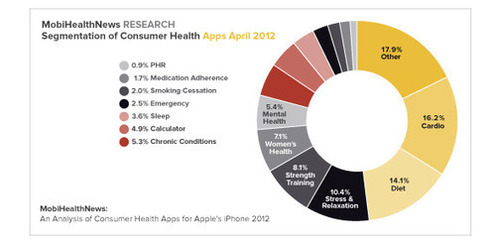
Four years after the launch of the AppStore, growth in the number of available consumer health apps for iPhone users is still accelerating. It’s growing more quickly now than ever. There were more consumer health apps in April 2012 than we expected there to be: In July 2011 we predicted that the number of consumer health apps would top 13,000 in July of this year, but that happened at least three months ahead of schedule.

In April of this year there were already more than 13,600 relevant consumer health apps, and that number does not include the thousands of miscategorized and foreign language apps found in the Health & Fitness and Medical categories of of Apple’s AppStore. As we have done for almost three years now, the MobiHealthNews team sifted through Apple’s health-related categories and placed each consumer health app, one-by-one, into more than 80 subcategories of our own for our 2012 definitive, quantitative analysis of consumer health apps for Apple’s iPhone.

  This unexpected acceleration in the number of consumer health apps does bring more meaningful app choices for patients, but it also exacerbates the discoverability issue. With so many health and fitness apps available, can the best ones really break out? Certification platforms like Happtique are tackling the issue and an increasing number of medical professional blogs, publications, and journals are popping up to serve up reviews from the provider perspective.Over the long term we expect these top-down approaches to help drive provider awareness, and while “prescribing” apps will become more common, consumer health app adoption will be driven by patient communities and social networks. The best will bubble up because they work and because these app users will share their stories.

It’s clear from the still rudimentary – though increasingly creative – selection of consumer health tools that health apps still have to amp up their feature set before mass adoption occurs beyond novelty heart rate monitor apps and exercise trackers. As other have noted – including Chris Wasden from PwC – the regulatory environment is pushing some health app developers to pare back some features in an effort to remain unregulated or less regulated. Precious few consumer health apps offer coaching elements – similar to what Wasden calls “intelligence”. Additional regulatory guidance from the FDA may help more developers take their apps beyond reference and tracking and into the realm of coaching and personalized feedback.

Encouragingly, there are now hundreds of apps that focus on various chronic conditions, and many of them enable users to track symptoms or observations of daily living. Diabetes and heart disease-focused management apps are among the largest contingencies of chronic condition management apps, but cardio fitness, dieting, and stress relief apps continue to be the three biggest consumer health categories overall.

Another interesting trend: The price of consumer health apps continues to drop. As we reported in our August 2010 health apps report, the average price of all consumer health apps (including both paid and free apps) was $2.34 at the time. By July 2011 the price fell to $2.20, or by about 14 cents. Since July 2011 the price has dropped an additional 15 cents, making the average price for all consumer-facing health apps as of April 2012: $2.05.

While the price is falling for health-related apps, that still puts the category at the higher end of Apple’s AppStore for average pricepoints.

To learn more about the current state of consumer-facing health apps, join the thousands of others who have purchased MobiHealthNews’ apps reports or subscribe to all of our 2012 paid content reports. For more on MobiHealthNews’ latest research report: An Analysis of Consumer Health Apps for Apple’s iPhone, visit our online research store here.

See on mobihealthnews.com

Posted in Uncategorized

Ten reasons why doctors should use Twitter

See on Scoop.itHealth Care Social Media Monitor

Andrew Spong (@andrewspong) writes:


‘Dr. Anne Marie Cunningham is an expert healthcare practitioner of the social web.


She offers insightful, incisive critiques of the use-value of social environments in the education and practice of healthcare professionals, and her blog is a must-add for your RSS reader.

Earlier today, she delivered a presentation at the Annual Scientific Meeting of the Association for the Study of Medical Education entitled ‘Why does a Twittering doctor tweet’ (parallel sessions timetable PDF).


I look forward to reviewing the full presentation in due course. In the interim, as the event was not streamed Anne Marie has been kind enough to share the ten reasons why she believes healthcare professionals interested in medical education should use Twitter:


1. Connect

2. Engage

3. Inform

4. Share

5. Reflect

6. Be challenged

7. Be supported

8. Lead

9. Learn

10. Inspire


Personally, I’d extend that definition to include healthcare professionals of every stripe as I’d contend that the same benefits are both conferred upon and received by all those practitioners who elect to participate in social environments within the broader context of medicine’s education-practice-education continuum.’


See on stwem.com

Posted in Uncategorized

Online Reputation Management for Physicians: Putting Your Best Cyber-Foot Forward | HealthWorks Collective

See on Scoop.itHealth Care Social Media Monitor

 Traditionally, a physician’s reputation was best established and passed along by word of mouth.  Discussions among friends or at church, sporting events or civic groups often provided the information necessary for potential patients to choose a healthcare provider.  Today, most patients and consumers of healthcare get information about medical conditions and physicians online.  Some studies have shown that nearly 80% of today’s consumers go online first when evaluating a medical provider.  Information (whether accurate or not) is consumed and perpetuated at a light-speed pace and it is often difficult to keep up with your own digital presence.  Physicians must actively manage their online reputations or suffer the consequences of an unfair and unfounded digital reputation.  In my world, online reputation is critical.  Cyberspace is where my patients and customers are, where they go first and where I need to be

Key Concepts When Managing a Digital or Online Reputation:

1.  You cannot control what people are saying about you or your business

2.  You have 100% Control of the online story YOU create


Strategies to Create and Manage  the Optimal Online Reputation:  

1.  Start with a professional website

2.  Respond to Comments

3.  Remain Diverse and Don’t Get Stale

4. Engage in online communities


The Upshot:

Medicine and the delivery of care is rapidly changing.  The internet has provided both patients and physicians with instantaneous information, feedback and opportunity.  As physicians, we must embrace the fact that our patients and our potential customers use the internet for screening and evaluation of providers as well as to gain information about their particular medical problems.  It is essential that today’s physician develops his or her own digital/online reputation now.  Put your best cyber-foot forward.   It is a top priority for me–my digital footprint has opened many doors and provided many new opportunities to educate and serve patients both at home and across the world.   Dr Campbell provides educational seminars to residents, fellows and practicing physicians on topics which include “The Effective Use of Social Media in Medicine”  More details can be found at www.DrKevinCampbellMD.com


See on healthworkscollective.com