Posted in #HCSM

Motivating patients to make wise choices – amednews.com

See on Scoop.itHealth Care Social Media Monitor

Patients are often the biggest obstacle to their own health. Physicians are exploring new communication techniques to help patients make lasting changes.

Marie Ennis-O’Connor‘s insight:

Achieving superior clinical outcomes often depends less on physicians making the right diagnosis and recommending the correct treatment and more on their patients’ willingness to take the necessary steps to maintain or improve their health.

See on www.ama-assn.org

Posted in #HCSM

Denise Silber: Research Partnership To Reveal What Doctors Worldwide Say on Social Media About Cardiovascular Disea

See on Scoop.itJourneying Beyond Breast Cancer

Denise Silber, President of Basil Strategies, founders of Doctors 2.0 TM & You, said: “We are very excited about the research partnership between Creation Healthcare and Doctors 2.0 TM & You which will bring our participants original data about physician commentary in the cv therapeutic area.  And there will be a real benefit to Creation Healthcare to have so many of the world’s most engaged healthcare social media people on hand to discuss and communicate the results in Paris in June.”

Marie Ennis-O’Connor‘s insight:

Doctors 2.0 TM & You and Creation Healthcare today announce a research partnership that will reveal for the first time how healthcare professionals (HCPs) discuss cardiovascular disease and treatments using public social media channels. The research is being conducted using Creation Pinpoint, the world’s first social media monitoring tool dedicated to studying public conversations among HCPs, and will be presented at Doctors 2.0 & You in Paris, June 6-7, 2013

See on newsle.com

Posted in #HCSM

Is this the future of healthcare?

dandunlop's avatarThe Healthcare Marketer

Screen Shot 2013-02-19 at 8.53.08 AM

Could consumers using kiosks to speak remotely with physicians be the future of healthcare – or at least one affordable component? The Healthspot Station is an enclosed kiosk equipped with a teleconference system, allowing patients to speak privately with a doctor on-screen. Using equipment available in the kiosk, the patient works with the physician to remotely gather health-related data such as weight, height, temperature, and blood pressure. Healthspot claims to be “the first true integration of telehealth and primary care.”

Here’s how Healthspot describes its system (Source: Healthspot.net):

Visit the HealthSpot Station for a variety of primary care conditions. HealthSpot literally gives you the tools you need to get better — integrated medical equipment and board certified doctors make your neighborhood HealthSpot Station the one-stop option for great care. And online follow-up care ensures that the end of your appointment is only the beginning of better health.

“When you use…

View original post 60 more words

Posted in #HCSM

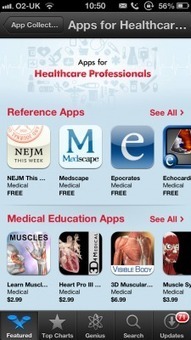
Apple launches dedicated ‘Apps for Healthcare Professionals’ collection

See on Scoop.itHealth Care Social Media Monitor

One of the updates to the Apple App Store recently is the inclusion of a specific collection entitled, “Apps for healthcare professionals”.

This collection can be found within the ‘Medical Category’.


It is a useful starting point for physicians with new mobile devices looking for relevant apps.


The collection is further subdivided into:Reference Apps, Medical Education Apps, EMR & Patient Monitoring Apps, Nursing Apps, Imaging Apps, Patient Education Apps andPersonal Care Apps.

See on www.imedicalapps.com

Posted in #HCSM

Some very valuable points here – as a PR professional, I particularly agree with Brian’s point about a lack of any integrated communications strategy.

bryannagy's avatarBryan Nagy - Marketing Insight

Over the last 5 years, social media marketing has grown from a platform of skepticism by brands to an essential tactic of marketing plans. Unfortunately, as more and more businesses further incorporate social media into their marketing, its primary use and strategic place has diminished. It has become the “go-to” for many businesses and professionals who simply don’t understand it. Unfortunately, it is these users who are simply ruining its effectiveness for those who do understand it.

There are countless problems with a majority of social media marketing plans. Are you guilty of them? Let’s have a look at a few major ones:

Unrealistic expectations

For top executives to accept social media as a marketing tactic, marketing professionals had to prove to them it worked. As marketers always encounter, executives want to see their efforts tied to a specific sales number. The thought is, if sales didn’t increase, what was…

View original post 894 more words

Posted in #HCSM

Colleen Young's avatarColleen Young

In May 2012, Ashley Weinhandl from the Ontario Hospital Association interviewed me to find out more about #hcsmca (Health Care Social Media Canada). She asked me:

  • Why did you decide to launch #hscmca?hcsmca-logo
  • What were your objectives?
  • Did you get the results you expected?
  • How do you make sure everyone feels included?
  • Why is hcsmca important to the health care community?
  • So where does hcsmca go from here?

Here is our conversation.

View original post

Posted in E-Patient, Patient Empowerment

Study highlights important role that patients play in determining outcomes

When it comes to health care, patients with the motivation, knowledge, skills and confidence to manage their own health have better health outcomes and incur fewer health care costs.

Those are the findings of a study led by Judith Hibbard, a professor emerita in the Department of Planning, Public Policy and Management at the University of Oregon. Hibbard and co-authors found that patients with the lowest level of “activation”— that is, those most lacking in the skills and confidence to be actively engaged in their health care—had average costs that were from 8 percent to 21 percent higher compared to patients with the highest level of activation. The study was the basis for two papers appearing in the February issue of Health Affairs.

“The study highlights the important role that patients play in determining outcomes,” said Hibbard, who recently appeared as a featured expert on health care reform at a White House health care summit at Stanford University. “We found that patients who were more knowledgeable, skilled and confident about managing their day-to-day health and health care—also called patient activation—had health care costs that were substantially lower than patients who lacked this type of confidence and skill.” Hibbard and her team adjusted for patient differences, such as demographic factors and severity of illnesses. Even among patients with the same chronic illness, they found those who were more “activated” had lower overall health care costs than patients who were less so. An earlier study by the same authors had already established that more activated patients also had better health outcomes.

Using a Patient Activation Measure that assesses beliefs, knowledge and confidence in managing health-related tasks, the researchers found that patient scores on a questionnaire that ranks patient activation showed that patients’ responses in effect predicted their overall care costs—even when adjusted by the severity of patients’ health conditions, age, sex and income. The researchers recommend that health delivery systems consider assessing these patient activation scores and supporting patients to become more engaged in their health and health care, as a way to both improve patient outcomes and lower costs.

See on medicalxpress.com

Posted in #HCSM, #HIT, Ehealth, mHealth

Resource guide points cancer patients to digital coping tools

The eHealth Initiative (eHI), a non-profit organization whose mission is to drive improvement in the quality, safety, and efficiency of healthcare through information and technology,  has unveiled its first-ever Health IT Cancer Resources Guide, a comprehensive overview of the digital tools and technologies available today that help patients and their families, caregivers and support networks understand, treat and cope with cancer.

The guide lists 76 tools ranging from mobile applications to web sites to social networks that aim to improve cancer care. It was developed by eHI’s National Council on Cancer and Technology, which included representatives from American Cancer Society and American Society of Clinical Oncologists, and is organized in five sections: decision making, education, treatment management, social support and lifestyle management.

eHI developed the guide based on the findings of the Issue Brief on eHealth Tools and Cancer Care, a review of 124 articles, which examined how telemedicine, mobile health, internet-based technologies and social media are being used in cancer care today. The issue brief highlighted the meaningful impact eHealth tools have on care including the removal of geographic barriers, enhanced decision-making capabilities and improved patient-provider communication.

To view the full Health IT Cancer Resource Guide click here.