Posted in HCSM

The next generation doctor’s office

See on Scoop.itHealth Care Social Media Monitor

The next generation of doctors’ surgeries could feature:


* Patient check in – already an effective solution providing the ability to self-check in for appointments
* Medical Triage – many small items can be taken independently and combined into a self-service solution such as blood pressure, weight and height
* Physician communication portal – this solution could be used to communicate and document the purpose of the patient visit and input questions.
* Patient checkout –already an effective solution providing the ability to checkout, submit insurance and pay for service.
* Pharmacy – a self-service solution to scan a prescription into the pharmacy or a separate medication dispensary overseen by a qualified pharmacist.
* Directory/Wayfinding – this is already a successful self-service solution to help guide and direct patient flow to appropriate areas in the hospital.
* Nutritional planning kiosk – nutrition is a huge piece of healthcare and can impact positively or negatively patient health. Healthcare facilities could incorporate nutritional planning kiosks into wellness programs with recipes, cholesterol checks, weight loss and shopping lists.
* Weigh-in – with two-thirds of the adult population being overweight, a weight loss self-service kiosk could provide extended options for weight management and goal obtainment
* Patient communication portal – Patient satisfaction is evaluated in healthcare but performance is hard to document retroactively. A patient communication kiosk could provide opportunities for surveys and real-time feedback on staff.

See on www.selfserviceworld.com

Posted in HCSM

App wipes facebook timelines for a day to raise awareness for Alzheimers

See on Scoop.itSocial Media Marketing For Non Profits

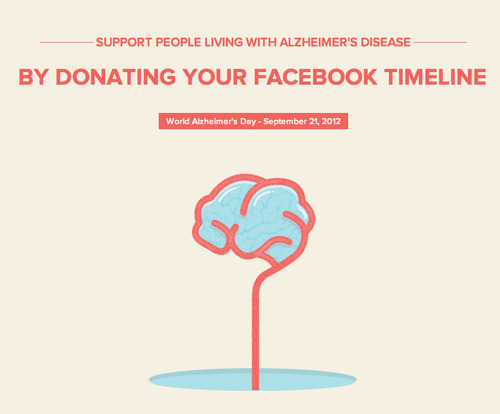
An awareness campaign for Alzheimer’s Disease International is asking people to donate their Facebook timeline in support of World Alzheimer’s Day on September 21st. By downloading an app, Facebook users will be able to experience how it feels to lose their memories for a day.


The app will lie dormant until September 21st when it will activate, wiping users’ memories from their timeline including pictures, status, videos, friends, etc. These will be replaced with a message that reads: “Imagine your life without memories. For 36 million people living with Alzheimer’s disease, this is reality.”


Nothing is actually removed from Facebook, and the information goes back to normal the next day. People can also share their support for the cause via Facebook, Twitter, and Google+.


Follow this link to activate the app:

http://www.alzheimerday2012.org/


See on www.psfk.com

Posted in #BCSM, HCSM

Blogging and the experience of cancer survivorship

Blogs bring about a sense of community.  In the greater online health community, blogs make you feel like you’re not alone, that someone else understands what you are going through ~ Wego Health

I was 34 years of age when I hit was hit with a juggernaut – the metaphorical juggernaut of the words “you’ve got cancer”. I went through nine months of treatment for my disease and I coped remarkably well with this period, but it was when my cancer treatment finally ended that the full impact of what had happened hit me.

There is an expectation that when you walk out of hospital on your final day of treatment, your cancer story has ended; but the reality is that in many ways your story is only just beginning. The apparent randomness of a cancer diagnosis shakes your sense of identity to its very core and afterwards nothing will ever feel certain again. Friends and family may find it hard to comprehend why you are sad or depressed.  Understandably your loved ones want you to put your cancer behind you, to get on with your life and move forward, but it isn’t so easy. Fellow cancer survivors do understand though, and in my search to make sense of the experience of cancer and integrate it into my life, it was to these survivors that I needed to turn.

But where to find them? I searched online and while I found many blogs, chat forums and websites with great advice for those newly diagnosed, or going through treatment, I found it harder to access information on how to deal with the post-treatment limbo I found myself in. So I decided to start my own online resource – Journeying Beyond Breast Cancer. I wanted to provide a safe space for cancer survivors to share their experiences of navigating their way beyond their cancer diagnosis.

“One of the most valuable things we can do to heal one another is listen to each other’s stories.” 
Rebecca Falls

When I was first diagnosed with breast cancer, I knew nothing about blogs or online forums. It was only after I finished my treatment and was struggling with the aftermath that I ventured into the blogosphere. I believe that my experience during treatment would have been a lot different and a lot less isolating for me, if I had been able to write about it in a blog. Cancer can be a frightening and lonely experience. Being able to write about it honestly and unsparingly and connect with others is a powerful release mechanism.

Writing for Journeying Beyond Breast Cancer and linking into a community of liked-minded bloggers has been the single most empowering thing that I have done in my journey with cancer.  It has enriched my experience, brought new friendships into my life and expanded my horizons like nothing else. Blogging has taught me so much about myself as a writer, a cancer survivor and a health activist. It has taught me to be more aware and mindful of my everyday experiences, to be more honest and courageous in my communication. But above all else, blogging has connected me to people and places I would never have ordinarily connected to, and given me a sense of community and blogging I don’t think could ever have been possible otherwise.

Related Post:

Mired in meded – the aha moment about blogging


Posted in HCSM

Mired in MedEd: The “A-HA Moment” about Blogging

See on Scoop.itHealth Care Social Media Monitor

I am currently enjoying my time at the Med2.0 conference in Boston.  This great group of folks  is coming together to learn and disseminate how to leverage the power of emerging technologies to help improve patient care.  It is simply eye-opening to learn and understand some things coming down the pike which will help health care professionals care for patients in the future.

  I attended a session on Blogging by patients which has me thinking.  One of the points that was brought home was that patients with chronic illnesses are blogging about their experiences with having certain health conditions, and that blogging has a powerful effect on how they self-manage their illnesses.  To me, this is VERY powerful.   In another session, a focus was on how many patients are searching for online information about an illness.  I have said this many times, and will say it again here.  The medical community has a duty and an obligation to dispel mis-information which is unfortunately so prevalent on the internet, and to provide simple, truthful, meaningful messages that patients can understand.  What better way to do this than through the use of social media.   One way to know about whether patients are looking online, or posting online through a blog, is to take on online history, or OH.  We should ask patients whether they do this, just like we should take a social history when we first meet them.  This can help us learn about how patients deal with their illness, and how we might be able to best help them.   This is my “A-HA” moment about the OH.  If you are a health care provider, you should consider the importance of the OH: it will be your A-HA moment too, and it will better help you get to know your patient.  Isn’t that what the Patient-Doctor Communication is all about, after all?
See on alexdjuricich.blogspot.ie

Posted in HCSM, Pinterest

Pinterest Drives more Traffic than Yahoo

bryannagy's avatarBryan Nagy - Marketing Insight

Well, we knew it was coming, but Pinterest has finally overtaken Yahoo! as a top organic referrer to sites. In fact, Pinterest is now the fourth top sources of organic traffic to sites online.

Top Organic Referring Sites:

1. Google
2. Direct
3. Facebook
4. Pinterest
5. Yahoo
6. Bing
7. StumbleUpon

What does this mean? All of the content I’ve been sharing about brands using Pinterest display some of the most savvy and with-the-curve brands out there! As Pinterest grows, it will become even more critical for brands to have a presence on the social media tool, and for Pinterest to create a revenue model for themselves.

– Bryan Nagy

View original post

Posted in HCSM

The Health Care Social Media List is Moving to mayo Clinic

Dr. Bertalan Meskó's avatarScienceRoll

Ed Bennett’s famous Health Care Social Media List is now moving to Mayo Clinic where it is going to have a great place, I think.

Four years ago Ed decided to create a resource for social media advocates in hospitals. He thought it would be great if those facing skeptical administrators could begin the conversation with a list of peer institutions already using Facebook, Twitter, or YouTube.

Thus was born the HSNL that Ed has hosted on his Found in Cache blog until now. List maintenance had been a manual labor of love, and yet he didn’t have to programming resources to streamline the process.

When Ed decided he had accomplished his original goal and announced his plans for one final update before achiving the list, we approached him about continuing HSNL. See his thoughts on the move.

View original post