Posted in HCSM

What’s the Influence of Patients’ Internet Health Information-Seeking Behaviour on the Patient-Physician Relationship?

How and in what ways does patients’ Internet health information-seeking behaviour influence the patient-physician relationship?

The rapid proliferation of health information on the Internet has resulted in more patients turning to the Internet as their first source of health information and acquiring knowledge on their health conditions before seeking a professional diagnosis.

This is changing the ways that patients interact with healthcare providers. Gone are the days when individuals passively received health information and interventions, assuming that a doctor held all the answers. Nowadays, it’s increasingly common for patients to find resources and/or seek out additional information online.

With online health information becoming increasingly popular among patients, this may change the way in which patients interact with and participate in consultations with their physicians and how they feel about their relationship with their physicians.

When researchers Sharon Swee-Lin Tan and Nadee Goonawarden systematically reviewed existing research on patients’ Internet health information seeking and its influence on the patient-physician relationship, they found that it can improve the patient-physician relationship depending on whether the patient discusses the information with the physician and on their prior relationship.

The impact of patients seeking online-heath information on the clinical encounter

In their review, Swee-Lin Tan and Goonawarden point to two over-arching concerns.

(1) Misinformation on the web

With the quality of medical information on the web ranging from peer-reviewed to personal blogs and anecdotes of other patients, patients may not possess the necessary skills to evaluate medical information and relate it to their own health circumstances. Therefore encouraging patients to discuss their Internet information searches is increasingly important, given that acquiring information on the Internet has the potential to misguide patients with inaccurate information.

(2) Satisfaction and trust in physician

When patients’ online findings do not align with physicians’ diagnosis or treatments, concerns have been raised as to how a patient’s appointment satisfaction and trust in the physician would be affected, and how conflicts could occur between the physician and patient – physicians could feel threatened by the information and respond defensively by asserting their “expert opinion.” This may then result in dissatisfied patients who may seek a second opinion, change the physician, change their treatment plan, or self-medicate using recommendations found on the Internet.
A study published in the Journal of Family Practice reported that eighty percent of patients went online post-visit. Dissatisfaction with the physician’s performance motivated information seeking for 40% .jpg
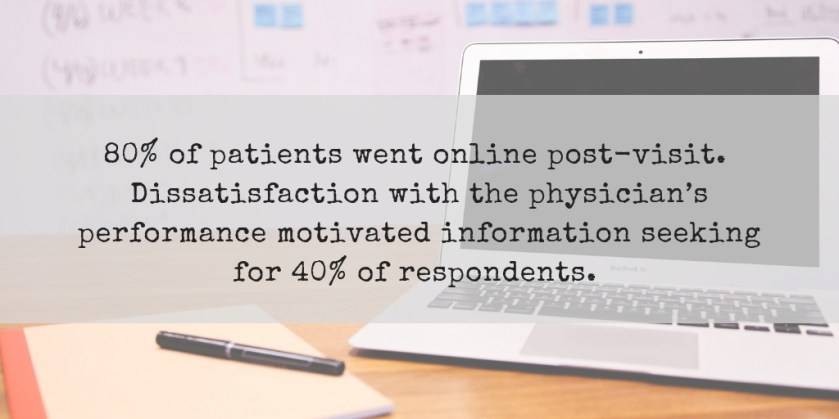
A study published in the Journal of Family Practice reported that eighty percent of patients went online post-visit.  Dissatisfaction with the physician’s performance motivated information seeking for 40% of respondents.

Facilitators of discussion of online findings during consultations

The review highlighted 3 facilitating factors that encouraged patients to discuss online health information with their physicians:

(1) Having a family member present at doctor visits

Having a family member present would help patients remember what to ask and made the context more comfortable to share online findings.

(2) Doctor-initiated inquiries

Some patients reported incidences of doctors’ positively encouraging patients to search the Internet for information.

(3) Encountering a treatment-related advertisement that suggested talking with a doctor.

Online advertisements or recommendations about certain medications and treatment prompted some patients to initiate a conversation with their physicians.

Barriers to discussion

(1) Concerns over how physicians would react

The most common barrier to patients’ willingness to discuss their online findings was that patients were skeptical of how physicians would react: “patients were afraid doctors would perceive them as “challenging” and  “confrontational” if they discussed their health condition from a more informed point of view during consultations.”

(2) Physician resistance to discussion of Internet information

The second most common barrier for patients was “the resistance or discouragement from physicians encountered when patients tried to discuss their Internet information research during consultations.”

Conflicts arising from physicians and patients having different interpretations of the online information (when patients valued this information more) had adverse implications for the patient-physician relationship, resulting in higher levels of patient anxiety, confusion, and frustration.

Patients also felt that some physicians reacted in a way that “implicitly or explicitly discredited the patients’ ability to become informed via the Internet, presenting serious barriers to shared decision making during consultations, with the physicians asserting their authority by dismissing patient-acquired knowledge.”  As a result, “patients carefully observed their physicians before deciding whether to reveal their Internet research, and patients would only bring up their Internet health searches if they felt the situation was right.”

(3) Fear of embarrassment

A third major barrier was the fear of embarrassment. Patients who identified this to be a barrier felt “they did not possess the required skill set to evaluate online medical information. They had a lower level of confidence in the trustworthiness and the credibility of online information. They manifested a sense of being unsure of how to explain the information they found and how to relate it to their own condition, and hence did not want to mention it to their physicians.”

Other than these three main barriers, some patients did not discuss their findings during consultations because “they did not think the information was important enough and they searched the Internet just to be informed.”  Other reasons cited were “a reluctance to interfere with physicians’ diagnostic process and lack of time during doctor visits.”

Implications for the patient-physician relationship
Patients experienced a better patient-physician relationship when they had the opportunity to discuss their online health information with their physicians, and their physicians were receptive to disc (1).jpg

In the studies reviewed by the authors, most patients felt that “Internet health information seeking prior to consultations had improved their communication with doctors and the effectiveness of their consultations.”

Patients felt more in control and confident during the consultation as a result of bringing information to their physicians. Patients also felt more confident in their physicians’ diagnosis once they had discussed their online findings.

Patients used the information to help them prepare for their visit, ask better questions, and understand what the physicians told them (they believed the patient-physician communication had improved because they could understand their doctors and the jargon they used better).

By discussing information they had accessed on the Internet or setting questions in advance, “patients were able to better understand and participate in consultation sessions with their doctors.” Thus patients “felt better equipped to communicate with their physicians during the consultations” resulting in “greater clarity, orientation, and certainty.”

A majority of patients had felt more comfortable with information from health care providers because of their Internet searches and felt more confident with the doctor’s advice.  Interestingly, patients who shared online information felt that they received more attention from their physician, compared with non-sharers.

The patients’ sense of empowerment was dependent on how receptive providers and specialists were to the patients’ desire to take part in the decision-making process. The review showed that “the effect of online information on the patient-physician relationship depended on several factors.”

(1) The positive influence of online information was stronger when patients had an opportunity to discuss their online findings.

Patients who perceived their information search to have improved their relationship with physicians saw the Internet as an additional resource that supported doctors’ advice and enhanced the relationship with doctors. On the other hand, when patients valued the information they found on the Internet above their physicians’, this information led patients to ignore physicians’ expertise.

Not disclosing their Internet information searches could erode patients’ trust in their physicians if the diagnosis or the recommendations are different from their Internet research findings.

(2) Physicians’ reaction to patients when they shared their online findings could determine the positive or negative effect on the relationship’s quality.

When patients perceived physicians to be threatened by their bringing online information, 49% of the patients were seriously dissatisfied with the consultation and 4% believed their relationship was worsened. Conversely, patients felt that the relationship was strengthened “when physicians displayed adequate communication skills in discussing patients’ queries.”

(3) The quality of the existing relationship with physicians

Patients judged their physicians’ reactions as “mostly positive when they had a good prior relationship, even when the doctors’ replies were evasive or openly critical of the patients’ Internet search.”

Conclusion

It’s important to note that patients don’t see their information searches as a substitute for clinical advice.  Patients typically see the Internet as an additional resource that can help them to better understand doctors’ recommendations and advice.  They still value traditional doctor-patient consultations as important to their understanding of online health information, and their trust in physicians remained very high. Under this model of care, the physician acts as a teacher or a friend by engaging patients in a dialogue through the decision-making process.

When physicians embrace openness to online information and encourage patients to discuss the online information they have, patients’ perception of physician resistance and fear of embarrassment could be reduced and patients are more likely to discuss online information with their physicians.

In contrast to the belief that patients’ Internet research can erode the patient-physician relationship, our findings show that patients’ Internet health information seeking has the potential to improve the relationship.

The authors conclude that as patients have better access to health information through the Internet and expect to be more engaged in health decision making, traditional models of the patient-physician relationship need to be adapted to patients’ changing needs by incorporating their perspective into a relationship-centered medical paradigm.


Tan SSL, Goonawardene N. Internet Health Information Seeking and the Patient-Physician Relationship: A Systematic Review. J Med Internet Res 2017;19(1):e9

Further reading: 

Posted in Cool Tool

Monday Morning Cool Tool: ImageQuote

I love learning about new tools to make social media marketing more creative and effective, so I’ve decided to share some of my favourite tools with you at the start of each week.

This week’s cool tool recommendation is ImageQuote –  a super easy tool to create quote images for sharing on social media.

imagequote

You can choose from high-quality background collections or use your own photos for images. Then choose from 50+ creative font choices to customise your text. When you’re happy with your image you can export it to Instagram, Facebook, or Twitter for easy sharing.


Posted in HCSM

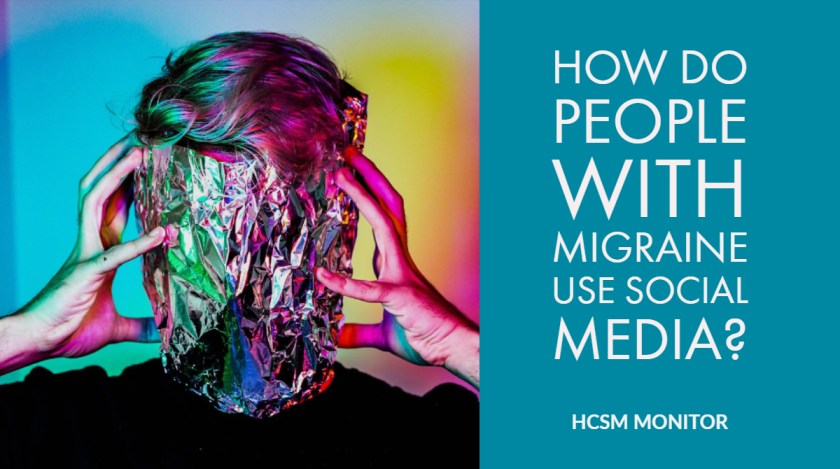
Not Just a Headache: How People With Migraine Use Social Media 

A recently published study* has set out to describe how people with migraine use social media and how social media use affects their identity and sense of self.

Migraine symptoms are typically episodic and unpredictable, making it a difficult condition to manage in daily life. It is distinctive from other chronic conditions as it lacks a visible illness marker. This can cause frustration for the person with migraine when the condition is not understood (or believed) and may result in altered self-concept or self-esteem. As a consequence, people with migraine may not receive adequate support owing to the experience of illness and pain being subjective.

Social Media Use

The study recruited 20 patients in total. Participants’ use of social media tended to fit on a spectrum from actively engaging with social media to more observational social media users, and some people in between.

Facebook was the most commonly used social media platform among participants. Many sought information and social support from closed migraine-specific Facebook groups. Blogs were used by 2 participants. A total of 3 participants used YouTube to observe migraine symptoms and learn about migraine causes or pain reduction. One participant created YouTube videos to educate others about migraine. Twitter was often viewed as a more professional domain rather than personal.

Seeking and Sharing Information

The study findings suggest that people with migraine are using social media to obtain health-related information to better understand their condition and treatment options.

In total, 11 said they gained expertise in migraine knowledge and 13 gained awareness of new treatments. For some, interacting with others in Facebook groups resulted in a change of self-management for migraines.

In total, 14 participants said they shared information with other users on social media, mostly on Facebook. Some shared information with others who experience migraines in migraine-specific groups.

Others used social media to share information with people who do not experience migraine by posting on their personal Facebook walls, seeking to help others to understand their condition.

16 participants spoke about the benefit of pooling knowledge on social media. The dialogue and collaboration with other users added another level of benefit to information seeking and sharing.

A total of 12 participants said information gathered on social media had increased their confidence, knowledge, and skills in managing their own health care.  Others benefited from reading the online discussion and not taking part themselves.

A total of 10 participants spoke about the need to experience migraine to truly understand it. Being able to read the lived experiences of other people with migraine was beneficial in providing personally relevant information

Social Support

Social media can offer instant access to continuous migraine-related information, as well as social support from empathic others. The opportunity to pool the subjective lived experience of migraines on social media was described as invaluable, and the exchange of support and information was viewed as mutually beneficial

A total of 10 participants described not feeling alone and that social media had helped them to feel less isolated. For some, social media provided a source of support for an unpredictable and invisible illness.  They spoke of the invisible and episodic nature of the condition that may contribute to societal misunderstanding about the impact and severity of migraine.

A total of 14 participants referred to migraine being an invisible illness, with 10 participants saying they had been given patronizing or unhelpful advice offline by others who often saw migraine as just a headache. In total, 18 participants discussed how the use of social media can help validate the migraine experience and combat the lack of understanding about the unpredictable and invisible nature of migraine.

I think the worst thing for people is not getting support…I think social media can be a good way of calling that out when we see it and people going: “Yes, that happened to me. That’s not okay.” There’s quite a lot of validating involved.

For 19 participants, the process of being able to hear about others’ experiences and compare them with their own provided a sense of comfort. In the cases where people were unsure of what they were experiencing, reading similar accounts from others provided validation and reminded them that they were not alone.

After accessing content on social media, some participants benefited from reassurance regarding unusual symptoms.

In this sense, the use of social media served to normalize what some felt might be abnormal. In total, 6 participants also described social media as a lifeline:

I don’t know how people survived beforehand actually, especially because it’s [migraine] invisible.

A total of 10 participants referred to social media being available all the time, providing a continual source of contact with other users not limited to geographic location.

A total of 10 participants described how they used social media as an outlet for discussing frustrating migraine experiences. Social media was a resource for some participants to cope with the emotions that built up from their experiences. 8 participants described how venting to other people on social media can prevent over-burdening family and friends.

Study Conclusion

Social media can help validate the experience of migraine and in turn help people who experience migraines to feel better understood and less alone. How migraine is part of a person’s identity and represented online varies. Further understanding about the needs of people with long-term chronic conditions may help in the development of future Web-based interventions to improve health and well-being.


*Pearson C, Swindale R, Keighley P, McKinlay AR, Ridsdale L. Not Just a Headache: Qualitative Study About Web-Based Self-Presentation and Social Media Use by People With MigraineJ Med Internet Res 2019;21(6):e10479

Related

Migraine Tweets – What can online behavior tell us about disease?

Posted in Cool Tool

Monday Morning Cool Tool: Trendsmap

I love learning about new tools to make social media marketing more creative and effective, so I’ve decided to share some of my favourite tools with you at the start of each week.

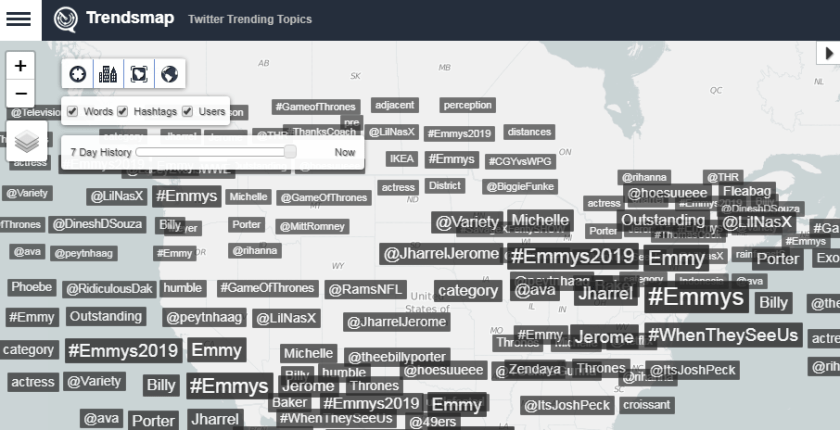
This week’s cool tool recommendation is Trendsmapa real-time map of the latest Twitter trending hashtags and topics from anywhere in the world.

e3cd82f8-50ec-4c53-af5d-c056874cf050

Click on a word, zoom into your area of interest, and explore. You can also jump directly to  Locations or Top tweets.

1b78c5a4-36fc-400a-a979-aef07ec04541

Tapping into cultural trends is all about marketing in the moment. This works because people are most interested in “what’s happening now.” This tool is super useful to help you keep tabs on trending topics on a daily basis.


You might also like to read How To Leverage A Cultural Trend


Posted in Cool Tool

Monday Morning Cool Tool: Mail Tester

download - 2019-08-11T125603.063

I love learning about new tools to make social media marketing more creative and effective, so I’ve decided to share some of my favourite tools with you at the start of each week. This week’s cool tool recommendation will be of interest to those of you who send email marketing (like newsletters) to subscribers.

Mail Tester is a free tool which tests the “spammyness” of your email. It will analyze your message, your mail server, your sending IP and assign you a spam score along with a detailed report of what’s configured properly and what’s not.

Your result will be accessible for 7 days with the free version or 30 days if you created an account and used your own prefix.

Visit https://www.mail-tester.com to try it out.


You might also like to read How to Build Your Email List On A Firm Foundation


Posted in HCSM

What Do Patients Complain About Online?

A group of researchers across China, the United Kingdom and the USA has set out to develop a taxonomy framework for patient complaints online based on patient centeredness and to examine whether the determinants of patient-centered care (PCC) mirror the determinants of patient experiences.

As internet availability and usage grows worldwide, patients are spontaneously rating their experiences with physicians and hospitals by sharing their opinions about health encounters on the World Wide Web via mediums such as social media websites, Web-based consumer opinion platforms, and physician rating websites.

Previous research has demonstrated that patients are often influenced by peer-submitted comments posted on opinion and rating websites when making health care decisions

Why this study matters

  • Medical providers are able to leverage the information posted on such platforms to better comprehend patient experiences and engagement levels and increase the understanding of patient frustrations and joy points during hospital visits.
  • By capturing patient data in real-time, health care providers can use them as a quality metric to highlight insufficient physician performances or irregular events.
  • Given the intrinsic value of comments posted online by patients, it is important that health care providers make efficient use of the information collected.
  • Patient complaints online can indicate weaknesses in the health care system through the eyes of the patients’ themselves.

Interested to learn more?

Read Liu J, Hou S, Evans R, Xia C, Xia W, Ma J. What Do Patients Complain About Online: A Systematic Review and Taxonomy Framework Based on Patient Centeredness. J Med Internet Res 2019;21(8):e14634

You might also like to read How do healthcare staff respond to patient experience feedback online? A typology of responses published on Care Opinion

Posted in Cool Tool

Monday Morning Cool Tool: Listen Notes

3430d8098532468ca657e210f21cdaf8.jpg
Image Source: Listen Notes

I love learning about new tools to make social media marketing more creative and effective, so I’ve decided to share some of my favourite tools with you at the start of each week. This week’s cool tool recommendation is Listen Notes  – a free podcast search engine.

With this tool, you can not only search the whole Internet’s podcasts, but you can also curate your own podcast playlists. (Note that the Listen Notes search engine is designed to help you find content such as people topics, not specific shows.)  If you’re researching a specific person or topic, the search tool can help you find related episodes from a range of podcasts. You can then add results that interest you to a playlist.  After you create a playlist in Listen Notes, you receive a playlist URL that you can copy and paste into your favorite podcast app so you can listen to that playlist. You can also use the URL to share the playlist.

More cool features include the clipping feature which lets you annotate, save, and share audio clips from podcast episodes.  You can add individual episodes to Listen Later playlists and bring these playlists to your podcast player apps via RSS.

The tool is totally free and if, as many people are these days, you are a podcast fan, you will want to add this tool to your toolkit.

Posted in Cool Tool, Visual Marketing

Monday Morning Cool Tool: Easil

download (34).png

I love learning about new tools to make social media marketing more creative and effective, so I’ve decided to share some of my favourite tools with you at the start of each week. This week’s cool tool recommendation is graphic design tool Easil  an online graphic design tool with templates that are especially useful for Instagram and Facebook stories.

Easil is a simple, browser-based system with pre-made templates that you can adapt in seconds with simple drag-and-drop tools.  The vertical image templates are especially good and make this tool great for stories.  The website also hosts a blog with super helpful design tips.

The free version of Easil is for individuals and limits the types of files you can download. For example, with the free version, you can’t download a GIF or PDF. The Plus service costs $7.50 per month, and the Edge service costs $59 per month.

Posted in Cool Tool

Monday Morning Cool Tool: Word2cleanhtml

This week’s cool tool recommendation is Word2cleanhtml, a free converter tool which cleans up HTML pasted from Word documents.

How it works

download

The tool strips out invalid or proprietary tags, which Microsoft Office puts in its HTML and gives you a well-formatted result that you can paste directly into a web page, ebook or content editing system.


Posted in Cool Tool

Monday Morning Cool Tool: Iconosquare


download (88).png

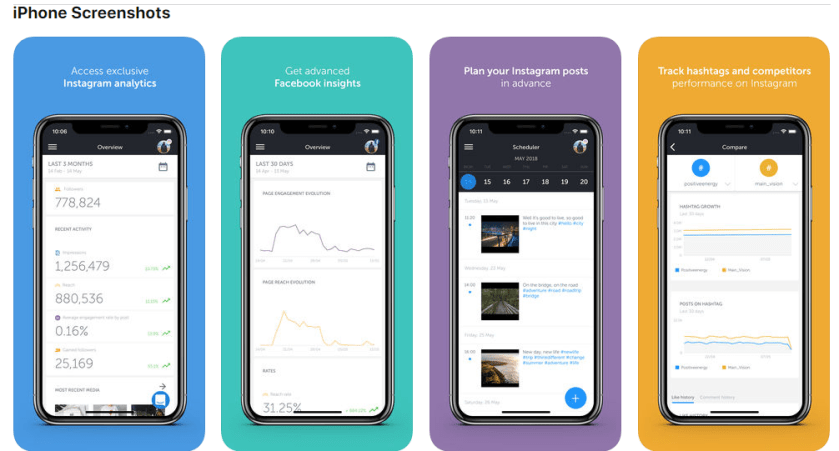
I love learning about new tools to make social media marketing more creative and effective, so I’ve decided to share some of my favourite tools with you at the start of each week. This week’s cool tool recommendation is Iconosquare, a smartphone app for managing your Facebook and Instagram presence.

Features Include:

Instagram analytics: visualize how your community is growing, see how many followers you gained and lost, identify your most engaging media and more.  For Business profiles, get also access to Stories insights, to community demographics and to reach and impressions data.

Facebook analytics: see how your number of fans is growing and how many fans you gained and lost, access demographics of your community, visualize the reach and impressions of your posts, see your most engaging publications etc.


Instagram Post Scheduler: plan ahead and schedule all your Instagram posts in advance from your computer. Upload photos and videos, type captions and get notified on your smartphone when it’s time to post.


Instagram Comment tracker: monitor comments received on your Instagram posts. Reply to them, mark them as read and delete inappropriate ones.

Multi-Account Management: schedule and manage for all your Instagram accounts and Facebook pages from within the app.

Get On: App Store | Google Play