
Twitter is a conversation, and just as you observe conversation etiquette in real life, when it comes to healthcare tweeting there are unwritten rules, too.
Source: linkis.com
See on Scoop.it – Health Care Social Media Monitor
Twitter is a conversation, and just as you observe conversation etiquette in real life, when it comes to healthcare tweeting there are unwritten rules, too.
Source: linkis.com
See on Scoop.it – Health Care Social Media Monitor

It is essential that we psychiatrists align ourselves with the public and our patients both to disseminate accurate information and to educate. Social media allows us to have this public voice more than ever before.
Source: www.psychiatrictimes.com
See on Scoop.it – Health Care Social Media Monitor

How can social media change health professional education? Dr. Anne Marie Cunningham will be discussing that issue as the morning plenary speaker at ICRE’s upcoming Social Media (SoMe) Summit. A cl…
Source: icreblog.royalcollege.ca
See on Scoop.it – Health Care Social Media Monitor

Gone are the days where LinkedIn was just a social media site for finding a new job. The network has evolved into the premier social destination for
Source: www.likeable.com
See on Scoop.it – Health Care Social Media Monitor
Have you been straddling the fence deciding whether or not social media is “a thing” in healthcare? Well, maybe this will tip the balance

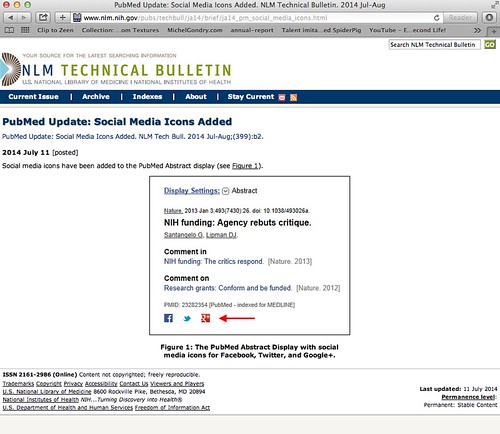
PubMed Update: Social Media Icons Added. NLM Tech Bull. 2014 Jul-Aug;(399):b2. http://www.nlm.nih.gov/pubs/techbull/ja14/brief/ja14_pm_social_media_icons.html
Have you been straddling the fence deciding whether or not social media is “a thing” in healthcare? Well, maybe this will tip the balance. Pubmed now includes social media sharing icons at the article level, as shown in the image above. This is in addition to NIH’s own active life on social media. Unfortunately, when I was testing it out, every now and then what it shared was not the link to the article, but a link to the search strategy from which I found the articles. Hopefully, they’ll get that fixed, but usually it was good. Here’s what it looks like when sharing something to Twitter.
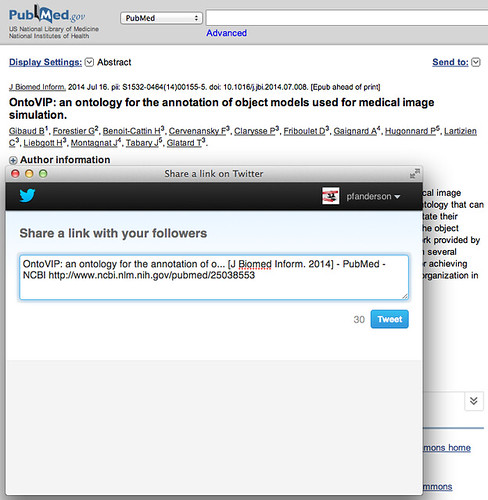
In honor of this noteworthy change, I thought I’d divert from actual hashtags to seeing what people are sharing from Pubmed this week. If you really want hashtags, take a…
View original post 312 more words
Whether it’s a Facebook Group, LinkedIn Group, Twitter Chat, blog or a patient support community on a private platform, building and maintaining a vibrant online community requires vigilance and dedicated management. This has become so clear to me as I’ve looked at the data from two online communities we developed for clients – one which we actively manage and one which the client has chosen to operate on its own without the involvement of a community manager.
These communities were built seven months apart from one another. They were built in exactly the same manner. They feature the same type of content. Interesting, the community that is floundering was the first to be launched and experienced early success while my firm managed its growth in the first 12 months. Once there was no longer a dedicated community manager, the group’s growth leveled off and eventually began to decline.
Community #1…
View original post 450 more words
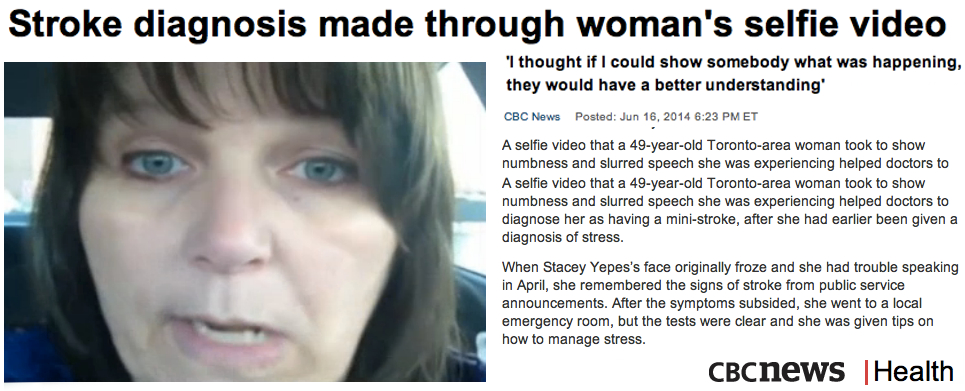
When Stacey Yepes was asked what possessed her to turn to her iPhone and record a selfie video:
“I just needed someone to be able to see what was happening. When I’m telling people this was happening they’re saying it’s just stress but I’m telling them I know this is not stress. It was a relief that someone would finally believe that it was not just stress“.
This remarkable story of a Patient who had her stroke symptoms dismissed highlights for me the ease with which important symptom information can be ignored or misinterpreted by clinicians and how important it is for healthcare providers to move on from the idea that documentation of symptoms is an exclusive entitlement we give to Healthcare Professionals and more of us start recognising the opportunity when we let Patients help with the documentation of their own history.
HatTip: Dr Chris Bickford…
View original post 1 more word
Another great post from Julian. I’ve just discovered his blog and am already a big fan of his insights
Everyone understands that things have changed, but not always how much and how far we still have to go. The Social Age is defined by change: changes in how we work, how we learn, how we lead, how we connect and communicate. Our entire ecosystem has evolved and yet many organisations are clinging to the remnants of eroded business models and HR practices. Those that are unable to adapt, unable to recognise and respond to the evolution will fail.
 The Social Age redefines how organisations need to operate. This tangle captures some of the core changes
The nature of work has changed: no longer defined by four walls and 9-5, we’ve seen technology revolutionise how we connect and how we are productive. Cloud services and VPNs are simply the latest iteration in a long chain of innovation that has led to laptops, tablets and smartphones, alongside remote working and…
View original post 1,305 more words


 Health Care Social Media