See on Scoop.it – Health Care Social Media Monitor

One of the hottest trends in technology today is the Internet of Things or IoT.
See on healthworkscollective.com
See on Scoop.it – Health Care Social Media Monitor
One of the hottest trends in technology today is the Internet of Things or IoT.
See on healthworkscollective.com

It is my pleasure to host the 33rd edition of the HCSM review – for those of you still unfamiliar with the model, here is a bit of a back ground:
Health Care Social Media Review is a peer-reviewed blog carnival for everyone interested in health care social media. Our mission is to serve as a hub for posts from the best and the brightest health care social media writers, thinkers, users and proponents worldwide, to contribute to better understanding and adoption of social media in health care. This carnival is intended to showcase posts about health care social media use, best practices, resources, and new social media communities and tools. We seek to spread the word that the use of social media in health care is becoming unavoidable and is of critical importance to both patients and providers worldwide.
This edition of the HCSM review will specifically focus on…
View original post 317 more words
See on Scoop.it – Health Care Social Media Monitor
Benjamin Hughes1, MSc, MBA; Indra Joshi2, MBBS; Jonathan Wareham1, PhD 1Department of Information Systems, ESADE, Barcelona, Spain
2West Hertfordshire Hospitals NHS Trust (WHHT), Hemel Hempstead, UK
The study results show that the terms Medicine 2.0 and Health 2.0 were found to be very similar and subsume five major salient themes: (1) the participants involved (doctors, patients, etc); (2) its impact on both traditional and collaborative practices in medicine; (3) its ability to provide personalized health care; (4) its ability to promote ongoing medical education; and (5) its associated method- and tool-related issues, such as potential inaccuracy in enduser-generated content. In comparing definitions of Medicine 2.0 to eHealth, key distinctions are made by the collaborative nature of Medicine 2.0 and its emphasis on personalized health care. However, other elements such as health or medical education remain common for both categories. In addition, this emphasis on personalized health care is not a salient theme within the academic literature. Of 2405 papers originally identified as potentially relevant, we found 56 articles that were exclusively focused on Medicine 2.0 as opposed to wider eHealth discussions. Four major tensions or debates between stakeholders were found in this literature, including (1) the lack of clear Medicine 2.0 definitions, (2) tension due to the loss of control over information as perceived by doctors, (3) the safety issues of inaccurate information, and (4) ownership and privacy issues with the growing body of information created by Medicine 2.0.
See on www.jmir.org
See on Scoop.it – Health Care Social Media Monitor
J Med Internet Res. 2011 Dec 19;13(4):e123. doi: 10.2196/jmir.2012.Eysenbach G.
University Health Network, Centre for Global eHealth Innovation & Techna Institute, Toronto, ON, Canada. geysenba@uhnres.utoronto.ca
This study concludes that the collective intelligence of Twitter users can, within limitations, predict citations, which normally take years to accumulate.
See on www.ncbi.nlm.nih.gov
See on Scoop.it – Health Care Social Media Monitor
PLoS One. 2013 Jul 17;8(7):e68914. doi: 10.1371/journal.pone.0068914. Print 2013. Allen HG, Stanton TR, Di Pietro F, Moseley GL.
Sansom Institute for Health Research, University of South Australia, Adelaide, Australia ; Neuroscience Research Australia, Sydney, Australia.
Abstract
A barrier to dissemination of research is that it depends on the end-user searching for or ‘pulling’ relevant knowledge from the literature base. Social media instead ‘pushes’ relevant knowledge straight to the end-user, via blogs and sites such as Facebook and Twitter. That social media is very effective at improving dissemination seems well accepted, but, remarkably, there is no evidence to support this claim. We aimed to quantify the impact of social media release on views and downloads of articles in the clinical pain sciences. Sixteen PLOS ONE articles were blogged and released via Facebook, Twitter, LinkedIn and ResearchBlogging.org on one of two randomly selected dates. The other date served as a control. The primary outcomes were the rate of HTML views and PDF downloads of the article, over a seven-day period. The critical result was an increase in both outcome variables in the week after the blog post and social media release. The mean ± SD rate of HTML views in the week after the social media release was 18±18 per day, whereas the rate during the other three weeks was no more than 6±3 per day. The mean ± SD rate of PDF downloads in the week after the social media release was 4±4 per day, whereas the rate during the other three weeks was less than 1±1 per day (p<0.05 for all comparisons). However, none of the recognized measures of social media reach, engagement or virality related to either outcome variable, nor to citation count one year later (p>0.3 for all). We conclude that social media release of a research article in the clinical pain sciences increases the number of people who view or download that article, but conventional social media metrics are unrelated to the effect.
See on www.ncbi.nlm.nih.gov
See on Scoop.it – Health Care Social Media Monitor
As more patients share information online, practices can benefit from establishing a presence and providing patients with digital communication options.
Physicians who forgo social media in their practices run the risk of falling behind patients’ growing demands for digital communication and allowing negative reviews to define their reputations, says a new research paper by HP Social Media Solutions, a digital consulting firm.
See on www.amednews.com
Here’s a handy cheat sheet for maximizing your social media marketing efforts on Facebook, Pinterest and Google+

See on Scoop.it – Health Care Social Media Monitor
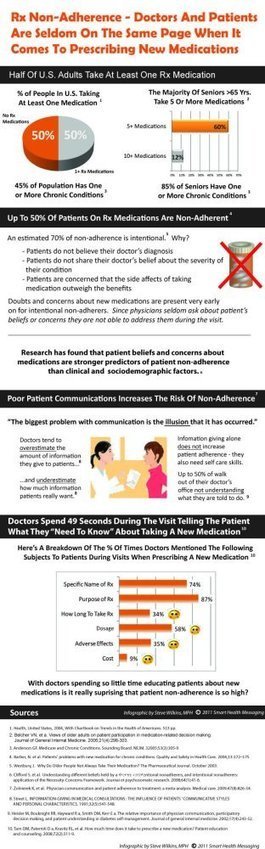
I am a big fan of Infographics. They are a great for turning otherwise complex data into practical information. Here’s an Infographic I built to describe the “disconnect” that often occurs between physicians and patients and the impact of adherence…
Guess what? Health content on Facebook and Twitter can be credible.




 Health Care Social Media