See on Scoop.it – Health Care Social Media Monitor

The common refrain in health care circles is that most “people won’t become engaged in care until it’s too late.” But there are those who do get engaged
See on www.hl7standards.com
See on Scoop.it – Health Care Social Media Monitor
The common refrain in health care circles is that most “people won’t become engaged in care until it’s too late.” But there are those who do get engaged
See on www.hl7standards.com
See on Scoop.it – Health Care Social Media Monitor
I came across a provider website the other day that impressed me as being extremely patient-centered. I then took a look at several more provider websites and noticed a huge difference in the total “look” and appeal (or not).
See on healthworkscollective.com
See on Scoop.it – Health Care Social Media Monitor
Today we are seeing an explosion in doctors using public social media channels to talk with each other about clinical and practice matters. In this webcast, …
See on www.youtube.com
See on Scoop.it – Health Care Social Media Monitor
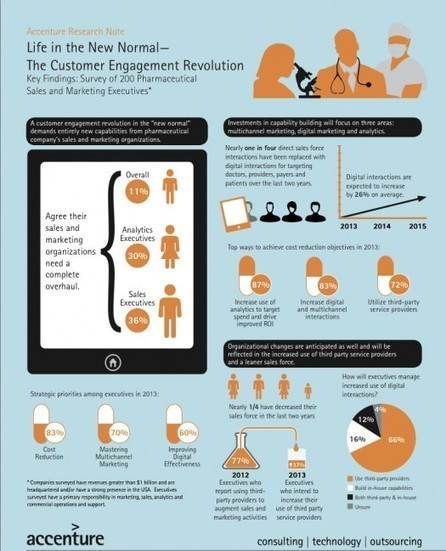
Maybe the gap between consumer packaged good marketers and pharma marketers is finally closing. According to a new Accenture Report ”the sales and marketing models of today need to be reshaped in order to be successful in today’s “new normal. Reducing costs, mastering multichannel marketing and improving digital effectiveness are the top strategic priorities for pharmaceutical sales and marketing executives.”
Accenture says, There is a customer engagement revolution in motion in the Life Sciences industry as it faces life in the “new normal” after the peak of the patent cliff1. The industry is in an era where targeting specific populations and improving patient outcomes is critical for specialty products and where reaching more customers in rapidly developing markets is paramount for growth. This revolution is requiring companies to rethink how they can reach patients, payers, providers and governments in both mature and emerging markets—at speed, at the right price and with the right information for each target audience. This is a significant change from the “feet on the street,” single message selling model that worked well for blockbuster drugs in mature healthcare markets.
And I think I finally found out why agency people are reporting that pharma is spending more in digital marketing. According to the report
The use of third-party service providers is a relatively common practice in the industry that will continue to increase.
…
The real challenge is can third parties really provide the best analytics and digital marketing strategy as someone who actually works within the brand team/company? It has been my experience that too many pharma companies treat third parties as vendors and don’t always share every bit of important information. Even more important outside agencies need to understand the dynamics, including the corporate politics, within the organization. Employees who don’t understand digital marketing and want to hold onto more “glamorous” channels like TV may fight the shift in dollars to analytics and digital marketing. Still this is great news for pharma which has a reputation of coming late to the party.
See on worldofdtcmarketing.com
This is a copy of a talk I gave yesterday at the April meeting of Health 2.0 Dublin on the topic of the empowered patient.
Health2Dublin, is one of 40+ chapters in cities around the globe, that facilitates and creates events that promote and demonstrate the innovation and promise that information technology is bringing to our health and the practice of medicine. By putting the leaders of the Irish healthcare innovation scene together in one place, we are creating the future of healthcare. Health2Dublin meets on the first Wednesday of every month and welcomes new members.
Learn more at: http://www.health2dublin.com/
See on Scoop.it – Health Care Social Media Monitor
In this month’s #BCCEU Twitter chat we will be discussing the rise of the ePatient movement.
ePatients are equipped, empowered, educated, engaged, and enabled to make their own decisions, talk with their medical team on an equal footing and take active participation in their medical care. ePatients want to learn more about their health, their condition and their treatment and share what they have learned with their peers.
See on Scoop.it – Health Care Social Media Monitor
OpenNotes is an effort to convince patients, families, and clinicians to share openly any and, most often, all material that pertains to a patient’s care. The goal is to improve communication and help patients engage more actively in their care.
See on www.rwjf.org
See on Scoop.it – Health Care Social Media Monitor
Chris Wasden, a managing director and innovation practice leader at PwC, is convinced that the current healthcare IT revolution will happen last at at hospitals and in doctors’ offices
See on www.healthleadersmedia.com
See on Scoop.it – Health Care Social Media Monitor
Patients are actively looking to engage their physicians online, but doctors aren’t too keen on the idea. What’s the big fuss?
See on qz.com
Online self-help groups multiply peoples’ possibilities to exchange information and social support. Such possibilities are expected to be of crucial value for the ‘new’ healthcare user. However, similar to experiences from face-to-face based groups, studies of online self-help groups report high drop-out rates. Knowledge about why this happens is scarce. By means of qualitative interviews and participant observation, this article examines non-participation and withdrawal from an online self-help group for Norwegian breast cancer patients. Five conditions are identified as barriers to use; a need to avoid painful details about cancer, not being ‘ill enough’ to participate, the challenge of establishing a legitimate position in the group, the organisation of everyday life and illness phases that did not motivate for self-help group participation. I suggest that an adoption of the biomedical explanation model represents an important background for this pattern, an argument which contrasts prominent assumptions about the new healthcare user who does not accept the biomedical ‘restitution story’ in her efforts to make sense of an illness. A further suggestion is that experiences of self-help groups as arenas for successful coping need to be further considered as a barrier to use.
See on onlinelibrary.wiley.com






 Health Care Social Media