Articles

Posted in #HCSM

Crafting a Welcoming Home Page with the Power of “You”

The home page of your website serves as the digital front door to your practice or organization. It’s the first impression potential patients or clients have of your services, and it can significantly impact their decision to explore further or look elsewhere. It’s apt that we use the word “home” to refer to the main page of a website because “home” invokes warmth and belonging. That’s exactly the mindset you need when you are writing and designing your website’s home page.

The Personal Touch

The healthcare industry is inherently personal. Patients and clients come to you seeking solutions to their health concerns or wellness goals, and they want to feel heard, understood, and valued. Using the word “You” on your home page can create an instant connection by making visitors feel like the focus is on their individual needs.

Begin by addressing your website visitor directly. Use statements like “Welcome to Your Healthcare Hub” or “Your Path to Wellness Starts Here.” This approach immediately makes the visitor feel like they are in the right place to find solutions to their health-related questions or concerns.

Show that you understand your audience’s unique needs by using “You” to introduce relevant content. For example, “Discover How We Can Help You Manage Chronic Pain” speaks directly to individuals seeking pain management solutions. Tailor your homepage content to address various health concerns or services you offer.

Invite your visitors to take action with “You” statements. For instance, “Schedule Your Appointment Today” or “Tell Us About Your Health Goals.” Encouraging interaction and engagement shows that you are interested in their well-being and actively want to assist them.

Building Trust and Reliability

In healthcare, trust is paramount. Patients and clients need to feel confident in your expertise and services. The strategic use of “You” on your home page can contribute to building this trust.

Express your commitment to the visitor’s well-being. Phrases like “We’re here for you” or “Your health is our priority” convey a sense of dedication, reassuring visitors that you are genuinely concerned about their health.

Explain how your services or expertise can benefit the visitor personally. For example, “Our Experienced Team Will Help You Achieve Optimal Health” emphasizes the value you bring to the visitor’s life. Showcase your accomplishments and success stories to further instill confidence.

Consider incorporating personalization features on your home page. Tailored content based on a visitor’s location, interests, or previous interactions can make them feel like you are attuned to their unique needs, reinforcing trust.

Creating a User-Centric Experience

A user-centric approach to website design is crucial in healthcare. Using “You” on your home page is a fundamental part of this approach, as it puts the visitor’s experience at the forefront.

Organize your website’s navigation with the visitor in mind. Use “You” to label categories or services, making it clear how each section relates to the visitor’s needs. For example, “Explore How We Can Help You” or “Your Guide to Our Services.”

Ensure your website is accessible to all visitors, regardless of their abilities. “You” can be a powerful tool for promoting inclusivity by signaling that your services are available and accessible to everyone.

Encourage ongoing engagement beyond the home page. Incorporate “You” into calls-to-action that lead visitors to relevant blog posts, FAQs, or appointment booking forms, helping them find the information they need.

Conclusion

Crafting a welcoming home page with the power of “You” is more than just semantics; it’s about making your healthcare website visitor-centered. By addressing their needs, building trust, and creating a user-centric experience, you can create a digital front door that not only attracts visitors but also invites them to explore the valuable healthcare solutions and expertise you have to offer. Remember, in healthcare, it’s all about “You.”

Posted in #HCSM

How to Power Up Your Social Media Posts with Data Analytics

Social media are treasure troves of data that, when harnessed effectively, can revolutionize your healthcare marketing strategy. From patient feedback to industry trends, social media holds a wealth of information that can be harnessed to create content that resonates with your target audience.

Understanding Your Audience

Effective healthcare communication is a multifaceted process that hinges on a deep understanding of your audience. Healthcare organizations often serve diverse populations with varying needs, concerns, and interests. This is where the power of social media data comes into play, enabling you to gain profound insights into your followers and consequently tailor your content strategy to meet their specific requirements.

You can discover their age, gender, location, education level, and more. Understanding these demographics allows you to personalize your content. For instance, if your audience comprises mostly young adults, you can create content that resonates with their life stage and priorities.

Beyond demographics, social media data helps uncover your audience’s interests and concerns. By examining the types of content they engage with and the topics they discuss, you can identify their areas of interest. For example, if you find that your followers frequently engage with posts related to mental health, it indicates a genuine interest in this topic. This insight allows you to develop content that directly addresses mental health issues, such as articles, infographics, or video content, offering valuable information and support.

Social media data not only informs what topics to cover but also how to approach them. For instance, if your analysis reveals that your audience responds positively to a compassionate and empathetic tone when discussing mental health, you can adapt your messaging accordingly. This approach ensures that your content not only aligns with their interests but also resonates emotionally, fostering a deeper connection.

Monitoring Trends and Conversations

Healthcare is a dynamic and rapidly changing field. New treatments, technologies, regulations, and public health concerns constantly emerge. Social media provides a real-time pulse of the industry. By actively monitoring relevant conversations, trending hashtags, and discussions, healthcare organizations can gain immediate insights into the most pressing issues and emerging trends. These insights can help you create content that directly addresses these issues, providing valuable solutions, guidance, and support. For example, during a flu outbreak or a public health crisis like the COVID-19 pandemic, social media data can help you tailor your messaging to provide accurate information and alleviate concerns.

Furthermore, by actively participating in discussions and sharing informed opinions on emerging healthcare topics, your organization can establish itself as a thought leader in the field. Sharing evidence-based insights, research findings, and expert opinions can position your healthcare organization as a trusted source of information. This not only enhances your credibility but also fosters engagement and trust among your followers.

Monitoring social media trends allows you to create content that is both timely and relevant. For instance, if there’s a surge in interest in a specific medical procedure or treatment due to a celebrity endorsement or recent research breakthrough, your organization can respond promptly by producing content that educates your audience about the procedure’s benefits, risks, and availability. This agility in content creation demonstrates your organization’s commitment to staying up-to-date and meeting your audience’s immediate needs.

And social media is a critical platform for crisis management in healthcare. By monitoring conversations and detecting potential crises early, healthcare organizations can take proactive steps to address issues, clarify misinformation, and manage public relations effectively. Quick and transparent communication can help mitigate the impact of crises and maintain trust with your audience.

Enhancing Patient Engagement

One of the significant advantages of social media data is its immediacy. When patients voice concerns or complaints on social media, it presents an opportunity for healthcare organizations to address these issues promptly. Timely responses and resolution of patient concerns demonstrate a commitment to patient-centric care and can turn a potentially negative experience into a positive one. Publicly acknowledging and addressing concerns also showcases transparency and accountability.

Social media data can reveal the topics and healthcare information patients are actively seeking. By identifying the questions and interests expressed by patients on social media, healthcare organizations can develop educational content that directly addresses these topics. Providing accurate and accessible information fosters patient empowerment and engagement, enabling patients to make informed decisions about their health.

Actively listening to patients and responding to their feedback on social media platforms demonstrates a commitment to patient-centric care. This commitment builds trust and fosters loyalty among patients. Patients are more likely to engage with and recommend healthcare organizations that prioritize their concerns and actively seek to improve their experiences.

By analyzing social media data, healthcare organizations can identify innovative ideas and solutions suggested by patients themselves. Patient input can be a valuable source of inspiration for improving services, designing patient-centric initiatives, and developing new programs that meet the evolving needs of the community.

Conclusion

Social media data is a treasure trove of information that can revolutionize your healthcare content strategy. By harnessing the power of this data, you can gain a deeper understanding of your audience, stay informed about industry trends, enhance patient engagement, and measure the impact of your efforts. In an ever-evolving healthcare landscape, leveraging social media data is not just an option but a necessity to maximize your online presence and make a lasting impact in the healthcare sector.

Posted in Cool Tool

Monday Morning Cool Tool: SnapWidget

I love learning about new tools to make social media marketing more creative and effective, so I am sharing some of my favourite tools with you at the start of each week.

This week’s cool tool recommendation is SnapWidget – a tool that allows you to display your Facebook, Twitter, and Instagram photos in collage format on your website or blog.

When you post photos and videos to Instagram, Twitter, Facebook or YouTube, the widget on your website or blog automatically updates with new content.

Pricing

You can start with a free plan and if you find you need more features, you can try out a paid plan for free for 14 days.

Posted in Cool Tool

Monday Morning Cool Tool: Fotor

This week I’m recommending Fotor, a free image editing tool and design maker for PC and mobile.

You can use it to create a variety of images, including photo collages for social media, making as many edits as you need from an extensive menu of edits. Fotor even provides an area where you can experiment to the side of your canvas. It includes ready-to-go graphics, icons, and studio-quality video templates.   One of my favorite Fotor features is the  LinkedIn banner design and the logo maker. 

A paid version is available that contains more features and is ad-free. 

Visit www.Fotor.com and try it for yourself.

Posted in Cool Tool

Monday Morning Cool Tool: UberSuggest

This week I’m recommending UberSuggest – a free keyword research tool that lets you see which keywords are performing best for your competitors/peers.

This truly is a super helpful tool when it comes to Search Engine Optimisation. It generates a list of keywords for you based on what is working for your competitors and based on what people are typing into Google, allowing you to see volume, competition, and even seasonal trends for each of your chosen keywords.

Let’s see it in action.

Type in your chosen keyword (or a domain of a competitor) to see which keywords are ranking for them). In this example, I’ll use the keyword ‘social media’.

The first thing I get is an overview of keyword search volume (the number of searches this keyword has per month) SEO difficulty (estimated competition in organic search – the higher the number the more competitive) paid difficulty (estimated competition in organic search – the higher the number the more competitive) and cost per click (if you are using paid Google ads).

Keyword Ideas

Now I can start to drill down into keyword ideas based on my head keyword.

As you can see from the screenshot above, you can do a lot more, such as identify how popular the keyword is based on its search volume over the last 12 months.  

Content Ideas

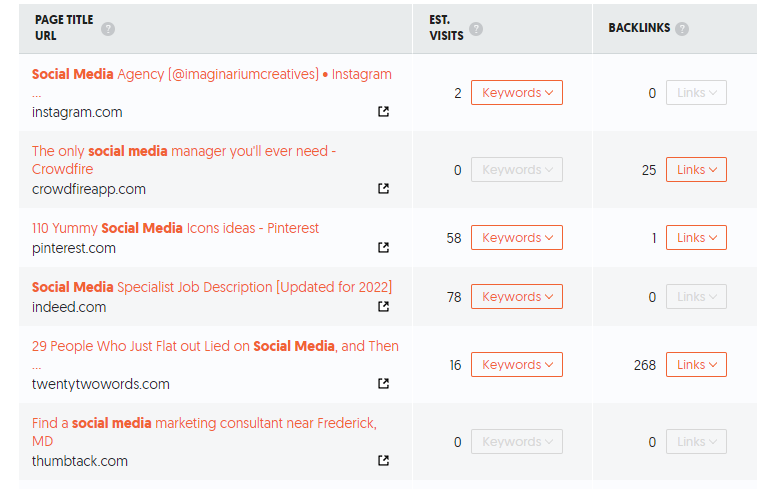
Now let’s look at what we can do with these keywords. Ubersuggest shows you the highest performing content for your chosen keywords.

Backlink Data

Backlinks are one of the most important components of Google’s ranking algorithm. However, there is a problem. They are difficult to build. Ubersuggest lets you see exactly what content people are linking to in your space. You then approach each of these sites and ask them to link to you.  

Pricing

You get three free daily searches with the free version. Before you decide to upgrade, you can try out a paid version for free for 7 days.   

Posted in Cool Tool, Visual Marketing

Monday Morning Cool Tool: WordArt

This week’s cool tool recommendation is WordArt –  a tool for creating eye-catching graphics out of word clouds or tag clouds.

Word clouds are a visual representation of text data, where the size of each word in the cloud is proportional to its frequency in the original text.

How to use it: 

  1. Visit  https://wordart.com and click “Create”
  2. Click “Input words” and either copy and paste text from, add your own, or enter a URL to generate a word cloud.
  3. Now for my favorite bit. Choose from dozens of shapes, fonts, layout; then hit “Visualize” to see your word cloud.

Here’s a quick visual I created using social media marketing-related words.

download.png
Posted in Cool Tool

Monday Morning Cool Tool: VSCO

This week’s cool tool recommendation is photo and video editing tool, VSCO.

VSCO is a photo editing and sharing tool that offers both free and paid versions. In the free version, users can access basic editing tools like white balance, exposure, and contrast, along with a selection of preset filters. They can try out different presets themselves or use the “for this photo” feature to get recommended presets for specific pictures. The free version also lets users explore others’ photos and curated portfolios, finding inspiration in themes like “humankind,” “editorial,” and “summer.”

Posted in #HCSM

How To Maximize the F-Pattern Technique When Creating Engaging Healthcare Content

Imagine your audience as a group of busy commuters at a bustling train station. They’re not looking to settle in for an immersive journey; instead, they’re glancing around, seeking information that piques their interest in a matter of seconds.

The reason behind this reading pattern is rooted in both cognitive and ergonomic factors. Psychologically, the F-pattern aligns with our natural tendency to prioritize information that stands out or is visually prominent. As a result, headings, subheadings, bullet points, and the first few words of sentences tend to capture our attention more effectively.

For content creators and website designers, understanding the F-pattern can be beneficial when creating more engaging and accessible content. By structuring your content in a way that aligns with this reading pattern, you can make it easier for readers to quickly grasp essential information and navigate through your content more efficiently. To capitalize on the F-pattern, it is important to structure content in a way that aligns with readers’ scanning behavior.

Click here to learn some tips to maximize your content for the F-pattern

Posted in #HCSM

Create Thumb-Stopping Social Media Content With These Tips and Tools

Picture this.

While scrolling through your Instagram feed, you swipe up to see the next picture or video.

Then suddenly, you see a stunning landscape, a captivating video clip, or a humorous meme. In that instant, you pause mid-scroll, your thumb hesitates, and your attention is wholly drawn to the content.

This momentary interruption is the essence of thumb-stopping content.

What sets thumb-stopping content apart is its ability to evoke an emotional response, spark curiosity, or provide immediate value. It could be an image that stands out in a sea of mundane images, a video that elicits laughter, or a thought-provoking quote.

But what is it that makes content truly “thumb-stopping”?

Continue reading this post on Medium