In a recent study, two experts identify ethical considerations for participant-led research that uses social networking websites. The authors recommend three categories of ethical oversight for such research based on the risk to participants.
Diagram shows the partition of Twitter users into communities, annotated with words selected to be typical of those often used by members of each community
Twitter users are spontaneously forming tribe-like communities of like-minded people who even share their own distinct languages, new research has found.
Scientists from Royal Holloway, University of London, and Princeton University in New Jersey found they could use the language in Tweets to group users into communities with a common character, occupation or interest.
They suggest that the use of a common language could allow members of such ‘Twitter tribes’ to quickly identify like-minded users, and that further investigation could yield insights into how sub-cultures evolve online.
The team produced a map of the communities showing how they have vocations, politics, ethnicities and hobbies in common.
In order to do this, they focused on publicly available messages sent via Twitter, which meant that they could record conversations between two or many participants.
The study, recently published in the open-acess journal EPJ Data Science, describes how the researchers analysed 75 million tweets sent by 189,000 users. To group these users into communities, they turned to cutting-edge algorithms from physics and network science. The algorithms worked by looking for individuals that tend to send messages to other members of the same community.
‘One ‘anipals’ group was interested in hosting parties to raise funds for animal welfare, while another was a fascinating growing community interested in the concept of gratitude.’
In the paper, the researchers write:
Online social networks offer us an unprecedented opportunity to systematically study the large-scale structure of human interactions. Our approach suggests that groups with distinctive cultural characteristics or common interests can be discovered by identifying communities in interaction networks purely on the basis of topological structure.
This approach has several benefits when compared to surveying groups identified on a smaller scale: it is systematic, and groups are identified and classified in an unbiased way; when applied to online social networks it is non-intrusive; and it easily makes use a large volume of rich data.
The potential to include social group identification, customise online experience, and crowd-source characterisation could certainly be applied to healthcare marketing, public health campaigns, etc. As the report points out, having people with a negative attitude towards vaccination preferentially in contact with those of the same opinion could lead to clusters of susceptibles and increased risk of outbreaks. So any process that structures people into groups could potentially play a strong role in cultural evolution, as well as in the spread of information or pathogens.
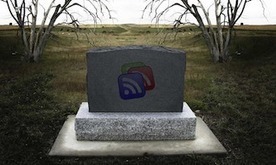
There is undeniable frustration, even sadness, at the impending loss of Google Reader. People depended on it. People loved it. And that’s why its removal from the online content landscape provides such a great opportunity for you, the content creator.
People often see games as bad for health but many institutions have been hard at work to make them work for us. Here are 6 ways games can help healthcare
There were far too many terrific takeaways over the four days I spent at the SXSW Interactive Conference in Austin, TX this past weekend, many of which I promise to elaborate on in the coming weeks. For now–here are my Top 10–really in no particular order, as all will be coming your way in due time. I cannot say enough good things about the SXSW experience — please comment and share your own takeaways if you also attended!
Mobile and Responsive design: For anyone creating content of any kind–this is the bus to be on, and it’s well on its way down the road. As a medical device or a content viewer, for healthcare diagnostics or your favorite magazine–almost any tool or content being developed today needs to have a mobile version ready to go. Responsive design adapts web content to the device it is being viewed upon, and…
Rise Of The Patient Talk Show continues this year, 2013! We are entering the segment: Socializing Health care and informaiton In this episode I interview Dr. Kevin Pho! Dr.
Marie Ennis-O’Connor‘s insight:
If you haven’t already discovered this show, then make sure to check it out.
Pinterest drives more traffic to websites than LinkedIn, Google+ and YouTube combined. So if you’ve got great information on your website that no one is seeing, try pinning it and see what happens!
Marie Ennis-O’Connor‘s insight:
Right now it has 12 million users and that number is growing daily. It’s largest demographic is women, clearly a target audience for hospital marketers.
World Health Organization publishes an annual compendium chronicling innovative medical devices and eHealth solutions suitable for low resource settings. It presents a snapshot of several health technologies which might have the potential to improve health outcomes or to offer a solution to an unmet medical need in low-resource settings





 Health Care Social Media