Articles

Posted in #HCSM

Healthcare Professionals in the Digital Era

See on Scoop.itHealth Care Social Media Monitor

Marie Ennis-O’Connor‘s insight:

To plan how to engage and activate healthcare professionals online, it is worthwhile considering the kinds of digital channels being used by healthcare professionals and the role that each channel plays. We might broadly categorise these channels into three groups:

Healthcare professionals’ social networksDedicated digital tools and resources for healthcare professionalsMainstream digital channels

See on engagementstrategy.com

Posted in #HCSM

Are we living in a ‘postmodern healthcare marketing world’? | Healthcare Engagement Strategy

See on Scoop.itHealth Care Social Media Monitor

Marie Ennis-O’Connor‘s insight:

t is safe to say that most communications professionals have learnt the fundamentals of today’s changing environment: communication is now a two-way model; using social media presents the opportunity to tell human stories and enhance online presence; content is king; and we are all moving towards transparency, supported by well-earned public trust. But has everything changed? Does every customer crave an enticing experience, and do they really want to engage with brands through self-expression all the time?

See on engagementstrategy.com

Posted in #HCSM

What Doctors Say on Social Media About Cardiovascular Drugs | Healthcare Engagement Strategy

See on Scoop.itHealth Care Social Media Monitor

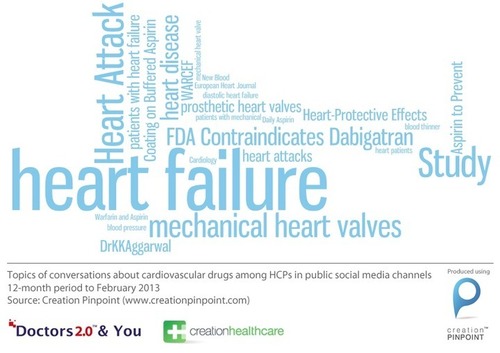
As part of Creation Healthcare’s research partnership with Doctors 2.0 & You, which uses Creation Pinpoint to analyse conversations among Healthcare Professionals (HCPs) in public social media channels about cardiovascular disease, I will be sharing some highlights of our work. Here is a first look at what we are discovering about HCPs discussing cardiovascular topics.

See on engagementstrategy.com

Posted in #HCSM

Protocol: HIPAA & Social Media Strategies for Hospitals and Physicians

See on Scoop.itHealth Care Social Media Monitor

Social media content strategies and HIPAA-compliance suggestions for physicians and hospital marketers.

Marie Ennis-O’Connor‘s insight:

Many healthcare organizations are struggling with the use of social media is that they are hesitant to communicate with patients online due to the fear of violating HIPAA, the privacy act that restricts hospitals or physician groups from using private patient information to promote products or services without permission.

A simple rule to maintain patient privacy in social networks is that physicians should avoid talking about patients, even anonymously.  That doesn’t mean they can’t find inspiration from a patient however, only that they write about the illness or condition as the subject, not the patient.

Another good idea is to give posts the “elevator test” before publishing. Read the post out loud, and if any part of it makes you uncomfortable to say in public, you probably shouldn’t post it.

See on smithandjones.com

Posted in #HCSM

Inform Healthcare Consumers with Content Marketing | Fathom

See on Scoop.itHealth Care Social Media Monitor

How can your healthcare organization use content marketing to inform consumers? Visit Fathom’s blog to learn easy ways to develop informative content.

Marie Ennis-O’Connor‘s insight:

Healthgrades recently released its American Hospital Quality Report for 2013, which focuses on performance for thousands of hospitals nationwide. The research has shown healthcare consumers need to become more informed before selecting their healthcare provider. Healthgrades encourages healthcare consumers to spend more time researching, especially when more than 90% of Americans think that choosing a physician or hospital is at the top of the list of significant life decisions. In fact, selecting a physician ranks second only to selecting a spouse for most Americans when ranking 8 key relationships, according to another Healthgrades study. Hospitals have the opportunity to become the main research source for healthcare consumers.  Hospital websites can become the information hub to address healthcare consumers’ concerns.  So how do you know if your hospital’s website has all of the content consumers need to make this significant life decision?


See on www.fathomdelivers.com

Posted in #HCSM

The FDA weighs in on social media in a warning way

See on Scoop.itHealth Care Social Media Monitor

The FDA issued a warning letter to a supplement company because they liked a Facebook page that has off-label claims.  Is this a warning shot fired at social media by the FDA ? 

Marie Ennis-O’Connor‘s insight:

RIch Meyer reports:


While many pharma companies are avoiding social media and afraid of the channel some are embracing it and they key lesson here is not to like another page that does not practice good control over content.  On facebook you can either “like a page” or “like a post” from someone else.  It seems that the FDA is going to ensure that pharma marketers don’t like posts or pages that contain any off label promotional claim.  


This means that if pharma wants to venture into social media they are going to need someone to take charge of their social media marketing to ensure that posts and likes don’t get out of hand. The bottom line here is that we are in an unexplored area but an area that has to be mapped.  You’re not going to learn by waiting for the FDA and consumers are using social media for health so when you enter the area off the map chart your course and leave a trail for others to follow.

See on worldofdtcmarketing.com
Posted in #HCSM, Doctor

Do We Care What Doctors Think?

193b3979-ff21-49fe-a546-beaaabe32af0Doctors often avoid an online presence for fear that they’ll be approached by strangers with questions, but how is the reality for doctors who do participate in social networking?

Susannah Fox arranged some recent Pew data which suggest that very few internet users pose questions to physicians online.  What’s far more common, however, is for folks to pose questions for friends and family. These numbers further support the established idea that physicians are not the sole source of information for inquiring minds.  Community is increasingly where people turn for front-line queries.

See on 33charts.com