See on Scoop.it – Health Care Social Media Monitor
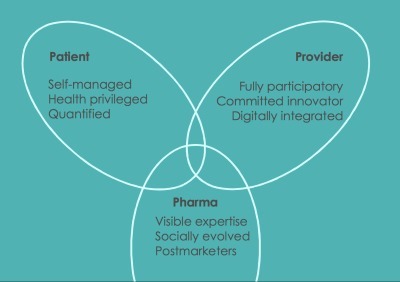
The future patient will be:
* Committed to self management.
The future patient is aware of the fact their personal health future is most likely to be conditioned by preventative strategies rather than treatment after the fact. The future patient is self-aware, and whilst they may not always abstain from actions that have health impacts, or engage in risky behaviours, they do so as a personal microchoice that they account for to themselves rather than expecting their decision to be ameliorated by external agencies. The future patient appreciates that informed choice trumps informed consent. The future patient will become who they are.
* Health privileged.
The future patient appreciates that whilst access to good healthcare should be a right, good health itself is a privilege and should be treated as such. The future health consumer aspires to maintain or attain good health in the same way that the historical retail consumer has aspired to the acquisition of commodities on the basis of their appreciation that health is the most precious possession of all.
* Quantified.
The future patient practices and advocates the collection and redistribution of the data that streams from their body among their healthcare team (and perhaps further, if they see a collective/personal benefit) not just to manage their day to day health or to optimise the management of chronic disease, but to inform the advancement of future health research through the processing of data on a planetary scale.
The future provider will be:
* Fully participatory.
The future provider’s default assumption is that the patient will participate fully in all decisions that are made about their health. The future provider will see it as a duty of care on their part to encourage the patient to self-identify as a shared decision maker, and a co-creator of their own care.
* A committed innovator.
The future provider will facilitate those expectations that the future patient brings to the point of care. They will provide access to health records. They will expect and encourage patients to research their own conditions. They will be looking to deploy proven innovations within the point of care as soon as their benefits have been proven. The future provider talks constantly about the ways in which facial recognition technologies could welcome patients to their practice, how non-invasive sensor technologies will revolutionise health, how artificial intelligence in the consulting room is an adjunct to their practice rather than an insult to their professionalism, how healthcare information should be prescribable, and dream along with their patients of the time when the personalised, genomic EHR is a reality.
* Digitally integrated.
The future provider continually seeks to refine and improve the reach of their professional digital presences to the communities they serve at a local level, and perhaps beyond. They endeavour to find ways of using digital technologies that improve the frequency and quality of professional connections with patients with a view to supporting health behaviours, improving compliance and working cooperatively towards better patient outcomes.
Two out of three future pharma requirements are primarily internal rather than external objectives. Future pharma will be:
* Visible experts.
Future pharma will be the most open, available and discoverable source of gold standard information about their own products and the disease areas they work in. Future pharma works tirelessly to make all data about their medicines available in a balanced, approvable way in online environments and platforms that the communities of interest which they serve are most likely to find and use it. Future pharma’s default expectation is that it has an ethical responsibility to proactively and openly disseminate all information about its products from clinical trials onwards.
* Socially evolved.
Future pharma drives the precepts of social business through its enterprise and uses social technologies and the attitudinal dispositions that underpin them to the fullest. Future pharma fully appreciates that its future financial success is contingent upon rather than threatened by observing policies of openness wherever possible, and has reoriented its business away from the traditional conceptual frameworks within which its activities had formerly been configured.
* Postmarketers.
Future pharma has reconfigured the means whereby it talks about and shares information concerning its products and services to the point that they no longer resemble ‘marketing’ activity as it was formerly understood. Future pharma’s former dominant marketing behaviours and the contexts within which they were practiced have become residual. Future pharma now listens actively to patient and professional needs and responds quickly and openly. Future pharma’s goal state is to anticipate needs, not to directly influence behaviours. Future pharma appreciates that its further success will reside in sublimating everything other than its irrepressible desire to innovate and promote the science it practices.
Future health is already here. Are you at its intersection?
See on stwem.com