Posted in #HCSM

Exploring Hospitals’ Use of Facebook: Thematic Analysis

A new study published this month in Journal of Medical Internet Research analyzes the types of content US hospitals post on their Facebook pages and how hospitals’ Facebook activities differ with regard to content types.

The study authors, Nima Kordzadeh and Diana K. Young, point out that whilst health care organizations “have widely embraced social media as a means to educate the community on health topics and increase patient loyalty and satisfaction, little is known about the content these organizations actually share when using social media channels.”

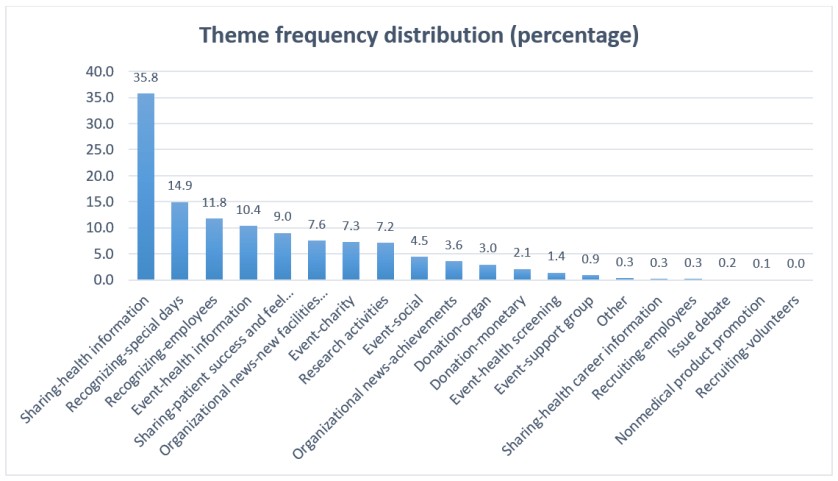
The researchers collected and thematically analyzed more than 1700 Facebook posts made over a 3-month period by 17 US hospitals. They identified a list of 13 unique health social media post themes and classified those themes into thematic groups.

Thematic Analysis
855aa646a73d2f87194028379f0e2a77

The most frequently used theme was sharing health information, which appeared in 35.81% of the posts analyzed. Such posts sought to provide health tips and advice to community members.

Recognizing special days and recognizing employees were the second and third most frequently used themes, respectively, with 14.95% and 11.82% of the posts containing those themes. The researchers expressed surprised at the frequency of these themes, nothing “the content was geared more toward stakeholders internal to the organization, although most previous literature has focused on social media as a tool to connect with external stakeholders.”

In addition, the researchers found many of the posts involved more than one theme, and selected sets of themes co-occurred frequently. For example, 25.4% of the posts recognizing special days also included content to share health information, and approximately 38%  of the posts announcing research activities also included content to share health information.

Principal Findingse8f44ffe1a165ce8fde8ae55e6b7c747


The results of this study showed most posts in the sample could be classified as serving 3 purpose groups:

  •  announcing and reporting
  •  recognizing
  • sharing activities

Within the announcing and reporting purpose group, the authors found the sampled institutions used Facebook to broadcast information relating to donations opportunities, upcoming events, research activities, and organizational news. They further found that recognizing posts were used to acknowledge employees and special days, whereas sharing posts were used to disseminate health information as well as patient success and feel good stories.

Conclusions

The study concludes with a recommendation that hospitals and clinics that are expanding their social media activities or are starting to embark on social media strategies can use the results of this study to better formulate their activities on Facebook.

These results can be used as a benchmark for the health care institutions that want to establish a social media presence to communicate with the public audience and for the smaller clinics and hospitals that want to further expand and improve their activities on social media websites.

Further Research

The authors point to further research opportunities including investigating the following questions:

  1. Does announcing events on Facebook increase attendance?
  2. Does acknowledging employees increase their organizational commitment, morale, and satisfaction?
  3. Is sharing health information via Facebook an effective approach in raising awareness about diseases and medical issues in the community?

Another avenue for future research, suggested by the authors is to examine the content generation process in terms of who is responsible for posting contents on health care organizations’ Facebook pages, and whether their expertise is in health care (eg, physicians, dentists, and nurse practitioners) or in social media marketing.

Such research should investigate how the content provider impacts the type of content shared, the manner in which it is shared, and the resulting level of audience engagement. This can ultimately influence the overall effectiveness of health care organizations’ activities on Facebook and other social media platforms.

Furthermore, future research can examine user engagement in different types of posts to understand the extent to which each content type can draw users’ attention and trigger their reactions in terms of liking a post, leaving a comment on it, or sharing it with others on Facebook.

In a statement that will have many of us nodding our heads in agreement, the authors conclude that “understanding user engagement is important because it can transform one-way, provider-to-consumer information dissemination activities into two-way or many-to-many communication processes. In this way, the “social” aspect of such platforms as Facebook can be realized more meaningfully, adding value to the health care organizations’ activities in virtual environments.”
Kordzadeh N, Young DK, Exploring Hospitals’ Use of Facebook: Thematic Analysis, J Med Internet Res 2018;20(5):e190

Posted in #HCSM

How To Increase Social Shares With “Click To Tweet”

Updated. Since first writing this post, Click To Tweet has launched a Google Chrome Extension that makes it even easier to use the tool on any website you visit. Now, you can create and share a Click To Tweet link just by clicking a button in your Chrome browser. A Click To Tweet window will appear pre-filled with information about the site you are on and make it easy to customize and create a new link.

Click to Tweet is a cool free tool which generates one-click tweet boxes or links that can be shared through your website, your blog, or via email. It’s a powerful way to increase social shares and highlight quotes, stats, and key takeaways for your content marketing.

Here’s a good example of how it looks on a blog.click2tweeteg.png

And here’s how to do it for your own blog or website.

Step One: Sign in with your Twitter account.

clicktotweet

Step Two: Write the message that you want others to share in the box provided.

clicktotweet2.png

Step Three: Click the “Generate New Link” button to create a custom link.

clicktotweet3.png

Step Four: Share the link and track the activity of each link over time.

screen-3.png

Whoever clicks on the link will have the message automatically added to their Twitter status box- they simply click to tweet.

Try it now and see for yourself!

Posted in #HCSM

What’s The State of Healthcare Content Marketing in 2018?

I just love reports, don’t you? 

Firstly, Social Media Examiner’s annual marketing industry report, published last week, threw up these findings:

  • A very significant 94% of marketers use Facebook (followed by Instagram at 66%). Two in three marketers claim Facebook is their most important social platform. However, only 49% of marketers feel their Facebook marketing is effective and 52% said they’ve seen declines in their organic Facebook reach in the last year.
  • Facebook ads reign supreme: Facebook ads are used by 72% of marketers
    (followed by Instagram at 31%). Nearly half of all marketers increased their
    Facebook ad activities in the last year and 67% plan on increasing their use of
    Facebook ads over the next 12 months.
  • Facebook Messenger bots pique marketers’ interest: While only 15% of
    marketers are using Messenger bots, 51% plan on using Messenger bots in the
    next year.
  • For the first time in years, generating leads has become more of a focus for marketers than cultivating a loyal fan base. This could be a sign that metrics and automation are becoming more important than engagement.

You can download the report here.

Secondly, a content marketing report from True North Custom and Healthcare Insight based on data from a survey conducted in 4Q17 among 53 healthcare marketing professionals who work for hospitals, urgent care centers, physician practices, and other healthcare organizations, found that the rise of content marketing in the healthcare industry continues, with steady growth in usage. 

Chapter1_Graph1.png

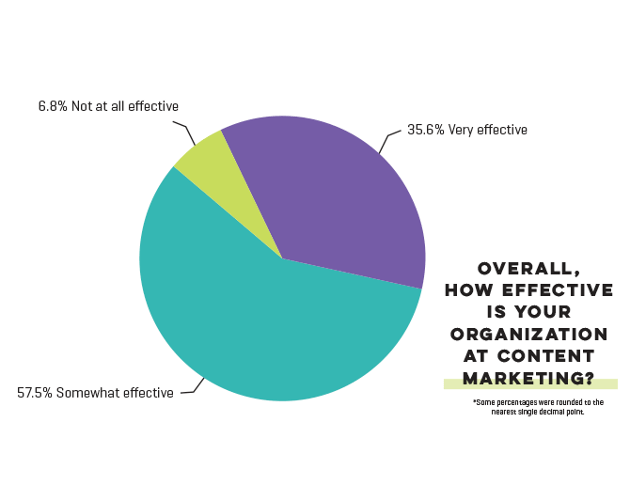
However, measuring content marketing effectiveness is (still) slightly behind the adoption curve. Some 36% of respondents say their organization’s content marketing efforts are very effective, and 58% say they are somewhat effective.

Chapter1_Graph2-4.png

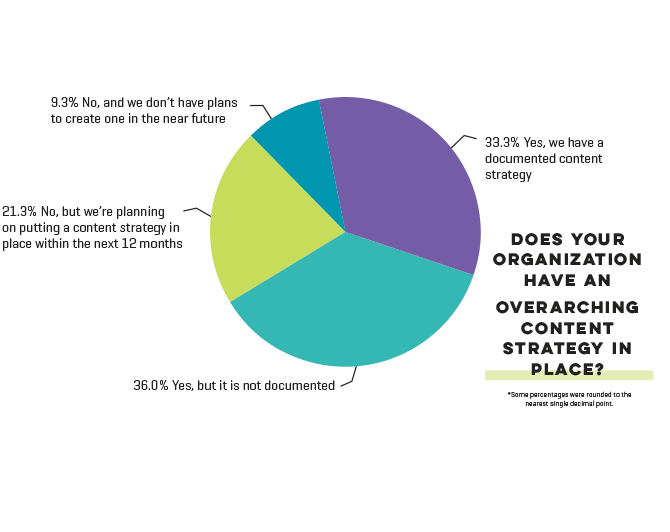
Only one-third of respondents say their healthcare organization has a documented content marketing strategy.

Chapter1_Graph3-1.png

Measuring ROI

Increasing the ability to demonstrate return on content marketing investment remains a challenge. The majority of respondents (65%) consider themselves successful at tracking ROI, compared to 44% who responded the same way last year. However, only 10% consider themselves very successful at tracking ROI.

Chapter2_Graph2.png

When it comes to measuring impact, website traffic is the most popular way to do this.

Chapter2_Graph3.png

Content Marketing Goals

Content marketing goals remain consistent with top-of-the-funnel priorities like Brand Awareness, Engagement and Patient Loyalty holding the top three spots for the third consecutive year. 

Chapter2_Graph1.png

Marketing Tactics

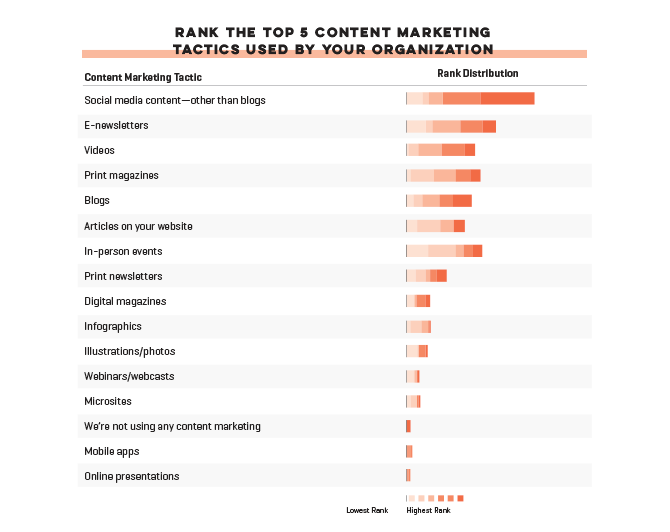
Social media reigns supreme, followed by eNewseltters and video taking the top three places in marketing tactics.

Chapter3_Graph1.pngAccording to Becker’s Hospital Review in an article on healthcare marketing trends for 2018, “Health-related video content is in demand. There is a whole market for qualified physicians to provide health information through videos without offering clinical advice.” 
Social Media Distribution

No surprise that Facebook tops the poll when it comes to organizations promoting their content on social media. YouTube is also extremely popular testifying to video’s growing influence, and I am happy to see Twitter is still hanging on in there. Chapter3_Graph2.png

Recommendations

The report concludes with three recommendations.

Create a documented strategy

A well-documented strategy will help your brand message rise above the noise. Mapping out your plan avoids what Convince & Convert Founder Jay Baer calls random acts of content and involves the use of personas, journey maps, editorial calendars, and other tools that set your brand and content apart from the pack.

Leverage Email Marketing

The large majority of people who visit your website or subscribe to your e-newsletter aren’t ready to make a healthcare decision. This is where content can play a crucial role in keeping them engaged while building affinity for your brand as a trusted resource. And while email is a leading channel for delivering content, many healthcare organizations never tap into that potential. A well-designed email nurturing program has proven to be an effective tool for building an audience and advancing them through the buyer’s journey.

Make Sure Everyone Is On Message

Rather than losing your prospect at the most critical point in the campaign, coordinate with your call center or intake team to integrate tracking mechanisms and create scripts that facilitate the lead intake process.

You can read the report in full here.

What do you think of these two reports? I don’t think there are any real surprises – we’ve been hearing for years that many healthcare organizations don’t have a documented strategy in place and struggle to measure ROI.

  • Facebook still reigns supreme, but I wonder how effective it truly is considering the lack of metrics employed to measure its effectiveness?
  • LinkedIn and Instagram are in joint place in terms of social media marketing, but should this be the case? They are two very different platforms and I wonder if marketers are using each of them effectively?
  • I am pleased to see YouTube high up the rankings – this is a good strategy for healthcare marketing.
  • And while people either fall into two camps of loving or hating Twitter, I personally see many robust healthcare conversations take place on this platform.
  • Finally, Pinterest and Snapchat are under-utilized and there’s a real opportunity here for us to own this space.

I’d love to hear your thoughts on these reports. What are your observations? What’s working for you? Where do you recommend healthcare marketers should focus their attention going forward?

Posted in #HCSM

How to Create an Awareness Campaign with Social Media

Is creating an online campaign part of your 2018 marketing strategy? Do you need a plan to get started?

Whether you are an individual, a small non-profit, or a large healthcare organization, a strategic plan is essential to your campaign’s success. On Thursday, 22 February, I will be hosting an online webinar with Mayo Clinic Social Media Network, in which I will show you how to plan and execute a social media campaign from setting your campaign objectives right through to measuring your campaign’s impact. You will also learn creative ideas and best practice tips from other successful campaigns.

At the end of this webinar, you will be able to apply the learning to:

  • Clarify your campaign message
  • Set defined goals and performance metrics
  • Find and reach your target audience
  • Choose the right tactics and tools to raise campaign awareness
  • Leverage the power of online influencers to increase campaign reach
  • Create shareable content with clear calls-to-action
  • Plan your content calendar to maximize momentum
  • Use the power of storytelling to create impact
  • Measure your results

Details and Signup 

Hope to see you there!

Posted in #HCSM

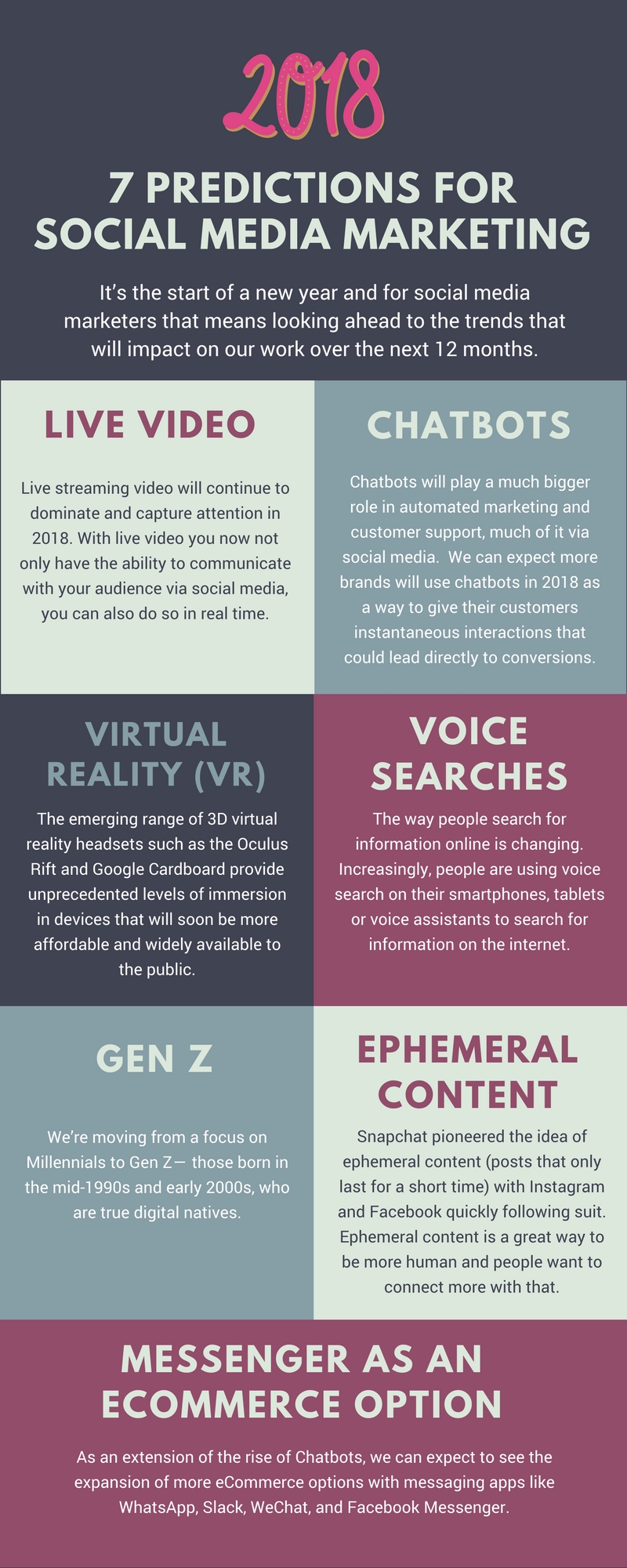
7 Social Media Marketing Trends To Prepare For In 2018 [Infographic]

It’s the start of a new year and for social media marketers that means looking ahead to the trends that will impact on our work over the next 12 months.

As the close of 2017 drew nearer, social media marketing experts gazed into their crystal balls to see what’s coming down the line in 2018. So which of their predictions should we set our sights on? I’ve put together this list of the top predictions from around the web to help you keep your finger on the pulse of the trends which will shape the social media landscape. Take some time to look at your existing marketing strategies, and see which ones could benefit from (or be negatively affected by) these coming trends.

The best thingsto donate.jpg

For more trends and predictions click here.

Posted in #HCSM

5 Common Social Media Marketing Myths… And How To Bust Them![Infographic]

Even though social media is a common tactic used by marketers across the globe, myths about how and why to use social media persist. Buying into these myths will seriously undermine your social media marketing. In my latest infographic learn how to counter five of the most prevalent myths with my myth-busting tips.

charity.png

Click to see more social media marketing myths and how to bust them.

Posted in #HCSM

What’s New in Social Media This Week?

My latest healthcare social media newsletter has gone out to subscribers. In this week’s round-up of news and tips:

Facebook Page Reach Declined 20% in 2017

unnamed

According to new research by BuzzSumo, the average number of engagements with Facebook posts created by brands and publishers has fallen by more than 20% since January 2017. This report will hardly come as surprising news to those of us who have been despairing at the fall in organic reach on Facebook over the past few years. What I found most interesting in this report is the data on which posts are driving engagement – or not.

WhatsApp Is Testing Verified Business Accounts

unnamed (4)WhatsApp is now testing verified business accounts, which can be identified by their green check marks. The Facebook-owned messaging application said in a frequently asked questions post that the test “is currently limited to a small number of businesses participating in a pilot program.”
Google Announces Major Update To Mobile Search Results Page

Google has announced a major update to its mobile search results pages. Whenever your query brings up a video, Google will now show you a silent six-second clip to help you decide if it’s actually a video you want to see.


Twitter Adds Team Management Feature on Tweedeck’s Mobile App


unnamed (5).png

Multiple Twitter users can now share access to a single account via the social network’s iOS and Android applications without needing to share that account’s password.

Plus

Your weekly cool tool recommendation, social media quote of the week, and six things you should know in the world of social media.

Read this week’s newsletter and subscribe for regular tips. 

Posted in #HCSM

How Gens X, Y and Z Consume Video Content

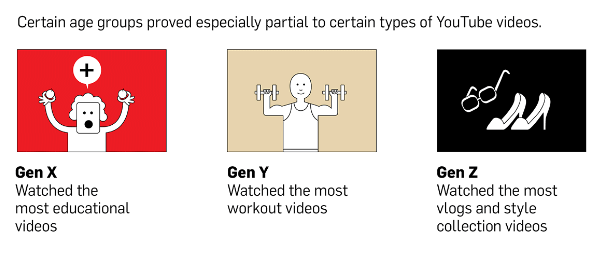
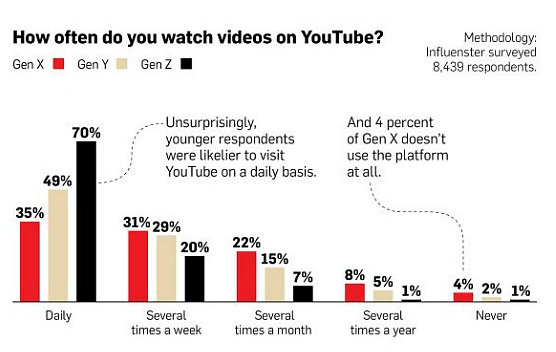
People around the world are now watching a billion hours of YouTube’s content every single day.  But who is watching what? This infographic from Adweek helpfully breaks down how much Gens X, Y and Z watches video content on YouTube, as well as what types of videos they like to watch.

Unsurprisingly, younger respondents to the survey were more likely to visit YouTube on a daily basis, while 4  percent of Gen X (34 and 54-years-old) respondents indicated they don’t use the platform at all.

download.png

When it comes to the type of video most watched by each generation, the breakdown  is as follows:

download.png

Whichever demographic you’re looking to market to, YouTube is a valuable channel. For maximum impact, use these findings to understand just how your target age group interacts with the video-sharing platform.

Related Reading: YouTube: A Missed Opportunity For Patient Education