See on Scoop.it – Health Care Social Media Monitor

A health-monitoring sensor can be attached to your arm with a temporary tattoo.
See on mashable.com
See on Scoop.it – Health Care Social Media Monitor
A health-monitoring sensor can be attached to your arm with a temporary tattoo.
See on mashable.com
See on Scoop.it – Journeying Beyond Breast Cancer
1) Do a better search:
Bookmark sites that are affiliated with trusted sources—that way, you know the articles are well researched and up-to-date.
2) Avoid doing broad searches:
Google “knee pain” and you’ll get about 30 million results. “The drawback of a general search, whether you need quick help for a burn on your hand or more insight into a just-diagnosed allergy, is you get a mix of information, some of which could be inaccurate or irrelevant,” says Lisa Gualtieri, an assistant professor at Tufts University School of Medicine, who specializes in tech and health.
3) Set up e-subscriptions:
“We’re seeing an evolution from patients searching for information online to information finding patients,” says Dr. Bryan Vartabedian, a Houston doctor who writes 33charts.com.
4) Sign up for Google Alerts:
Sign up for a Google Alert (http://www.google.com/alerts) on any topic, and an email with links will show up daily, weekly, or as new content is available (your choice). You can also pick the media sources, like news outlets or videos. Be sure to click on “only the best results.”
5) Read right to the end:
Lists of symptoms that ran from general to specific (and vice versa) were more likely to make healthy people think they were at higher risk for cancer, compared with lists that mixed the order of general symptoms (like fatigue) and illness-specific signs, finds a recent study in Psychological Science. Order varies by site, so read it all.
See on www.foxnews.com
See on Scoop.it – Health Care Social Media Monitor
Open health refers to a set of developing information technologies that make it easier for patients, professionals and administrators to access health-care information or make it anonymous and open to the public.
This is done by integrating existing health-care records and data. It is hoped the result will be more health information for more people to access more easily.
Open health requires online access. It’s easy to think of this as a background issue because the national broadband network is due to roll out in Australia over the next few years. But the so-called digital divide is a real concern in Australia and around the world.
What’s more, the world isn’t just divided between those who have internet access and those who don’t. We also need to consider the staggering differences between the quality of access, individual internet literacy, and how these variables can be leveraged to create good outcomes.
Although the digital divide is closing, a large number of vulnerable individuals still don’t have basic internet access. And technological literacy is a necessary part of using open health services.
Open health will hold data on vulnerable populations that those populations may not be able to use through lack of access. The elderly, for instance, are major users of health-care services so we need to ensure that they have the technological access and the capacity to engage with open health.
New technologies can bring huge benefits to those with the resources, education, and opportunity to access them. Open health is no exception.
Perhaps the most obvious concern for open data policy is the privacy of individuals. If there’s enough identifiable information in a data set that has become public, then individuals can be picked out and potentially targeted by private businesses, government agencies, and even by police in ways they might not want.
Even if the intentions of the viewer are good, we still have the right to expect that our personal information remains anonymous and our privacy is protected.
Linked data can be very useful to citizens and businesses alike, but carries with it the risk of de-anonymisation. There’s a concern that primary data, which hasn’t been interpreted or aggregated, can be used to identify individuals.
The important thing about linking data is that individual data sets, such as age, height, car model and postcode, are not considered overly private. And a lot of this sort of innocuous personal information can be accessed online – through sites such as Facebook, and census data, for instance.
We should also be concerned about who can exploit the data, and how much control we have over access. Some of us may not want even our anonymised data being used in ways we don’t agree with.
Open health should make opting out simple. While large scale opt-outs are likely to diminish the utility of data, we have to weigh the trade-off between privacy and potential innovation carefully.
Finally, to whom do we turn if something goes wrong? With a move towards more automated and rapid release of data, there’s more urgency around what options individual citizens and groups have to question, comment, or contest the release and use of open data.
See on Scoop.it – Health Care Social Media Monitor
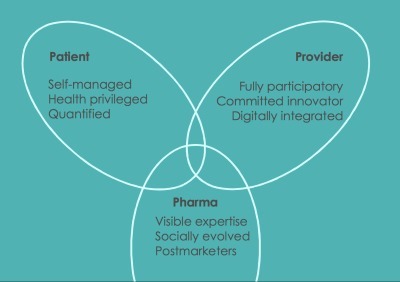
The future patient will be:
* Committed to self management.
The future patient is aware of the fact their personal health future is most likely to be conditioned by preventative strategies rather than treatment after the fact. The future patient is self-aware, and whilst they may not always abstain from actions that have health impacts, or engage in risky behaviours, they do so as a personal microchoice that they account for to themselves rather than expecting their decision to be ameliorated by external agencies. The future patient appreciates that informed choice trumps informed consent. The future patient will become who they are.
* Health privileged.
The future patient appreciates that whilst access to good healthcare should be a right, good health itself is a privilege and should be treated as such. The future health consumer aspires to maintain or attain good health in the same way that the historical retail consumer has aspired to the acquisition of commodities on the basis of their appreciation that health is the most precious possession of all.
* Quantified.
The future patient practices and advocates the collection and redistribution of the data that streams from their body among their healthcare team (and perhaps further, if they see a collective/personal benefit) not just to manage their day to day health or to optimise the management of chronic disease, but to inform the advancement of future health research through the processing of data on a planetary scale.
The future provider will be:
* Fully participatory.
The future provider’s default assumption is that the patient will participate fully in all decisions that are made about their health. The future provider will see it as a duty of care on their part to encourage the patient to self-identify as a shared decision maker, and a co-creator of their own care.
* A committed innovator.
The future provider will facilitate those expectations that the future patient brings to the point of care. They will provide access to health records. They will expect and encourage patients to research their own conditions. They will be looking to deploy proven innovations within the point of care as soon as their benefits have been proven. The future provider talks constantly about the ways in which facial recognition technologies could welcome patients to their practice, how non-invasive sensor technologies will revolutionise health, how artificial intelligence in the consulting room is an adjunct to their practice rather than an insult to their professionalism, how healthcare information should be prescribable, and dream along with their patients of the time when the personalised, genomic EHR is a reality.
* Digitally integrated.
The future provider continually seeks to refine and improve the reach of their professional digital presences to the communities they serve at a local level, and perhaps beyond. They endeavour to find ways of using digital technologies that improve the frequency and quality of professional connections with patients with a view to supporting health behaviours, improving compliance and working cooperatively towards better patient outcomes.
Two out of three future pharma requirements are primarily internal rather than external objectives. Future pharma will be:
* Visible experts.
Future pharma will be the most open, available and discoverable source of gold standard information about their own products and the disease areas they work in. Future pharma works tirelessly to make all data about their medicines available in a balanced, approvable way in online environments and platforms that the communities of interest which they serve are most likely to find and use it. Future pharma’s default expectation is that it has an ethical responsibility to proactively and openly disseminate all information about its products from clinical trials onwards.
* Socially evolved.
Future pharma drives the precepts of social business through its enterprise and uses social technologies and the attitudinal dispositions that underpin them to the fullest. Future pharma fully appreciates that its future financial success is contingent upon rather than threatened by observing policies of openness wherever possible, and has reoriented its business away from the traditional conceptual frameworks within which its activities had formerly been configured.
* Postmarketers.
Future pharma has reconfigured the means whereby it talks about and shares information concerning its products and services to the point that they no longer resemble ‘marketing’ activity as it was formerly understood. Future pharma’s former dominant marketing behaviours and the contexts within which they were practiced have become residual. Future pharma now listens actively to patient and professional needs and responds quickly and openly. Future pharma’s goal state is to anticipate needs, not to directly influence behaviours. Future pharma appreciates that its further success will reside in sublimating everything other than its irrepressible desire to innovate and promote the science it practices.
Future health is already here. Are you at its intersection?
See on stwem.com
See on Scoop.it – Health Care Social Media Monitor
The third in a series on the credibility of health information on the Web (Beyond Dr.Google: How social media can improve our health http://t.co/Tw7tIHT2 #hcsm…)…
See on www2.macleans.ca
See on Scoop.it – Blogging For Business
At a recent FDA/CDER-CHPA seminar on
promoting over the counter medicines in a social media world, experts wrestled with the fact that consumers are increasingly turning to others like themselves or other online channels for health information, data, and first-hand experiences to help them make better medical decisions. Almost half of consumers are reading someone else’s commentary or experience about health or medical issues on an online news group, website, or blog. They are turning to social channels and platforms because they want customer service, immediate answers to basic questions, guidance and someone to make sense out of the cacophony of medical information.
The challenge this poses for healthcare companies is how best to get involved in monitoring and correcting misconceptions or misinformation. There is great upside and promise of social health promotion and marketing including sharing experiences, driving better behaviors and spreading useful information. However, there are cautions to take into consideration when using social media to promote healthcare products and medicines including the risk of misinformation spreading and information being taken out of context.
Rules against misleading advertising also apply to social media. The FDA, FTC and leading legal experts on social media marketing all cautioned that the prohibition against deceptive and misleading advertising applies to social media marketing. Advertisers can’t make claims using third parties that they couldn’t legally make themselves. Consumers have the right to know when they are being advertised to.
Celebrity endorsements via social media must be disclosed. When it comes to using celebrities to endorse products, in conventional ads, it’s not necessary for an ad to disclose that a celebrity is being paid, because in that context payment would be understood. Outside of conventional ads however, for instance on talk shows and social networking sites, the relationship with the advertiser should be disclosed when a celebrity talks up a product because payment isn’t obvious in that context. In addition, companies using bloggers or consumer endorsers as part of their campaigns must have policies in place to monitor whether disclosures are being made.
Best practices for monitoring and reporting remain a priority. Social media is a new data source for both industry and regulators. It is more far reaching and in a less controlled environment than traditional sources such as phone, email and postal letter. There is increased case volume to monitor. Companies need to be vigilant when following up with a post on a company site, while being mindful of privacy concerns. Company privacy policies should also be consistent with adverse event reporting activities.
The bottom lines is that marketers and communication professionals need to understand the social media venue’s terms of use, as well as their company’s or client’s policies. For instance, if a consumer uses a “handle”, is that an identifiable patient/reporter? For a non-company owned site: is follow-up on a social media post infringing on harassment/or promotional when a company is “listening in” and not directly involved in conversation?
These questions are not necessarily easy to answer but will remain important to ask as social media for healthcare promotion becomes more and more expected and accepted.
See on health.ketchum.com
See on Scoop.it – Health Care Social Media Monitor
These slides were originally presented in November of 2012 at the first Q1 CME Grants Forum in Cambridge, Mass.
See on www.slideshare.net
Increasingly, doctors are realizing how social media can help them professionally. Many a times, doctors may indulge in ‘unprofessional’ activities online or might not behave in a way consistent with expected behavior online.
See on blog.digmed.in
See on Scoop.it – Health Care Social Media Monitor
James Borton, University of South Carolina Sumter, is convinced of one thing: medicine and storytelling go hand in hand. As a heart patient himself and English Professor, James is in a privileged position to understand the interdependence of literature and medicine. James recently contacted me to discuss our common interest in web 2.0 social media and the dramatic shift brought about by internet massive use that it is driving health-care professionals, medical students, patients and caregivers to blog about the illness narrative.