Posted in #HCSM

The Patient Experience and Health Outcomes — NEJM

See on Scoop.itHealth Care Social Media Monitor

Do patients’ reports of their health care experiences reflect the quality of care? Despite the increasing role of such measures in research and policy, there’s no consensus regarding their legitimacy in quality assessment. Indeed, as physician and hospital compensation becomes increasingly tied to patient feedback, health care providers and academics are raising strong objections to the use of patient-experience surveys. These views are fueled by studies indicating that patient-experience measures at best have no relation to the quality of delivered care and at worst are associated with poorer patient outcomes. Conversely, other studies have found that better patient experiences — even more than adherence to clinical guidelines — are associated with better outcomes. Which conclusion is correct? We believe that when designed and administered appropriately, patient-experience surveys provide robust measures of quality, and our efforts to assess patient experiences should be redoubled.

Marie Ennis-O’Connor‘s insight:

Perspective from The New England Journal of Medicine — The Patient Experience and Health Outcomes


See on www.nejm.org

Posted in #HCSM

How patients want to engage with their personal health record: a qualitative study

See on Scoop.itHealth Care Social Media Monitor

To assess factors related to use and non-use of a sophisticated interactive preventive health record (IPHR) designed to promote uptake of 18 recommended clinical preventive services; little is known about how patients want to use or be engaged by such advanced information tools.

Marie Ennis-O’Connor‘s insight:

In addition to patients’ stated desires for advanced functionality and information accuracy and privacy, successful adoption of the IPHRs by primary care patients depends on such technology’s relevance, and on its promotion via integration with primary care practices’ processes and the patient–clinician relationship. Accordingly, models of technological success and adoption, when applied to primary care, may need to include the patient–clinician relationship and practice workflow. These findings are important for healthcare providers, the information technology industry and policymakers who share an interest in encouraging patients to use personal health records.

See on bmjopen.bmj.com

Posted in #HCSM

Do consumers want smartphone health apps ?

See on Scoop.itHealth Care Social Media Monitor

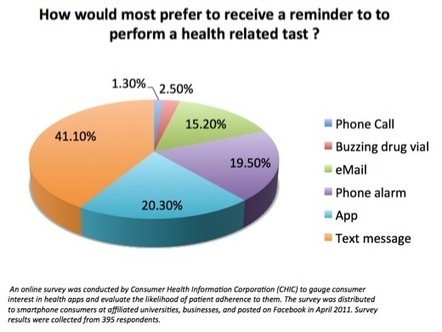
Smartphone apps have a high rate of dropouts with 26% being used only once and 74% being discontinued by the tenth use. A CHIC survey shows that the availability of a better app (34.4%) and lack of user friendliness (32.6%) are the top reasons for discontinuation of smartphone apps.  However what the survey isn’t showing is that some people do not like to be reminded that they have a health condition that needs monitoring.

Marie Ennis-O’Connor‘s insight:

Some very interesting observations in this article.

See on worldofdtcmarketing.com