Posted in #HCSM

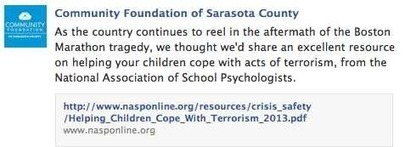
How to Communicate In Midst of Tragedy

See on Scoop.itHealth Care Social Media Monitor

Like you, my heart and head are heavy in the wake of yesterday’s bombings in Boston. Especially since I feel so helpless.

I had a completely different post planned today, but wanted to respond a.s.a.p. to the questions, worries and just totally-wrong communications I’ve seen going out since the bombings yesterday afternoon.

Most of this outreach was harmless, but simply a mismatch with what’s on our minds right now. Because most of us are feeling horror, sadness, fear, uncertainly and a sense of helplessness and vulnerability.

Marie Ennis-O’Connor‘s insight:

Excellent advice from Nancy E. Schwartz on communicating in the wake of the Boston bombings.

See on gettingattention.org

Posted in #HCSM, mHealth, Twitter

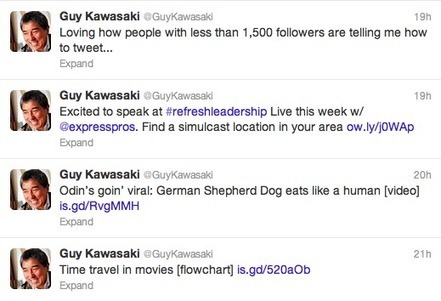
Can you tweet your way to heart health?

Real-time social phenomenon, Twitter, can be a powerful tool to help prevent heart disease and improve health practices, according to a group of researchers affiliated with the University of Sydney.

Their study, published in the Journal of the American College of Cardiology, surveying 15 international health-focused Twitter accounts, nine professional organisations and six medical journals, were selected for analysis of their Twitter growth, reach, and content.

See on sydney.edu.au

Posted in mHealth

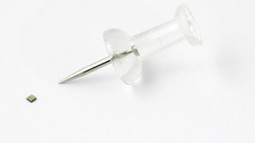
A pill that sends a text on entering a patient’s stomach

Proteus Digital Health has developed a pill that can text an alert when it enters a patient’s stomach. The technology, widely tested and already available for over-the-counter sale in a pilot program in the UK is just one of several new developments in caregiving technology designed to prevent hospital readmissions and relieve family caregivers of the persistent worry: “Is Dad taking his meds?”

See on www.forbes.com