See on Scoop.it – Health Care Social Media Monitor

The third in a series on the credibility of health information on the Web (Beyond Dr.Google: How social media can improve our health http://t.co/Tw7tIHT2 #hcsm…)…
See on www2.macleans.ca
See on Scoop.it – Health Care Social Media Monitor
The third in a series on the credibility of health information on the Web (Beyond Dr.Google: How social media can improve our health http://t.co/Tw7tIHT2 #hcsm…)…
See on www2.macleans.ca
See on Scoop.it – Blogging For Business
At a recent FDA/CDER-CHPA seminar on
promoting over the counter medicines in a social media world, experts wrestled with the fact that consumers are increasingly turning to others like themselves or other online channels for health information, data, and first-hand experiences to help them make better medical decisions. Almost half of consumers are reading someone else’s commentary or experience about health or medical issues on an online news group, website, or blog. They are turning to social channels and platforms because they want customer service, immediate answers to basic questions, guidance and someone to make sense out of the cacophony of medical information.
The challenge this poses for healthcare companies is how best to get involved in monitoring and correcting misconceptions or misinformation. There is great upside and promise of social health promotion and marketing including sharing experiences, driving better behaviors and spreading useful information. However, there are cautions to take into consideration when using social media to promote healthcare products and medicines including the risk of misinformation spreading and information being taken out of context.
Rules against misleading advertising also apply to social media. The FDA, FTC and leading legal experts on social media marketing all cautioned that the prohibition against deceptive and misleading advertising applies to social media marketing. Advertisers can’t make claims using third parties that they couldn’t legally make themselves. Consumers have the right to know when they are being advertised to.
Celebrity endorsements via social media must be disclosed. When it comes to using celebrities to endorse products, in conventional ads, it’s not necessary for an ad to disclose that a celebrity is being paid, because in that context payment would be understood. Outside of conventional ads however, for instance on talk shows and social networking sites, the relationship with the advertiser should be disclosed when a celebrity talks up a product because payment isn’t obvious in that context. In addition, companies using bloggers or consumer endorsers as part of their campaigns must have policies in place to monitor whether disclosures are being made.
Best practices for monitoring and reporting remain a priority. Social media is a new data source for both industry and regulators. It is more far reaching and in a less controlled environment than traditional sources such as phone, email and postal letter. There is increased case volume to monitor. Companies need to be vigilant when following up with a post on a company site, while being mindful of privacy concerns. Company privacy policies should also be consistent with adverse event reporting activities.
The bottom lines is that marketers and communication professionals need to understand the social media venue’s terms of use, as well as their company’s or client’s policies. For instance, if a consumer uses a “handle”, is that an identifiable patient/reporter? For a non-company owned site: is follow-up on a social media post infringing on harassment/or promotional when a company is “listening in” and not directly involved in conversation?
These questions are not necessarily easy to answer but will remain important to ask as social media for healthcare promotion becomes more and more expected and accepted.
See on health.ketchum.com
See on Scoop.it – Health Care Social Media Monitor
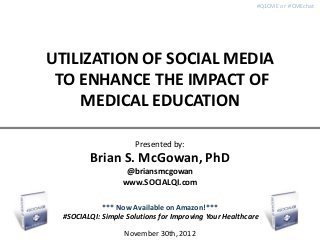
These slides were originally presented in November of 2012 at the first Q1 CME Grants Forum in Cambridge, Mass.
See on www.slideshare.net
Increasingly, doctors are realizing how social media can help them professionally. Many a times, doctors may indulge in ‘unprofessional’ activities online or might not behave in a way consistent with expected behavior online.
See on blog.digmed.in
See on Scoop.it – Health Care Social Media Monitor
James Borton, University of South Carolina Sumter, is convinced of one thing: medicine and storytelling go hand in hand. As a heart patient himself and English Professor, James is in a privileged position to understand the interdependence of literature and medicine. James recently contacted me to discuss our common interest in web 2.0 social media and the dramatic shift brought about by internet massive use that it is driving health-care professionals, medical students, patients and caregivers to blog about the illness narrative.
See on Scoop.it – Health Care Social Media Monitor
See on Scoop.it – Health Care Social Media Monitor
See on www.hitconsultant.net
See on Scoop.it – Health Care Social Media Monitor
Many physicians post YouTube videos to educate patients about specific health issues. In addition, some doctors use YouTube to build their personal brand, post presentations that accompany studies and share information with their colleagues.
See on www.ihealthbeat.org
See on Scoop.it – Health Care Social Media Monitor
If you’re exhibiting at or running a trade show – or thinking of starting one – the correct use of social media can be the single difference between standing out and driving a boatload of footfall to your stand or event… or disappearing without a trace.
See on www.mediabistro.com
See on Scoop.it – Health Care Social Media Monitor
Ben’s Friends Patient Communities – support group for patients affected by rare diseases (RT @bensfriends: “@BENSFRIENDS PATIENT COMMUNITY GROUPS”: serves as an “incubator” for new communities of all diseases http://t.co/fL9Yohop...
See on rarediseases.bensfriends.org