See on Scoop.it – Health Care Social Media Monitor

Understanding the Factors That Influence the Adoption and Meaningful Use of Social Media by Physicians to Share Medical Information…
See on www.jmir.org
See on Scoop.it – Health Care Social Media Monitor
Understanding the Factors That Influence the Adoption and Meaningful Use of Social Media by Physicians to Share Medical Information…
See on www.jmir.org
See on Scoop.it – Health Care Social Media Monitor
While mHealth is growing quickly, consumers aren’t embracing it at the same rate.
See on www.emrthoughts.com
See on Scoop.it – Health Care Social Media Monitor
See on www.medicalnewstoday.com
See on Scoop.it – Health Care Social Media Monitor
A health-monitoring sensor can be attached to your arm with a temporary tattoo.
See on mashable.com

Medicine, as we know it, is undergoing a radical transformation. New innovations in technologies such as computing, design, biosensors and social media will fundamentally revolutionise the way in which we learn and practice medicine.
Chaired by Dr. Ronan Kavanagh,the .Med Conference brought together some of the top thinkers and innovators in medicine to speak about how we can harness new technologies to improve the quality of medical care.


Among the many compelling talks, Dr Peter Lovatt, (@dancedrdance) literally had the audience dancing during his fascinating talk on the psychology of dancing, and its effects on the symptoms of Parkinson’s Disease.

Introductory presentation to health promotional professionals on the uses of social media for professional purposes by Carolyn Der Vartanian.
See on Scoop.it – Journeying Beyond Breast Cancer
1) Do a better search:
Bookmark sites that are affiliated with trusted sources—that way, you know the articles are well researched and up-to-date.
2) Avoid doing broad searches:
Google “knee pain” and you’ll get about 30 million results. “The drawback of a general search, whether you need quick help for a burn on your hand or more insight into a just-diagnosed allergy, is you get a mix of information, some of which could be inaccurate or irrelevant,” says Lisa Gualtieri, an assistant professor at Tufts University School of Medicine, who specializes in tech and health.
3) Set up e-subscriptions:
“We’re seeing an evolution from patients searching for information online to information finding patients,” says Dr. Bryan Vartabedian, a Houston doctor who writes 33charts.com.
4) Sign up for Google Alerts:
Sign up for a Google Alert (http://www.google.com/alerts) on any topic, and an email with links will show up daily, weekly, or as new content is available (your choice). You can also pick the media sources, like news outlets or videos. Be sure to click on “only the best results.”
5) Read right to the end:
Lists of symptoms that ran from general to specific (and vice versa) were more likely to make healthy people think they were at higher risk for cancer, compared with lists that mixed the order of general symptoms (like fatigue) and illness-specific signs, finds a recent study in Psychological Science. Order varies by site, so read it all.
See on www.foxnews.com
See on Scoop.it – Health Care Social Media Monitor
Open health refers to a set of developing information technologies that make it easier for patients, professionals and administrators to access health-care information or make it anonymous and open to the public.
This is done by integrating existing health-care records and data. It is hoped the result will be more health information for more people to access more easily.
Open health requires online access. It’s easy to think of this as a background issue because the national broadband network is due to roll out in Australia over the next few years. But the so-called digital divide is a real concern in Australia and around the world.
What’s more, the world isn’t just divided between those who have internet access and those who don’t. We also need to consider the staggering differences between the quality of access, individual internet literacy, and how these variables can be leveraged to create good outcomes.
Although the digital divide is closing, a large number of vulnerable individuals still don’t have basic internet access. And technological literacy is a necessary part of using open health services.
Open health will hold data on vulnerable populations that those populations may not be able to use through lack of access. The elderly, for instance, are major users of health-care services so we need to ensure that they have the technological access and the capacity to engage with open health.
New technologies can bring huge benefits to those with the resources, education, and opportunity to access them. Open health is no exception.
Perhaps the most obvious concern for open data policy is the privacy of individuals. If there’s enough identifiable information in a data set that has become public, then individuals can be picked out and potentially targeted by private businesses, government agencies, and even by police in ways they might not want.
Even if the intentions of the viewer are good, we still have the right to expect that our personal information remains anonymous and our privacy is protected.
Linked data can be very useful to citizens and businesses alike, but carries with it the risk of de-anonymisation. There’s a concern that primary data, which hasn’t been interpreted or aggregated, can be used to identify individuals.
The important thing about linking data is that individual data sets, such as age, height, car model and postcode, are not considered overly private. And a lot of this sort of innocuous personal information can be accessed online – through sites such as Facebook, and census data, for instance.
We should also be concerned about who can exploit the data, and how much control we have over access. Some of us may not want even our anonymised data being used in ways we don’t agree with.
Open health should make opting out simple. While large scale opt-outs are likely to diminish the utility of data, we have to weigh the trade-off between privacy and potential innovation carefully.
Finally, to whom do we turn if something goes wrong? With a move towards more automated and rapid release of data, there’s more urgency around what options individual citizens and groups have to question, comment, or contest the release and use of open data.
See on Scoop.it – Health Care Social Media Monitor
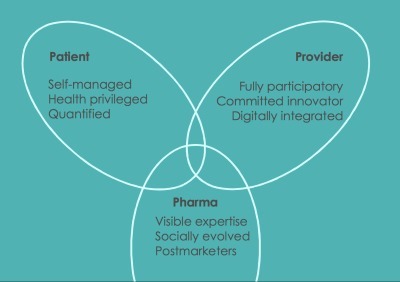
The future patient will be:
* Committed to self management.
The future patient is aware of the fact their personal health future is most likely to be conditioned by preventative strategies rather than treatment after the fact. The future patient is self-aware, and whilst they may not always abstain from actions that have health impacts, or engage in risky behaviours, they do so as a personal microchoice that they account for to themselves rather than expecting their decision to be ameliorated by external agencies. The future patient appreciates that informed choice trumps informed consent. The future patient will become who they are.
* Health privileged.
The future patient appreciates that whilst access to good healthcare should be a right, good health itself is a privilege and should be treated as such. The future health consumer aspires to maintain or attain good health in the same way that the historical retail consumer has aspired to the acquisition of commodities on the basis of their appreciation that health is the most precious possession of all.
* Quantified.
The future patient practices and advocates the collection and redistribution of the data that streams from their body among their healthcare team (and perhaps further, if they see a collective/personal benefit) not just to manage their day to day health or to optimise the management of chronic disease, but to inform the advancement of future health research through the processing of data on a planetary scale.
The future provider will be:
* Fully participatory.
The future provider’s default assumption is that the patient will participate fully in all decisions that are made about their health. The future provider will see it as a duty of care on their part to encourage the patient to self-identify as a shared decision maker, and a co-creator of their own care.
* A committed innovator.
The future provider will facilitate those expectations that the future patient brings to the point of care. They will provide access to health records. They will expect and encourage patients to research their own conditions. They will be looking to deploy proven innovations within the point of care as soon as their benefits have been proven. The future provider talks constantly about the ways in which facial recognition technologies could welcome patients to their practice, how non-invasive sensor technologies will revolutionise health, how artificial intelligence in the consulting room is an adjunct to their practice rather than an insult to their professionalism, how healthcare information should be prescribable, and dream along with their patients of the time when the personalised, genomic EHR is a reality.
* Digitally integrated.
The future provider continually seeks to refine and improve the reach of their professional digital presences to the communities they serve at a local level, and perhaps beyond. They endeavour to find ways of using digital technologies that improve the frequency and quality of professional connections with patients with a view to supporting health behaviours, improving compliance and working cooperatively towards better patient outcomes.
Two out of three future pharma requirements are primarily internal rather than external objectives. Future pharma will be:
* Visible experts.
Future pharma will be the most open, available and discoverable source of gold standard information about their own products and the disease areas they work in. Future pharma works tirelessly to make all data about their medicines available in a balanced, approvable way in online environments and platforms that the communities of interest which they serve are most likely to find and use it. Future pharma’s default expectation is that it has an ethical responsibility to proactively and openly disseminate all information about its products from clinical trials onwards.
* Socially evolved.
Future pharma drives the precepts of social business through its enterprise and uses social technologies and the attitudinal dispositions that underpin them to the fullest. Future pharma fully appreciates that its future financial success is contingent upon rather than threatened by observing policies of openness wherever possible, and has reoriented its business away from the traditional conceptual frameworks within which its activities had formerly been configured.
* Postmarketers.
Future pharma has reconfigured the means whereby it talks about and shares information concerning its products and services to the point that they no longer resemble ‘marketing’ activity as it was formerly understood. Future pharma’s former dominant marketing behaviours and the contexts within which they were practiced have become residual. Future pharma now listens actively to patient and professional needs and responds quickly and openly. Future pharma’s goal state is to anticipate needs, not to directly influence behaviours. Future pharma appreciates that its further success will reside in sublimating everything other than its irrepressible desire to innovate and promote the science it practices.
Future health is already here. Are you at its intersection?
See on stwem.com