Articles

Posted in #HCSM

What drives activity on Pinterest?

See on Scoop.itHealth Care Social Media Monitor

Researchers have released a new study that uses statistical data to help understand the motivations behind Pinterest activity, the roles gender plays among users and the factors that distinguish Pinterest from other popular social networking sites.

Marie Ennis-O’Connor‘s insight:

Interesting research on Pinterest from Georgia Tech and the University of Minnesota. I have written extensively on how healthcare organizations can leverage Pinterest for marketing and the data in this study backs up my own research.

See on www.sciencedaily.com

Posted in Ethics, Marketing

Ethics in Social Media Marketing: Responding to the Boston Tragedy


Augie Ray reminds us: “Before you click “submit” to your next social media post, do not simply ask if it will achieve its goal, fits best practices and suits the brand. Ask yourself if it is honest, transparent and ethical. That is a much higher standard, but higher standards are what consumers want and what brands increasingly wish to deliver, aren’t they?”

See on socialmediatoday.com

Posted in Twitter

Curate healthcare news with Twitter-RSS

This blog, as you have probably noticed, is mainly a content curation site, mixed with some original content. So, I am always interested to find new ways to curate healthcare news.

My latest find – Twitter-RSS.

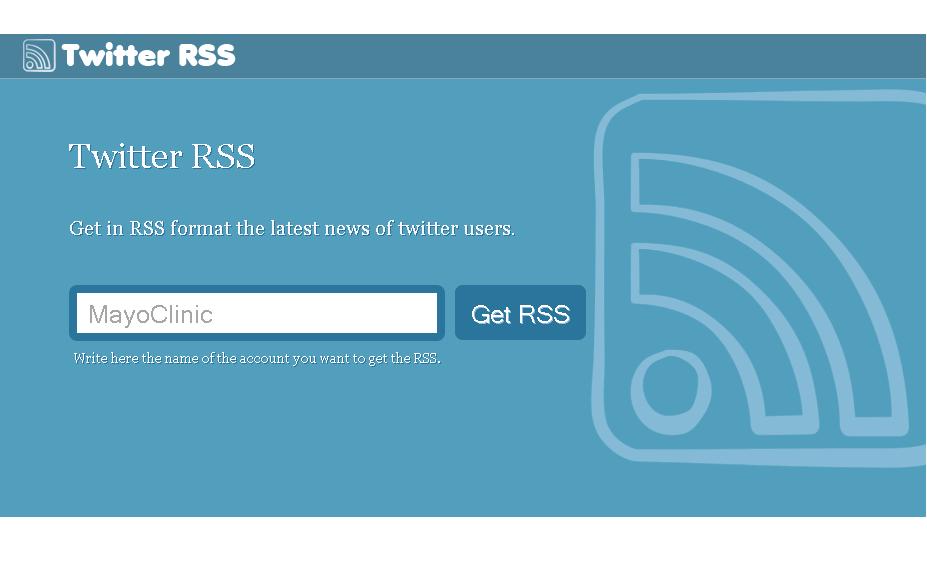
Twitter-RSS  is a free web service which allows you to get the RSS feed for any active Twitter account.

Here is how it works.

RSS


Enter the details of a specific Twitter account you have chosen. This brings up the RSS feed of their latest tweets.

Mayo


Posted in #HCSM

Why blogging is important for your community hospital

See on Scoop.itHealth Care Social Media Monitor

If you’re not blogging, your community is missing out.

Marie Ennis-O’Connor‘s insight:

When you want to maintain control of your online social media content, blogs are the perfect tactic for reaching your target audience. But the community hospital marketer should be forewarned that they take time and commitment.

See on www.healthcarecommunication.com

Posted in #HCSM

Chaos to Hope: A Narrative of Healing – Zheng – 2013 – Pain Medicine – Wiley Online Library

See on Scoop.itHealth Care Social Media Monitor

Marie Ennis-O’Connor‘s insight:

Abstract


Aims


To investigate the progression of the illness and opioid journeys of people who are taking opioids for chronic non-cancer pain.


Methods


In-depth qualitative interviews were conducted with 20 people who were taking opioids for non-cancer pain. A purposive sample was drawn from patients attending two pain clinics in Melbourne, Australia. Transcripts were analyzed within case, as individual narratives, and across case, as a thematic analysis. Conceptual explanatory variables were developed.


Results


The experience of taking opioids for chronic non-cancer pain varies greatly between individuals and these diverse narratives—chaos, restitution, and quest narratives—raise questions about why and how some individuals find a way forward, while others remain in situations of chaotic and worsening ill health. We offer an explanation for this variability in terms of four key influences: support from individual health professionals and the health system; medical explanation or solutions; social support and social responsibilities; and the use of non-pharmaceutical interventions and self-help strategies. A unifying theme was the importance of maintaining hope.


Conclusion


The four key factors influencing the progress of people taking opioids for chronic non-cancer pain are rooted in the provisions made by society for caring for this patient group and involve relationships between patient and provider, between patients and their social world, and between different providers and their professional knowledge. In our patient sample, effective support involved the provision and maintenance of hope, and professionals who are knowledgeable about opioids and chronic pain, good communicators, and cognizant with their patients’ social support and responsibilities.

See on onlinelibrary.wiley.com