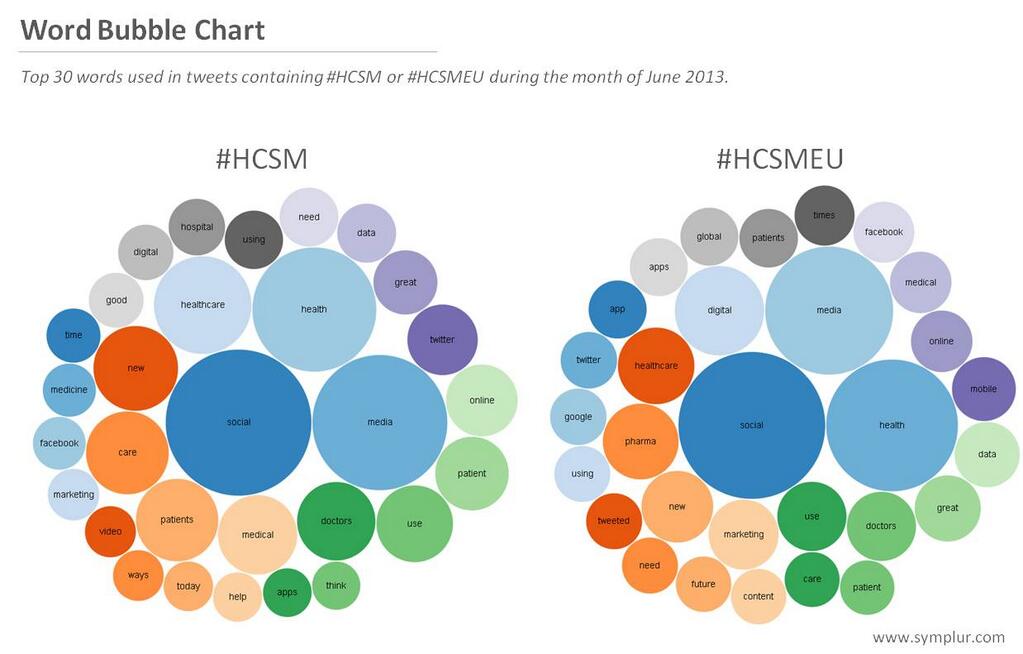
It’s always so interesting to see the similarities and the differences between healthcare social media discussions in Europe and the USA.
Author: Editor
How to Blog for Patients and Families
See on Scoop.it – Health Care Social Media Monitor

Are you a physician group or a healthcare organization that is new to blogging? Here are some tips to help you get started.
Marie Ennis-O’Connor‘s insight:
Patricia Redsicker always has sound advice on her blog. One of my favorite healthcare bloggers.
See on www.wordviewediting.com
Let’s all sing like the birdies sing


Doctors who aren’t on Twitter are missing out. Really.
That conclusion came through loud and clear from recent conversations I had with several physicians in the small Ontario city of Kingston recently. These individuals represented the whole spectrum of the medical profession from student, to primary care community care doc to specialists and academic teachers.
Given that only an estimated 1 in 10 Canadian doctors uses Twitter even now, it was somewhat surprising how adamant these physicians were about the benefits of the tool for medical professionals, as well as patients and the public.
They were very clear that they felt Twitter represented a unique channel for providing new connectivity between doctors, between medical teachers and students, and between physicians and other members of the community.
Many of those I interviewed had come to Twitter via non-medical routes – one initially used Twitter for traffic reports, another to connect with…
View original post 236 more words
Community Management That Works: How to Build and Sustain a Thriving Online Health Community
See on Scoop.it – Health Care Social Media Monitor

Community Management That Works: How to Build and Sustain a Thriving Online Health Community
Marie Ennis-O’Connor‘s insight:
ABSTRACT
Health care professionals, patients, caregivers, family, friends, and other supporters are increasingly joining online health communities to share information and find support. But social Web (Web 2.0) technology alone does not create a successful online community. Building and sustaining a successful community requires an enabler and strategic community management. Community management is more than moderation. The developmental life cycle of a community has four stages: inception, establishment, maturity, and mitosis. Each stage presents distinct characteristics and management needs. This paper describes the community management strategies, resources, and expertise needed to build and maintain a thriving online health community; introduces some of the challenges; and provides a guide for health organizations considering this undertaking. The paper draws on insights from an ongoing study and observation of online communities as well as experience managing and consulting a variety of online health communities. Discussion includes effective community building practices relevant to each stage, such as outreach and relationship building, data collection, content creation, and other proven techniques that ensure the survival and steady growth of an online health community.
See on www.jmir.org
Social media can destroy or boost hospital reputations
See on Scoop.it – Health Care Social Media Monitor
Social media has become so powerful that a healthcare provider’s efforts to fully engage with social networks could harm both patients and the provider’s reputation, contends a new whitepaper from HP Social Media Solutions.
See on www.fiercehealthcare.com
Study: Patients’ Internet use a predictor for participation in their own care
See on Scoop.it – Health Care Social Media Monitor
Patients who use the Internet more frequently are more likely to embrace patient-centered healthcare efforts and participate in their own care, according to a study published this week in the Journal of Medical Internet Research.
See on www.fiercehealthit.com
How Social Media Impacts SEO (Infographic)

Social Media and SEO – An infographic by the team at WhiteFire, an SEO Company
Patient Non-Adherence (Like Engagement) Is A Physician-Patient Communication Challenge – Not A Health Information Technology Challenge
See on Scoop.it – Health Care Social Media Monitor

Marie Ennis-O’Connor‘s insight:
Some great points about the complicated nature of non-adherence in patients – it’s not as straight-forward as "forgetting" to take your pills.
Why Online Patient Communities are Better than Real Life Support Groups

A support group has many potential benefits, some of which include improving coping skills, reducing anxiety, depression, isolation, ignorance about the condition and others. Online patient communities (OPCs) are a recent phenomenon. Some are open (with respect to type of member or fee) and some are more focused and closed. Irrespective of the type, OPCs have blossomed. It is a major indication of social media’s penetration into healthcare (or vice versa) and why physicians need to establish a presence in social media. While there are still reasons why support groups are popular, OPCs have definite advantages. I will highlight a few of them.
1. Many patients and caregivers cannot physically attend a support group. In the early phase of a support group of patients with implantable defibrillators I led for over 20 years, I was informed of scheduling conflicts and transportation difficulties (some patients coming from distances…
View original post 917 more words
Hashtags for Twitter Cancer Communities
Taking hashtags to the next level. Wonderful article.


Librarians have been geeking out, or grossing out, over hashtags since they first appeared. Some of the conversation has been about concerns over ‘allowing’ the public to define their own metadata, while much of it has been the flip side of trying to engage the public in generating metadata for library online collections, and thus enriching access and awareness for those collections.
Naturally, the general public simply move forward with creating new hashtags for their own purposes, largely unaware of the conversations and concerns of professionals in the area of metadata. This is as it should be. The idea of a Folksonomy, a.k.a. folk taxonomy, as originated by Thomas Vanderwal centers around the social aspect — real people, real folk, coming up with language that means something to them to describe content that matters to them with ideas that matter to them. Meaning.
I could go on about this for…
View original post 1,314 more words
 Health Care Social Media