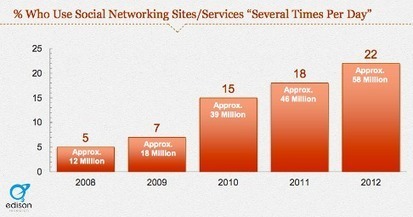
Knowing how consumers use social media can help your healthcare business to understand behavior and create suitable strategies. Take a look at these 9 trends.
See on www.wordviewediting.com
Knowing how consumers use social media can help your healthcare business to understand behavior and create suitable strategies. Take a look at these 9 trends.
See on www.wordviewediting.com
Under what circumstances will clinicians want to prescribe apps, and what would make it easier for them to do so?
Apps, like pharmaceuticals, can in principle help patients and families meet their healthcare goals. Many would like clinicians to embrace apps and begin recommending them to their patients. It would be easy for clinicians to end up making the same mistakes with apps as we’ve often made with the prescription of medications: recommendations based on marketing rather than more considered assessments of expected value, and prescription of apps for every little medical condition rather than choosing a few high-yield apps based on a whole-person approach to managing healthcare. To ensure more thoughtful recommending of apps, especially for medically complex patients, we could consider strategies that can be helpful in managing multiple medications. These include reviewing the use of a proposed app within the context of the patient’s overall health issues and goals of care, being explicit about the purpose of the app and expected benefit, and periodically reviewing and adjusting app use. The recommendation of apps for every single medical diagnosis affecting an older person could easily lead to app overload, and should be avoided.
See on thehealthcareblog.com
Telemedicine sounds like a good idea, but state laws limit it, and insurers usually won’t pay for that. Parkinson’s specialist Ray Dorsey is determined to prove that it can work, one patient at a time.
See on www.npr.org
Many years ago, I launched the first blog carnival about social media and medicine, but after 39 editions I switched to more dynamic methods for curating information online. Although it’s always a pleasure to see other active carnivals such as the Health Care Social Media Review. Moreover, this is my honor now to host the 24th edition focusing on the undervalued fact that social media actually loves healthcare.
Google Glass, iWatch and IBM Watson Revolutionizing The Practice of Medicine
In my submission, I described the ways how disruptive technologies can help medical professionals and patients.
Patient Engagement Explored at the ePharma Summit
Casey Quinlan had the fortune of being asked to participate on a panel titled Social Media for Pharma: A Match Made in Heaven or Hell? at the ePharma Summit in New York.
In Tweets We Trust: Determining The Credibility Of Health Related Tweets
A 2012 paper by…
View original post 447 more words

Shock and dismay greeted the latest decision by Google to kill off its Reader, and while a “Save Our Reader!”petition is gathering pace today, I am inclined to agree with Forbes contributor Alex Kantrowitz that “Google evidently weighed the decision beforehand, it is unlikely that any protest, no matter how long it trends on Twitter, will get Google to change its mind. Google Reader, for all intents and purposes, is dead.”
So what are the alternatives to Google Reader? There are several already available, and the one I am currently using is Feedly.
Feedly is an RSS feed reader application which allows you to organize your favorite blogs, news sites and Youtube channels and access them all in one place (or sync with Google Reader, Twitter and Facebook). It works with Chrome, Firefox, and mobile devices and syncs with Google Reader to manage your RSS feeds. Feedly have a step by step guide to help migrate from Google Reader here.
Feedly recently announced a new collaboration with Buffer (a tool which schedules your social media updates for maximum exposure) allowing users to share their favorite articles from Feedly using their personalized Buffer schedule (click here for some good tips on how to maximise these two tools for effective content sharing).
You can also add Feedly to your phone, tablet and computer and keep up to date with your reading while on the go. The magazine style layout lets you easily browse through previews and see pictures to decide quickly what’s worthy of your attention.
In my latest blog post on using Twitter as a healthcare tool, two of the findings which emerged in determining the credibility of tweets were that:
Clearly, establishing your online identity is a key factor in establishing your credibility. So, I will be very interested to see the results of an online survey on healthcare social media identity which will be presented in Paris in June at Doctors 2.0 & You.
If you would like to take part in this survey please click here to participate.

A special report by Inspire, developed in cooperation with the Stanford University School of Medicine
See on www.inspire.com
At this years Innovation Expo (13/14 March) the NHS Commissioning Board will be launching the Health Apps Library. The Health Apps Library acts as a NHS approved app store for iOS, Android, Blackberry and web apps allowing users to find apps to help with their conditions, live healthier and provide information on health and social care. Every app in the Health App Library has been through a formal review process that ensures that the information is correct and clinically safe.
There are over 13,000 health apps available to smartphones at the moment. The quality of the apps and the information contained within them vary wildly as developers with different motives and ability look to use the smartphone’s app paradigm to improve the user’s health or to make some easy money. The app markets also cater for international markets; developers can choose which countries they’d like to sell their app in (and can produce localised versions if they wish) but there is no quality check to ensure that the apps are localised meaning that some of the apps in the UK app stores are actually American.
When a developer submits their app to the app store it is checked over to ensure it runs and meets a number of app store criteria. Of the app stores Blackberry and Apple are the most demanding but they only check to ensure that the app works to a certain standard, won’t comprise the device and are provide enough functionality to be considered an app. The Google Play Market are less demanding and in general apps submitted to it will be live within a few hours compared to the week or longer wait of Apple’s app store.
By offering users a single point of contact for UK clinically reviewed apps the user doesn’t run the risk of downloading an app that isn’t going to meet the standards of NHS patient information. This helps to create some equilibrium in the otherwise turbulent app market environment where apps are judged by the number of times downloaded and not the overall quality of the app and the information it contains. For clinicians the Health Apps Library will serve as a clear index of apps suitable for patients to use on their devices and will allow them to suggest apps knowing that the app has met the high standards expected of NHS backed products. This will help with the information prescriptions initiative and ultimately increase the amount of clinically validated information available to a patient.
See on nhssm.org.uk
Related Reading:
What can we, as consumers and caregivers, do to reduce medication errors?
Excellent discussion of health literacy based on recent #hchlitss twitter chat.
See on kdhhealthcomm.wordpress.com
See on Scoop.it – Health Care Social Media Monitor
Whether you need a concept, or don’t know where to start, this article will help you develop content that will educate, engaged and impact your patients.
Good content has value to everyone who encounters your brand, from casual health information seekers to long-term loyal patients – Nicola Ziady
See on nicolaziady.com