See on Scoop.it – Health Care Social Media Monitor
See on socialmediatoday.com
See on Scoop.it – Health Care Social Media Monitor
See on socialmediatoday.com
Social media is transforming how doctors and patients interact. How should doctors use social media? What tools can they use to do the job?
In this short video segment, Albert Einstein College of Medicine‘s Social Media Manager, David Flores speaks with Kent Bottles, M.D., a noted speaker on the subject of social media and medicine and senior fellow at the Jefferson School of Population Health at Thomas Jefferson University.
See on Scoop.it – Health Care Social Media Monitor
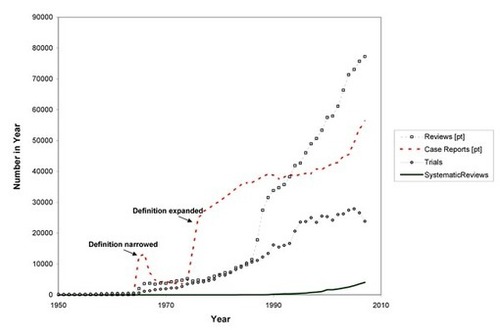
“27,000 published clinical trials per year. Can anyone possibly keep up with it, by relying only on what’s in their memory?”
See on e-patients.net

 WOWEE…check out the Dear Mental Health Professional Hashtag on twitter today. Here is a taste. These are not isolated experiences, now, are they? There are hundreds of more tweets just like these!
See also my writing on the chasm between professionals and “patients” I’ve sat on both sides of the proverbial couch and have seen some pretty uncomfortable stuff. I do my best to expose it. I want to thank all the tweeters doing the same today.
There are grateful tweets mixed in the sad and painful and angry ones too. What is horrifying is the sheer volume of re-traumatizing experiences people share.
#DearMentalHealthProfessionals I’m a complex unique individual, not a text book hypothesis. Please treat me with dignity & respect
— Girl Interrupted (@Girl_Interrupt_) August 10, 2013
#DearMentalHealthProfessionals Please remember my normal is not the same as yours! — Simply Positive (@PositiveSimply) August 10, 2013
#DearMentalHealthProfessionals Medication isn’t a…
View original post 295 more words
See on Scoop.it – Health Care Social Media Monitor
“A device the size of an espresso machine quietly whirs to life. The contraption isn’t filled with fresh, pungent grounds but, instead, spoonfuls of opaque, sterile goo. Its robotic arm moves briskly: It hovers, lowers, and then repositions a pair of syringes over six petri dishes. In short, rapid-fire bursts, they extrude the milky paste. Soon, three little hexagons form in each dish. After a few minutes, the hexagons grow to honeycomb structures the size of fingernails. No one here is getting a latte anytime soon.
The honeycombs are human livers, says Sharon Presnell, chief technology officer of Organovo—or at least the foundations of them. The tiny masterpieces of biomedical engineering are nearly identical to tissue samples from real human livers, and they are constructed from actual human cells. But instead of growing them, scientists in the gleaming, 15,000-square-foot headquarters of Organovo print them, just as they would a document. Or, more accurately, just as they’d print a scale model.
In two decades, 3-D printing has grown from a niche manufacturing process to a $2.7-billion industry, responsible for the fabrication of all sorts of things: toys, wristwatches, airplane parts, food. Now scientists are working to apply similar 3-D–printing technology to the field of medicine, accelerating an equally dramatic change. But it’s much different, and much easier, to print with plastic, metal, or chocolate than to print with living cells.”
See on www.popsci.com
See on Scoop.it – Health Care Social Media Monitor
Interventions aimed at behavior change are increasingly being delivered over the Internet. Although research on intervention effectiveness has been widely conducted, their true public health impact as indicated by reach, effectiveness, and use is unclear.
This study concluded that more research is needed on effective elements instead of effective interventions, with special attention to long-term effectiveness. The reach and use of interventions need more scientific input to increase the public health impact of Internet-delivered interventions.
See on www.jmir.org
See on Scoop.it – Health Care Social Media Monitor
When Tammie Van Sant, paralyzed from the chest down following a car accident, heard about Google Glass, she applied to be an Explorer, using a dictation program to explain how the device would improve her life.
Google is paying close attention to how people like Van Sant and Blaszczuk are using Glass. At Georgia Tech, the company is working on two projects aimed at finding Glass applications for those with muscular dystrophy and Parkinson’s disease. A collaborative effort between researchers at Carnergie Mellon University and the University of Rochester focuses on using Glass to help the blind. So while Glass may still be widely viewed as a status symbol, the future of the device may have a much deeper humanitarian impact than we envisioned by clearing a path for the disabled.
See on mashable.com
See on Scoop.it – Health Care Social Media Monitor
Another startup wants to save patients from a deluge of potentially irrelevant health information online with a service that customizes a regular feed of reliable research.
See on gigaom.com
Slidedeck by Joel Selzer, co-founder of ArcheMedX from his talk at the Society of Clinical Research Associates conference on “Harnessing Social Media to Advance Clinical Research”, August 2, 2013 in Philadelphia.
Key Takeaways
Researchers can harness social media to:
See on Scoop.it – Health Care Social Media Monitor
The threat of a global pandemic posed by outbreaks of influenza H5N1 (1997) and Severe Acute Respiratory Syndrome (SARS, 2002), both diseases of zoonotic origin, provoked interest in improving early warning systems and reinforced the need for combining data from different sources. It led to the use of search query data from search engines such as Google and Yahoo! as an indicator of when and where influenza was occurring. This methodology has subsequently been extended to other diseases and has led to experimentation with new types of social media for disease surveillance.
The objective of this scoping review was to formally assess the current state of knowledge regarding the use of search queries and social media for disease surveillance in order to inform future work on early detection and more effective mitigation of the effects of foodborne illness.




 Health Care Social Media