Did you know that on average, 8 out of 10 people will read headline copy, but only 2 out of 10 will read the rest? Your headline is the first impression you make on a prospective reader. An eye-catching headline is a key factor in getting readers to click through to your article.
An attention-getting headline will capture the reader’s attention right away and compel them to want to find out more. Clear, concise, and original content is important, but words that appeal to their emotions is the magic ingredient to giving your visitors a reason to want to diver deeper. Business2Community
Trigger words can entice readers to your content, but use these words with caution because they can also trigger skepticism and distrust. Make sure your content carries through on the promise in the headline and always avoid click-baiting. Clickbait headlines typically aim to exploit the “curiosity gap”, providing just enough information to make the reader curious, but not enough to satisfy their curiosity without clicking through to the linked content. Always craft a headline that links to authentic and relevant content.
For a deep dive into which words and phrases drive the most shares and engagement, Buzzsumo analyzed 100 million article headlines and reported their findings here.
I’ve just returned from Dubai where I was part of the teaching faculty for the Mayo Clinic’s first Middle East Healthcare Social Media Summit. It was an amazing experience and wonderful to see how many people there are already embracing social media in healthcare.
Before the two-day conference commenced, I taught on the social media residency clinic sharing advanced Facebook and Instagram tips. You’ll find links to the slide decks below.
As always, any questions, feel free to contact me via the comments below.
Social media offers innovative ways to enhance health communication, collegiality, and clinical care, but the tenets of professionalism should always guide online interactions.
Professional standards do not change in social media; rather social media proposes new circumstances to which the established ethical and professional principles can still apply. Upholding public trust in the healthcare profession is fundamental to successfully incorporating social media in clinical care.
I’m excited to be on the Mayo Clinic teaching faculty for the first Middle East Healthcare Social Media Summitin Dubai next week. I’ll be teaching on the Social Media Residency Clinic which takes place a day before the conference and also delivering a talk on the role of hashtags in healthcare on day two of the conference.
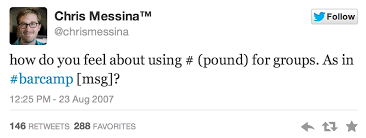
Did you know that the very first Twitter hashtag was prompted by a conference?
So it should come as no surprise that hashtags are super useful for disseminating knowledge presented at conferences. As part of my talk, I will highlight some best practice tips for tweeting the meeting – which I will also share for you here.
1. Tag Your Tweets with the Event Hashtag
Pretty self-explanatory but be sure to use the designated event hashtag which should be displayed by the organizers. If you are organizing the event, keep an eye on unofficial hashtags. Sometimes, people tweet using hashtags that make sense to them instead of using the official hashtag. This shouldn’t be an issue if you have chosen a simple, intuitive hashtag and promoted it in advance, but it is still a good idea to an eye out for rogue hashtags and direct the users to the official one.
Let your Twitter followers know the meaning of the hashtag and why you are tweeting from the conference so that people have some context to what you’re tweeting about. It is good practice to let your followers know in advance that you are live-tweeting so they can mute the hashtag if they aren’t interested in those tweets.
2. Focus on Value
The true aim of live-tweeting is to provide value to others, so avoid tweeting sound-bites that won’t make sense to online listeners. Be selective about the quotes or insights you choose to tweet and only post high-quality photos and videos that your followers will find interesting. No one wants to see a blurry photo of a speaker or a slide.
Strive for originality and context and make it relatable to your Twitter followers. Tweet links to websites, studies, or other information which will enhance understanding of the topic. It’s fine to highlight your own expertise, but don’t spam. Retweet attendees and speakers who represent your mission and core values. Search for questions being asked using the event hashtag which you can answer.
3. Don’t “Binge Tweet”
Be selective, share key points only and avoid flooding your timeline with tweets. Don’t mindlessly re-tweet what everyone else is already tweeting, unless you can add a unique perspective. When live-Tweeting, one Tweet every five minutes is a good rule of thumb.
4. Give Correct Attribution
Be sure to attribute quotes to the speaker who made them, by using quotation marks. Whenever you cite a speaker, add their Twitter handle and affiliation if known (this is where those pre-prepared Twitter lists come in useful). Separate your own comments/viewpoints from the speaker’s own words.
5. Encourage Engagement
Don’t tweet in a vacuum; engage with fellow live tweeters and contribute to a larger conversation. Involve online listeners by asking questions; e.g. “Speaker X says doctors need to be more empathetic – do you agree/what do you think about this?”
6. Be Social
Finally, don’t restrict yourself to tweeting behind a screen; take the opportunity to network and meet new people face-to-face too. Live-tweeting is a great way to meet like-minded people, so use it to organize “tweetups” at coffee and lunch breaks during the event to further the connection.
Bonus Tip
After the event has finished, you can still add value by using a tool like Twitter Moments to archive tweets. You could also summarise the event in a follow-up blog, embedding selected tweets to illustrate your points.
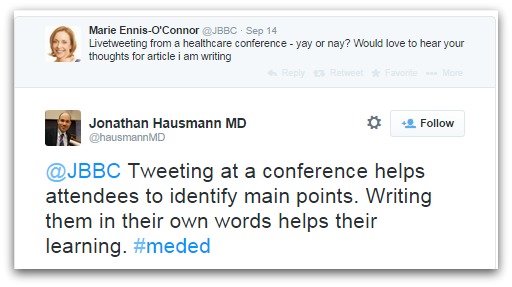
Live-tweeters use the hashtag relevant to the event they are tweeting about (which can usually be located on the conference’s website or Twitter profile). Twitter followers who cannot be at the event in person can follow along using the hashtag and this in turn expands the reach of the conference.
Live-tweeting enhances personal learning
Live-tweeting can also enhance your own personal learning as it requires you to listen more carefully and focus more sharply on the key details of a talk in order to better summarize what the speakers are saying. Furthermore, live-tweeting is a means of amplifying the conference experience, generating global reach and stimulating collaborative potential.
This learning is further consolidated with an archive of tweets on which you can reflect further after the event. Sarah Chapman, whose work at the UK Cochrane Centre focuses on disseminating Cochrane evidence through social media, observes how this in-the-moment tweeting captures the immediacy and energy of the event: “Live tweeting can convey the atmosphere generated by a controversial or entertaining presentation in a way that will be lost by the time you get to look at the slides uploaded on the internet”.
Many times the original tweet will be supplemented by pertinent comments on Twitter from other conference attendees and also from those listening in online. For example, someone may respond to a tweet by questioning the strength of the clinical outcomes of a study, or a practicing physician might respond with their experiences treating patients. As a review published in J. Clin. Med. states: “The diversity of expertise and backgrounds that can communicate on Twitter is unique, and this exchange of information can be extremely beneficial.”
Live-tweeting enhances virtual learning
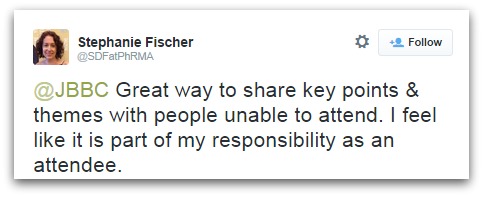
Reporting live from a medical conference or event allows you to provide valuable insights to those who are unable to attend in person. Due to rising costs, concern about our carbon footprint and increasing time commitments, virtual attendance is becoming more commonplace at healthcare events – hence the rise in live-tweeting.
There are enumerate conferences and symposia to choose from these days, and that choice often becomes impossible due to the sheer diversity. Following attendees using meeting, hashtags permits in real-time remote access to the meeting, viewed through their interest / opinion spectrum. Wong, Wilkinson & Malbrain, Using social media in medicine to your advantage, with care!
Mark Brown, a UK-based mental health advocate, points out that “There have been many recent publications and events imploring us to have a national conversation about mental health. Why then do so many fascinating discussions happen at conferences, uncaptured and inaccessible to people wanting to join them?”
Brown believes “this democratisation of access is vital if we want to broaden our mental health discussions and raise the level of sophistication in our arguments and debates. For this to happen we need some brave souls who know how to cover an event via live tweeting and who are prepared to do so out of a sense of public service.”
This is the first in a two-part guide to live-tweeting. In part 2, I will share my tips for best practice in live-tweeting. Whether you are a conference organizer, a speaker, or an attendee these tips will help you make the most of the opportunity to report live from your next event.
Worldwide, there are over 2.45 billion monthly active Facebook users and 1.47 billion people on average log onto Facebook daily. Statistically speaking, Facebook is too big to ignore but when it comes to social media marketing, is it actually delivering the results you’d hope to see?
Over 80 million businesses have a presence on the social network which makes it a crowded and competitive landscape. And at a time when organic Facebook Reach is estimated to currently be as low as 1–3%, succeeding on the platform is more difficult than ever.
If you’re struggling to make an impact on Facebook, then this article is for you. In it, I will share some best practice tips to help you increase your organic reach and boost engagement.
So let’s get started with Tip #1
1. Grab attention with a compelling visual
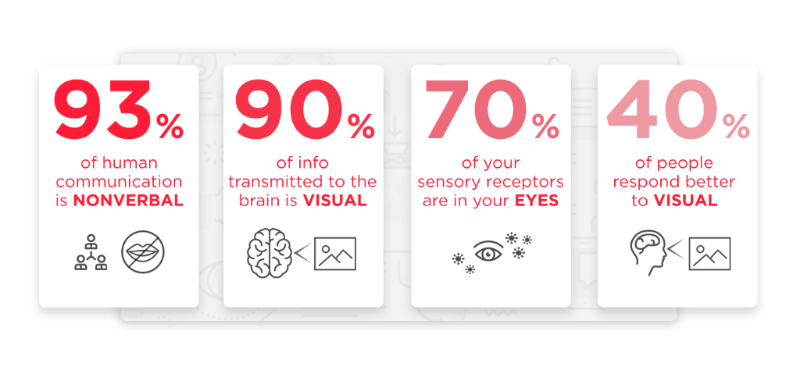
Study after study confirms that how you create and share content matters — with visual content leading the way.
According to research by Kissmetrics, photos get 53% more likes, 104% more comments and 84% more click-throughs on links than text-based posts. Facebook recommends each post you create should include some type of creative, like images, GIFs or videos.
Make sure these creative assets are of high quality. Avoid using blurry images or videos or creative that doesn’t accurately reflect your brand or message. If you post any pictures of your patients, be sure to obtain their permission.
Pro Tip: You can easily create your own images with drag-and-drop tools, like Canva and Ribbet. They will also automatically create the right sizes for your Facebook page, so you don’t need to worry about it.
2. Keep things simple
Facebook advises that “simple posts with clean creative are best at capturing an audience’s attention” and recommends the following tips:
· Keep your color scheme clean and consistent
· Include images that are recognizable
· Use minimal, concise and impactful text
3.Share a behind-the-scenes photo of your office
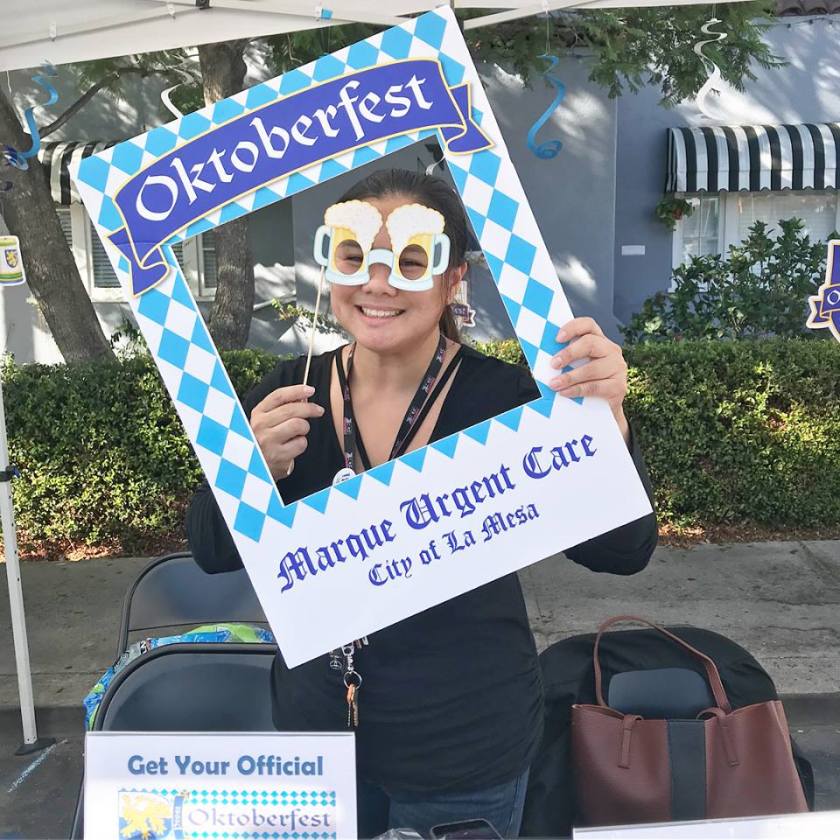
People love to see behind the scenes of your practice – so bring your camera to your next staff meeting, lunch or event. Sharing pictures of your employees (with their permission, of course) makes your practice so much more relatable.
4. Post about cause awareness events
Whether it’s Breast Cancer Awareness Month, Alzheimer’s Disease Awareness Month or Healthy Weight Week, there is a cause awareness month you can write about at least once a month.
5. Create holiday-themed posts
Christmas, Hanukah, Thanksgiving — they all provide an opportunity to share holiday themed advice or send best wishes to your followers. You could also join in fun holidays like National Donut Day. Check out this calendar to keep you right up to date with ideas.
6. Post news and updates from your practice
Are you rolling out a new program, product or service? Have you acquired a new piece of equipment that affords better care? Let your followers know about it. Patients will appreciate you keeping them informed.
7. Share videos
Video has become the predominant way we consume information.The average video post generates 135% greater organic reach when compared to photo posts according to research from Social Bakers.
Here are some tips to use video more effectively on Facebook
Keep it short. Facebook’s own advice is to keep your videos short: “This is a best practice in digital to capture attention. Remember that 6 and 15 seconds are the new digital standards for video.”
8. Go Live
Facebook Live videos get three times the engagement of traditional videos shared on the platform and it draws 10 times as many comments as regular video. Facebook actively prioritizes live video by placing it at the top of the News Feed, as well as sending notifications to potentially interested audience members. Additionally, Facebook Live videos are archived on Facebook and can be viewed and shared after the live broadcast.
Facebook Stories — user-generated slideshows and video collections — are short (around 20-seconds) pieces of content created on your smartphone and available for up to 24 hours. After this time your story automatically deletes itself, althoughthere is an option to save your content.
10. Post When Your Followers Are Online
To optimize your engagement and reach, you want to share content when your audience is online. If you search for optimal posting times, you will find many guides online. You can follow these recommendations as a starting point, but it’s best to do your own testing to see which days and times work best for your own audience.
Facebook makes it easy to find out your optimal posting times by navigating to the Insights Tab and selecting Posts. Here you will get data about when your Facebook Page fans are online for each day of the week. Once you’ve determined your optimal posting times, make use of Facebook’s post scheduling feature to post at just the right time.
To Wrap Up
While I have focussed on increasing organic reach on Facebook, the reality is that Facebook is a pay-to-play environment now. You will need to include paid strategies for a successful Facebook marketing plan. Use organic content to analyze and test to see what works best with your audience. You can then use these insights for paid ads. Your top-performing posts are proven content. With the right ad targeting, these posts can continue to reach and engage more people.
I love learning about new tools to make social media marketing more creative and effective, so I’ve decided to share some of my favourite tools with you at the start of each week. This week I’m recommending Giphy – a source of free animated gifs.
Why use Gifs?
Hootsuite recommends the use of Gifs “to spice up, excite and wake up your social audience.”
A little motion makes your content marketing more memorable. Though use sparingly, otherwise it distracts rather than enhances.
This Friday is #CappuccinoDay so why not celebrate with a Gif like the one below?
I love learning about new tools to make social media marketing more creative and effective, so I’ve decided to share some of my favourite tools with you at the start of each week.
This week’s cool tool recommendation isTweriod – a Twitter tool that helps you identify the best times to post on Twitter for your audience of followers.
Use the tool to pinpoint the days and times of the week when your followers are online to maximize the reach of your tweets. Here’s a snapshot of my account showing me that engagement is highest on weekdays between 4 pm and 5 pm; 6 pm and 7 pm and 10 pm and 11 pm.
Try it for yourself and adjust your tweeting schedule to reflect the results. Use a tool like Hootsuiteor Buffer to schedule your tweets according to the optimum times for your audience on Twitter.
How and in what ways does patients’ Internet health information-seeking behaviour influence the patient-physician relationship?
The rapid proliferation of health information on the Internet has resulted in more patients turning to the Internet as their first source of health information and acquiring knowledge on their health conditions before seeking a professional diagnosis.
This is changing the ways that patients interact with healthcare providers. Gone are the days when individuals passively received health information and interventions, assuming that a doctor held all the answers. Nowadays, it’s increasingly common for patients to find resources and/or seek out additional information online.
With online health information becoming increasingly popular among patients, this may change the way in which patients interact with and participate in consultations with their physicians and how they feel about their relationship with their physicians.
When researchers Sharon Swee-Lin Tan and Nadee Goonawarden systematically reviewed existing research on patients’ Internet health information seeking and its influence on the patient-physician relationship, they found that it can improve the patient-physician relationship depending on whether the patient discusses the information with the physician and on their prior relationship.
The impact of patients seeking online-heath information on the clinical encounter
In their review, Swee-Lin Tan and Goonawarden point to two over-arching concerns.
(1) Misinformation on the web
With the quality of medical information on the web ranging from peer-reviewed to personal blogs and anecdotes of other patients, patients may not possess the necessary skills to evaluate medical information and relate it to their own health circumstances. Therefore encouraging patients to discuss their Internet information searches is increasingly important, given that acquiring information on the Internet has the potential to misguide patients with inaccurate information.
(2) Satisfaction and trust in physician
When patients’ online findings do not align with physicians’ diagnosis or treatments, concerns have been raised as to how a patient’s appointment satisfaction and trust in the physician would be affected, and how conflicts could occur between the physician and patient – physicians could feel threatened by the information and respond defensively by asserting their “expert opinion.” This may then result in dissatisfied patients who may seek a second opinion, change the physician, change their treatment plan, or self-medicate using recommendations found on the Internet.
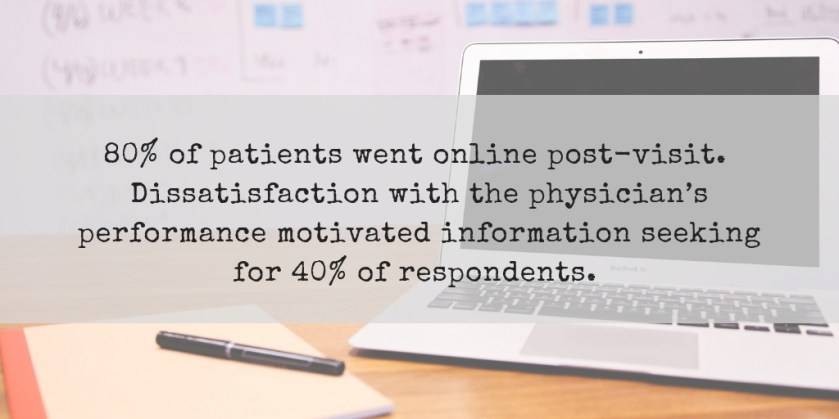
A study published in the Journal of Family Practice reported that eighty percent of patients went online post-visit. Dissatisfaction with the physician’s performance motivated information seeking for 40% of respondents.
Facilitators of discussion of online findings during consultations
The review highlighted 3 facilitating factors that encouraged patients to discuss online health information with their physicians:
(1) Having a family member present at doctor visits
Having a family member present would help patients remember what to ask and made the context more comfortable to share online findings.
(2) Doctor-initiated inquiries
Some patients reported incidences of doctors’ positively encouraging patients to search the Internet for information.
(3) Encountering a treatment-related advertisement that suggested talking with a doctor.
Online advertisements or recommendations about certain medications and treatment prompted some patients to initiate a conversation with their physicians.
Barriers to discussion
(1) Concerns over how physicians would react
The most common barrier to patients’ willingness to discuss their online findings was that patients were skeptical of how physicians would react: “patients were afraid doctors would perceive them as “challenging” and “confrontational” if they discussed their health condition from a more informed point of view during consultations.”
(2) Physician resistance to discussion of Internet information
The second most common barrier for patients was “the resistance or discouragement from physicians encountered when patients tried to discuss their Internet information research during consultations.”
Conflicts arising from physicians and patients having different interpretations of the online information (when patients valued this information more) had adverse implications for the patient-physician relationship, resulting in higher levels of patient anxiety, confusion, and frustration.
Patients also felt that some physicians reacted in a way that “implicitly or explicitly discredited the patients’ ability to become informed via the Internet, presenting serious barriers to shared decision making during consultations, with the physicians asserting their authority by dismissing patient-acquired knowledge.” As a result, “patients carefully observed their physicians before deciding whether to reveal their Internet research, and patients would only bring up their Internet health searches if they felt the situation was right.”
(3) Fear of embarrassment
A third major barrier was the fear of embarrassment. Patients who identified this to be a barrier felt “they did not possess the required skill set to evaluate online medical information. They had a lower level of confidence in the trustworthiness and the credibility of online information. They manifested a sense of being unsure of how to explain the information they found and how to relate it to their own condition, and hence did not want to mention it to their physicians.”
Other than these three main barriers, some patients did not discuss their findings during consultations because “they did not think the information was important enough and they searched the Internet just to be informed.” Other reasons cited were “a reluctance to interfere with physicians’ diagnostic process and lack of time during doctor visits.”
Implications for the patient-physician relationship
In the studies reviewed by the authors, most patients felt that “Internet health information seeking prior to consultations had improved their communication with doctors and the effectiveness of their consultations.”
Patients felt more in control and confident during the consultation as a result of bringing information to their physicians. Patients also felt more confident in their physicians’ diagnosis once they had discussed their online findings.
Patients used the information to help them prepare for their visit, ask better questions, and understand what the physicians told them (they believed the patient-physician communication had improved because they could understand their doctors and the jargon they used better).
By discussing information they had accessed on the Internet or setting questions in advance, “patients were able to better understand and participate in consultation sessions with their doctors.” Thus patients “felt better equipped to communicate with their physicians during the consultations” resulting in “greater clarity, orientation, and certainty.”
A majority of patients had felt more comfortable with information from health care providers because of their Internet searches and felt more confident with the doctor’s advice. Interestingly, patients who shared online information felt that they received more attention from their physician, compared with non-sharers.
The patients’ sense of empowerment was dependent on how receptive providers and specialists were to the patients’ desire to take part in the decision-making process. The review showed that “the effect of online information on the patient-physician relationship depended on several factors.”
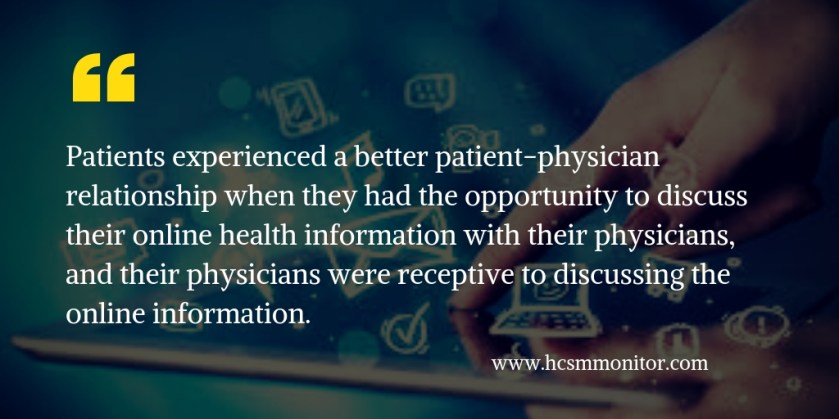
(1) The positive influence of online information was stronger when patients had an opportunity to discuss their online findings.
Patients who perceived their information search to have improved their relationship with physicians saw the Internet as an additional resource that supported doctors’ advice and enhanced the relationship with doctors. On the other hand, when patients valued the information they found on the Internet above their physicians’, this information led patients to ignore physicians’ expertise.
Not disclosing their Internet information searches could erode patients’ trust in their physicians if the diagnosis or the recommendations are different from their Internet research findings.
(2) Physicians’ reaction to patients when they shared their online findings could determine the positive or negative effect on the relationship’s quality.
When patients perceived physicians to be threatened by their bringing online information, 49% of the patients were seriously dissatisfied with the consultation and 4% believed their relationship was worsened. Conversely, patients felt that the relationship was strengthened “when physicians displayed adequate communication skills in discussing patients’ queries.”
(3) The quality of the existing relationship with physicians
Patients judged their physicians’ reactions as “mostly positive when they had a good prior relationship, even when the doctors’ replies were evasive or openly critical of the patients’ Internet search.”
Conclusion
It’s important to note that patients don’t see their information searches as a substitute for clinical advice. Patients typically see the Internet as an additional resource that can help them to better understand doctors’ recommendations and advice. They still value traditional doctor-patient consultations as important to their understanding of online health information, and their trust in physicians remained very high. Under this model of care, the physician acts as a teacher or a friend by engaging patients in a dialogue through the decision-making process.
When physicians embrace openness to online information and encourage patients to discuss the online information they have, patients’ perception of physician resistance and fear of embarrassment could be reduced and patients are more likely to discuss online information with their physicians.
In contrast to the belief that patients’ Internet research can erode the patient-physician relationship, our findings show that patients’ Internet health information seeking has the potential to improve the relationship.
The authors conclude that as patients have better access to health information through the Internet and expect to be more engaged in health decision making, traditional models of the patient-physician relationship need to be adapted to patients’ changing needs by incorporating their perspective into a relationship-centered medical paradigm.
Tan SSL, Goonawardene N. Internet Health Information Seeking and the Patient-Physician Relationship: A Systematic Review. J Med Internet Res 2017;19(1):e9













 Health Care Social Media