Articles

Posted in Health Literacy

What Causes Health Information Disparity?

Google-Search1A growing number of people are seeking health information on the Internet. To meet demands, healthcare providers are increasingly disseminating information online. While online health information has enhanced the dissemination of health information and improved people’s health-related knowledge, critics posit that such dissemination has widened knowledge disparities in health information and health benefits as a result.

Are we in effect creating another level in our two tier health system – the digitally savvy, information rich haves and the have-nots? What factors increase this disparity? A study by the School of Library and Information Studies at the University of Oklahoma set out to answer this question. The result published Dec 27, 2013, show that education lies at the heart of the disparity and impacted other elements such as health literacy and computer self-efficacy.  What is most interesting is the finding that although an individual may possess high levels of computer self-efficacy, this does not correlate with health benefits. What this means is that access to a computer and knowing how to use it, does not impact on health information disparity; but knowing how to search for health information and what to do with that information does.

Ref: Yong-Mi Kim, J. Info. Know. Mgmt., 12, 1350032 (2013) [10 pages] DOI: 10.1142/S0219649213500329

Posted in #HCSM

My so-called digital life – what value does it have?

value

Catching up on some online reading, I came across this post by Brian Solis, which really captures the other side of social media – its addictive nature and encroaching presence in our everyday lives. As Solis observes, “My connectedness is slowly seizing my quiet moments. My sanctuary of enjoying my thoughts alone is now threatened.”

The moments of watching life pass by as I take pause are now replaced by the need to plug in and socialize without truly socializing. I swipe, pinch and zoom, and scroll as if I’ve become a digital conductor of sorts.The light of my mobile screen is the calming I need to fall asleep each night and the stimulus that starts each day. I’m not alone in this statusphere.

Sound familiar?

Taken to extremes our online interaction can reach recognizable levels of addiction. Solis says he is not addicted, but questions how much value he gets from his digital life and how we can perceive value based on a system he terms the 5 Vs.

With each update, we look for something in return and each represent a shifting balance between…

1) Vision (I learn something, I’m inspired);
2) Validation (I’m accepted or justified);
3) Vindication (I’m right, cleared);
4) Vulnerability (I’m open); and
5) Vanity (I’m popular, I’m important…not egotism, but accidental narcissism.)

These 5 V’s coalesce differently with each update and produce distinct emotional results based on the measure we apply to our own actions, reactions and inactions.

So is it time we started to rethink the value we get from our digital lives? To  re-train ourselves in how we use and appreciate social media to prevent ourselves becoming what Solis calls “an accidental narcissist”?  His answer to this question is something which should give us pause for thought as we enter a new year of blogging, tweeting, pinning and linking in:

The value we take away from this digital lifestyle must only be surpassed by what we invest in it. That’s for each of us to define. And define it we must.

Posted in #HCSM

Because One List Just Wasn’t Enough….

Inevitably I got a mixed reaction to posting my recommendations of healthcare social media accounts to follow on Twitter. It’s been an interesting exercise in probing the wisdom of the crowd. I am happy that it has opened a discussion on what constitutes value and meaning in the Twittersphere and I hope it is a discussion that will continue in the new year. I am heartened by the words of Dr Howard Luks, one of the healthcare influencers I most admire, who in a recent post on his blog agrees that “the discussion surrounding key opinion leaders, thought leaders and ‘influencers’ in medicine and healthcare deserves further attention”.

The most vehement reactions came from those who stated that these lists are meaningless – but who defines meaning?  Isn’t it as individual as we are?  As Dr Luks so rightly states in his blog,  “YOU decide who the key opinion leaders are and if our message resonates – and thus offers value.” One person’s meaningless Twitter account is another’s Klout score (this was suggested to me as a more meaningful way to create this kind of list). Again for some this may be how you decide who is worth following on Twitter, but Klout scores are also an imperfect measure of influence. If I chose only to focus on Klout scores, then I would be missing out on some great Twitter accounts. In fact one of the most surprising things I found when creating this list was the low number of followers on some accounts . Some of the accounts I most respect for what they are doing to change the conversation in healthcare have a surprisingly low number of followers – proof once again that quality engagement should never be measured in numbers.   By the same token, some of the better-known accounts have huge numbers of followers, but I wonder how many just follow these accounts because everyone else does – ergo they must be influential/meaningful/worth following. Creating this list made me question how meaningful they still are to me. Am I still learning from them? Are they still pushing the boundaries? It is good to review the lists of people you follow every now and again and ask these questions. You might be surprised at the answer you get. Still, we all have to start someplace, and usually we start with the wisdom of the crowd until we find our own individual tribe and our own meaningful level of engagement. I am also of the (subversive) belief that people can make up their own minds who to follow – a list is just a starting point to explore things further for yourself.

And so to list two. I realized very quickly that one list just wasn’t enough. There were some key people missing on my first list because I restricted it to 100 accounts. As I said in a previous post,  it was never meant to be a definitive list, nor meant to signify any hierarchical structure.  You don’t have to agree with this list either. All I ask is that you keep an open mind as you scan through. Perhaps lurking unnoticed is just the person you have something to learn from this year.

For a more comprehensive list visit http://list.ly/JBBC and add your suggestions there. 

Posted in #HCSM

100 Social Media And Digital Health Accounts To Follow In 2014

Social media is a radical shift in the way we communicate. The healthcare conversation is no longer a one-way narrative but is evolving into a global, participatory discussion. If you want to find where that discussion is most visibly and influentially taking place you need look no further than Twitter. Here you will find the latest healthcare news, the most innovative medical research and the conversations that matter to health consumers discussed in real-time across the globe. Physicians, nurses, medical and health researchers and other allied healthcare professionals interact with patients, pharmaceutical representatives, support groups, opinion leaders, and anyone with an interest in healthcare.

I decided to curate a list of 100 of the social media and digital health accounts I follow on Twitter.  From the USA to Europe, this list represents the global reach of Twitter in disseminating and expanding healthcare information. On it you will find a mix of healthcare professionals, advocates and patients, alongside pharmaceutical reps and marketers.  While you will be familiar with some of the names on this list who have amassed large followings,  I wanted particularly to highlight the accounts of those you may not be so familiar with. Their names may not be as well-known on a global stage but they have consistently added value to the healthcare conversation throughout 2013 and are poised to add even more in the new year.

I am aware that some people will question why make these lists at all.  They can appear arbitrary and restricting the list to 100 inevitably means there will be names omitted that you feel should have been included. Even I realized after I put the list together that I had left some key  influencers out –  completely unintentionally –  so this is by no means a definitive list, nor is it meant to signify any hierarchical structure or stroking of egos – though there are some who will claim it is so.   Those of us who are immersed in Twitter sometimes forget that when we started we weren’t familiar with many of the accounts we now follow every day.  I hope this list can be a starting point for those new to Twitter as they join the conversation.   As you become more familiar with Twitter your network will expand and you will create your own list.  

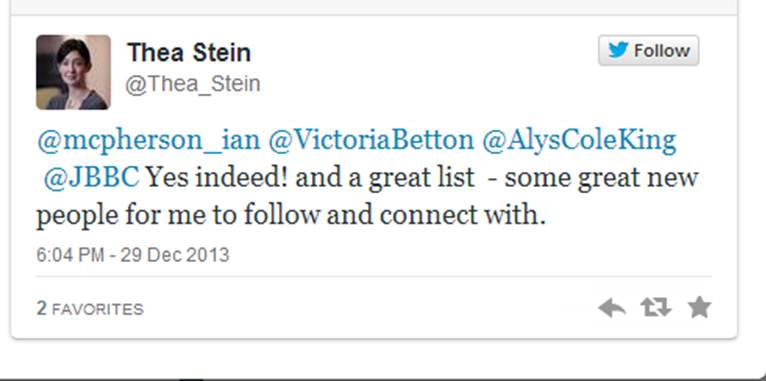
Even for those of us who are experienced Twitter users, we can always discover a new gem in an account we may not have come across before.  I know I can be guilty of swimming in the same Twitter pool and every now and again it is good to expand our horizons. I hope this list will help you (like Thea’s tweet indicates below) expand your network to make it even more valuable, global and inclusive. 

thea

Posted in #HCSM

Home telehealth helps specialists reach Parkinson’s patients | mobihealthnews

See on Scoop.itHealth Care Social Media Monitor

“Virtual house calls” over consumer-grade webcams and mobile devices have great potential to improve the care of patients with Parkinson’s disease and other neurological disorders, new research has shown, but the lingering issues of reimbursement and physician licensure continue to hinder growth of remote consultations.

See on mobihealthnews.com

Posted in #HCSM

How Did Doctors Use Social Media In 2013?

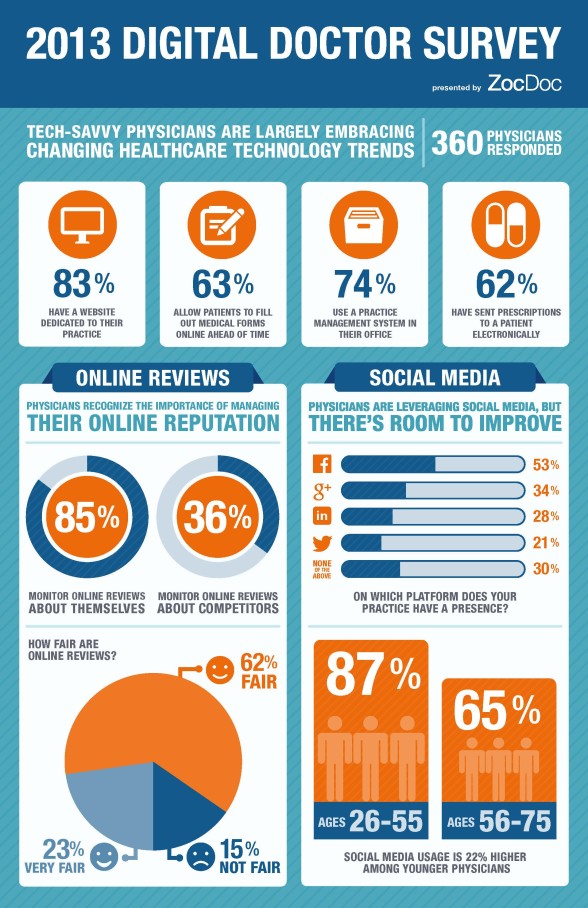
A Digital Doctor  survey commissioned by ZocDoc reveals which social media tools digitally savvy doctors are using. 

Digital-Doctor-Survey-ZocDoc-588x908

The Top 3 social media platforms used by doctors in the survey were:

  • Facebook
  • Google+
  • LinkedIn

I am surprised to see no mention of Twitter in the top 3, particularly as I have collated a list of over 600 doctors who are active on the platform.

Interesting to note that 65 percent of physicians who said they have a social media presence are aged 55 to 75.

I am looking forward to seeing how this data shapes up in the coming year.