Posted in #HCSM

Pubmed is LIVE on Social Media – Hashtags of the Week (HOTW): (Week of July 21, 2014)

Have you been straddling the fence deciding whether or not social media is “a thing” in healthcare? Well, maybe this will tip the balance

pfanderson's avatarEmerging Technologies Librarian

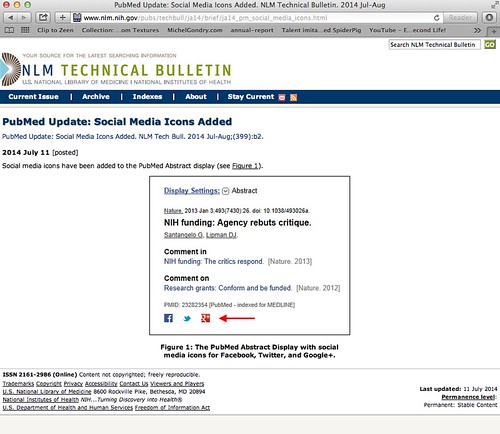
Pubmed Social Media Icons
PubMed Update: Social Media Icons Added. NLM Tech Bull. 2014 Jul-Aug;(399):b2. http://www.nlm.nih.gov/pubs/techbull/ja14/brief/ja14_pm_social_media_icons.html

Have you been straddling the fence deciding whether or not social media is “a thing” in healthcare? Well, maybe this will tip the balance. Pubmed now includes social media sharing icons at the article level, as shown in the image above. This is in addition to NIH’s own active life on social media. Unfortunately, when I was testing it out, every now and then what it shared was not the link to the article, but a link to the search strategy from which I found the articles. Hopefully, they’ll get that fixed, but usually it was good. Here’s what it looks like when sharing something to Twitter.
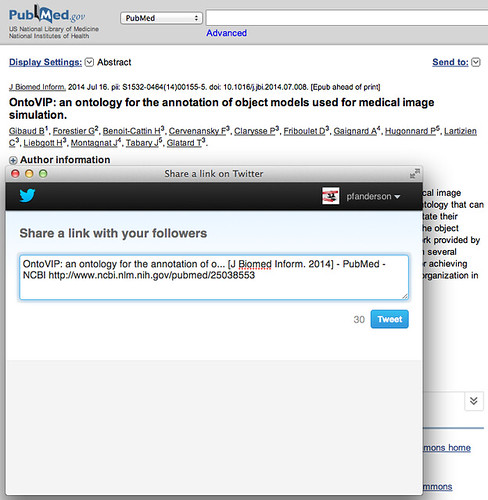
Pubmed Social Media Sharing Example: Twitter

In honor of this noteworthy change, I thought I’d divert from actual hashtags to seeing what people are sharing from Pubmed this week. If you really want hashtags, take a…

View original post 312 more words

Posted in #HCSM

A Tale of Two Online Communities

dandunlop's avatarThe Healthcare Marketer

Whether it’s a Facebook Group, LinkedIn Group, Twitter Chat, blog or a patient support community on a private platform, building and maintaining a vibrant online community requires vigilance and dedicated management. This has become so clear to me as I’ve looked at the data from two online communities we developed for clients – one which we actively manage and one which the client has chosen to operate on its own without the involvement of a community manager.

These communities were built seven months apart from one another. They were built in exactly the same manner. They feature the same type of content. Interesting, the community that is floundering was the first to be launched and experienced early success while my firm managed its growth in the first 12 months. Once there was no longer a dedicated community manager, the group’s growth leveled off and eventually began to decline.

Community #1…

View original post 450 more words

Posted in #HCSM

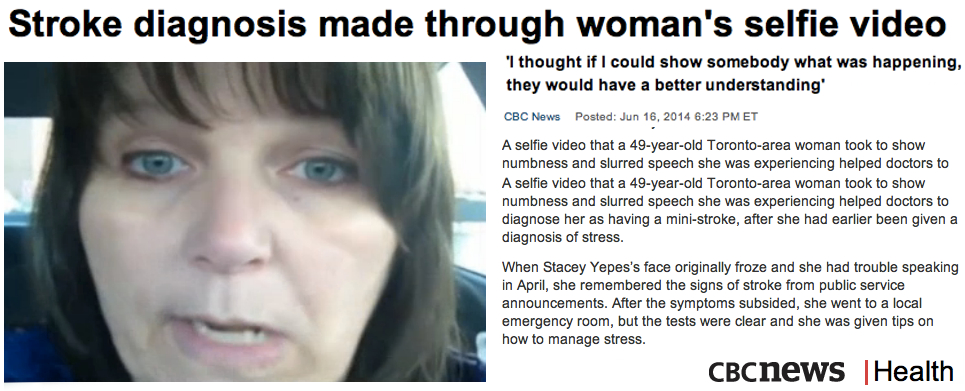
Stroke diagnosis made through selfie video Patient made after being sent home from Hospital

David Doherty's avatarmHealth Insight

Stroke diagnosis made through womans selfie video

When Stacey Yepes was asked what possessed her to turn to her iPhone and record a selfie video:

I just needed someone to be able to see what was happening. When I’m telling people this was happening they’re saying it’s just stress but I’m telling them I know this is not stress. It was a relief that someone would finally believe that it was not just stress“.

This remarkable story of a Patient who had her stroke symptoms dismissed highlights for me the ease with which important symptom information can be ignored or misinterpreted by clinicians and how important it is for healthcare providers to move on from the idea that documentation of symptoms is an exclusive entitlement we give to Healthcare Professionals and more of us start recognising the opportunity when we let Patients help with the documentation of their own history.

HatTip: Dr Chris Bickford…

View original post 1 more word

Posted in #HCSM

What you need to know about ‘The Social Age’

Another great post from Julian. I’ve just discovered his blog and am already a big fan of his insights

Julianstodd's avatarJulian Stodd's Learning Blog

Everyone understands that things have changed, but not always how much and how far we still have to go. The Social Age is defined by change: changes in how we work, how we learn, how we lead, how we connect and communicate. Our entire ecosystem has evolved and yet many organisations are clinging to the remnants of eroded business models and HR practices. Those that are unable to adapt, unable to recognise and respond to the evolution will fail.

The Social Age: new work The Social Age redefines how organisations need to operate. This tangle captures some of the core changes

The nature of work has changed: no longer defined by four walls and 9-5, we’ve seen technology revolutionise how we connect and how we are productive. Cloud services and VPNs are simply the latest iteration in a long chain of innovation that has led to laptops, tablets and smartphones, alongside remote working and…

View original post 1,305 more words

Posted in #HCSM

Health Literacy: Is there an app for that?

Another great Twitter chat lined up for this week from #hcsmca

Colleen Young's avatarColleen Young

This week May 28, 2014 at 9 pm ET, the Canadian Physiotherapy Association’s Manager of Policy and Government Relations, Kate Rexe (@CPA_Kate) will moderate the #hcsmca discussion. Kate Rexe is an engaged advocate of public health care and has been working in health policy and promoting knowledge exchange for the last 12 years.

By Kate Rexe (@CPA_Kate

head shot Kate Rexe Kate Rexe


Choosing Wisely

I was excited when the Choosing Wisely Canada campaign launched in April 2014. Modeled after the American Choosing Wisely initiative by the ABIM in 2012, this campaign educates physicians and patients about unnecessary tests and encourages patients to make informed choices. I believe this is a critical step towards improved health literacy because it gives patients and providers the evidence necessary to start conversations about tests and treatments. Why is this important? Because we’ve always been taught to trust the recommendations made by our doctors…

View original post 800 more words

Posted in #HCSM

The Power of Social Networks to Change Health Behavior

Tracy Granzyk MS, MFA's avatarEducate the Young

Nicholas Christakis and James Fowler , co-authors of Connected: How Your Friends’ Friends’ Friends Affect Everything You Think, Feel and Do, have been studying the power and influence of social networks for a large portion of their careers. The concept of ‘six degrees of separation’ took on a whole new meaning thanks to Kevin Bacon, but Christakis and Fowler turned this party game into a science and have shown through peer-reviewed research that social networks can also influence the health status and behavior of the group.

Using the Framingham Heart Study data set, Christakis and Fowler found health and related behavior reflects ‘three degrees of influence,’ meaning your health behavior can indeed be influenced by a friend of a friend. As Christakis puts it in the following TED talk, “If a friend says, ‘let’s go have muffins and beer,’ and you do…and more friends join you, a new norm of…

View original post 351 more words

Posted in #HCSM

Social Media Purpose and Tactics – The Truth About Content and Engagement

BundlePost's avatarBundlePost

Social Media Tactics Recently eMarketer released a new report that purported to cover Social Media Tactics and which work best. Though the report has a lot of valuable information, most is based on a highly misguided view of social media to begin with. In this post I am going to outline two of the points in the report and attempt to give you some straight talk about them that is intended to help you adjust strategy and be more effective.

Engagement:

Early in the report there was a statement that stood out to me as a huge red flag:

the greatest percentage of respondents from both business-to-business (B2B) and business-to-consumer (B2C) companies considered customer engagement to be the primary purpose of their social media marketing.”

With so many marketers seeing engagement as the primary purpose for their social media marketing, it is no wonder why the respondents answered the way they did on other segments in…

View original post 476 more words

Posted in #HCSM

Beginners Social Media in Medical Education

DrKP's avatarkarenpriceblog

So we need to talk about Social Media.

I helped to present at the Women In General practice conference a Social Media familiarisation session for Female doctors.  This was held on June 1st 2013 at Yarra Valley Lodge about an hour north of Melbourne Victoria, Australia.  This by the way is my first blog too so the adventure into the online medical space continues.

My talk segment was about Medical Education via Twitter.

 I puzzled over how to introduce SoMe Med Ed to the non-convinced.

Medical Education on Twitter

I discussed 140 characters with links to be saved or short articles as an ideal way for time poor female GP’s to broaden their range of access to medical journal articles and international medical opinion.

I demonstrated the great medical organisations on Twitter; I demonstrated the fabulous Medical Drs both international and local that I follow; I demonstrated all…

View original post 1,207 more words