Posted in HCSM

Will the Quantified Self Movement Take Off in Health Care? | The Health Care Blog

See on Scoop.itHealth Care Social Media Monitor

The quantified self movement should be closely monitored by all interested in the future of the American health care delivery system. The potential to improve the life of patients with chronic diseases is clearly apparent; whether most people will use the increasingly sophisticated tools being developed is open to debate.

Marie Ennis-O’Connor‘s insight:

According to Wolf four technologic advances made the quantified self movement possible:


“First, electronic sensors got smaller and better. Second, people started carrying powerful computing devices, typically disguised as mobile phones. Third, social media made it seem normal to share everything. And fourth, we began to get an inkling of the rise of a global superintelligence known as the cloud.”

See on thehealthcareblog.com

Posted in HCSM

Michael J. Fox Foundation takes first step toward crowdsourced research | mobihealthnews

See on Scoop.itHealth Care Social Media Monitor

The Michael J. Fox Foundation (MJFF) has recently begun to explore how data sourced from mobile phones and analyzed with machine learning algorithms can help improve research into Parkinson’s. The organization held the Parkinson’s Data Challenge, where teams competed for a $10,000 prize with their approaches to analyzing a dataset collected from Parkinson’s patients.

See on mobihealthnews.com

Posted in HCSM

Chris’s Cancer Community: The blogging revolution in healthcare

See on Scoop.itHealth Care Social Media Monitor

Reading other peoples stories is very powerful, and people can find a sense of release, when writing their own.The slightly unseen, and so far relatively untapped benefit, is when the professionals get involved. Patient blogs are a wonderful tool of understanding how cancer and it’s treatment, affects people in their lives, and I feel that many health professionals lack even a basic understanding of social media, and there is still a feeling that it is not valid in their work.

See on chris-cancercommunity.blogspot.ie

Posted in HCSM

Bridging the gulf of engagement | Reach The Public

See on Scoop.itHealth Care Social Media Monitor

Marie Ennis-O’Connor‘s insight:

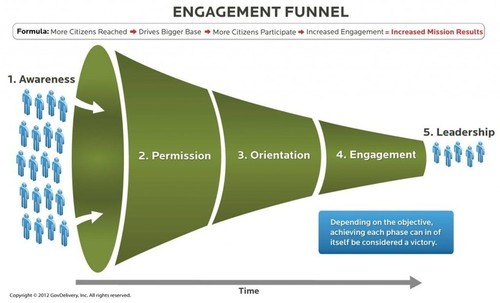
Citizens who use social media already engage digitally. They are more likely to use cheaper online channels and naturally choose digital by default.  You’re preaching to the converted so the return on investment is minimal.Some people don’t do digital, and they probably never will no matter how hard they are pushed. These shouldn’t be the main focus of your efforts.Many citizens will do digital with gentle persuasion. They already make basic use of the internet, have mobile phones and many have an email address. This is your target audience.

See on www.govdelivery.com

Posted in HCSM

A Theory-Based Video Messaging Mobile Phone Intervention for Smoking Cessation: Randomized Controlled Trial

See on Scoop.itHealth Care Social Media Monitor

Advances in technology allowed the development of a novel smoking cessation program delivered by video messages sent to mobile phones. This social cognitive theory-based intervention (called “STUB IT”) used observational learning via short video diary messages from role models going through the quitting process to teach behavioral change techniques.

See on www.jmir.org

Posted in HCSM

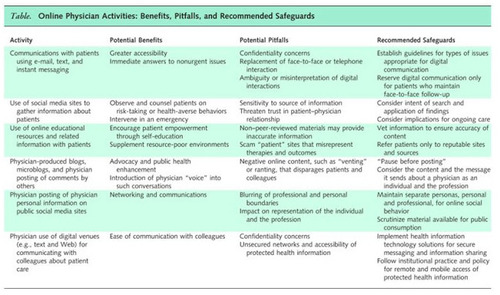
Social media policy guidelines for physican-patient relationships

See on Scoop.itHealth Care Social Media Monitor

The boundaries between the physician – patient relationship have always been difficult as the relationship is based on trust, intimacy and the ability to share information from both sides of the desk.  This relationship has grown more complex due to the rise of social media engagement.  Physicians are being friend-ed, followed and reviewed across the digital channel like crazy, placing the doctors that care for them in difficult positions regarding the confidentiality of their patients who often don’t think about the impact of their digital-buddy request.


Similarly, due to the ease of digital communications, the commonly time-stretched doctor also faces temptation to use quick communication methods to reach their audience, in lieu of a more professional path.  No-one really wants their test results Tweeted to them! These examples of digital doctoring to be avoided are covered in the guidance.  Protecting patient privacy and confidentiality is stressed as the main area for focus when using social media.


In order to help doctors better understand digital communication best practices and to fill a gap than many medical practice management efforts have neglected, about a week ago, the American College of Physicians (ACP) and Federation of State Medical Boards (FSMB) published a policy paper entitled“Online Medical Professionalism: Patient and Public Relationships.” Some of the highlights from this publication can be found in this helpful table

See on www.business2community.com