See on Scoop.it – Health Care Social Media Monitor

Christina Caraballo, MBA, describes how the use of integrated PHR platforms can enhance patient engagement and improve outcomes:
See on www.himss.org
See on Scoop.it – Health Care Social Media Monitor
Christina Caraballo, MBA, describes how the use of integrated PHR platforms can enhance patient engagement and improve outcomes:
See on www.himss.org
See on Scoop.it – Health Care Social Media Monitor
Engagement is about interaction, listening, and learning in relationship to another person. Engagement is not a strategy, it is care.
See on www.kevinmd.com
See on Scoop.it – Health Care Social Media Monitor
This guest article is by Aaron McKethan, senior vice president of strategy at RxAnte and a visiting scholar at the Brookings Institution.
See on www.forbes.com
See on Scoop.it – Health Care Social Media Monitor
Social media served to recharge my professional gusto. Patients are more interesting, I deal with the non-stop frustrations with less emotional exhaustion.
Kathy Nieder is a family physician who blogs at Family Practice 2.0
See on www.kevinmd.com
See on Scoop.it – Health Care Social Media Monitor
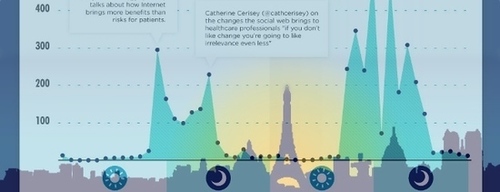
We have witnessed a tipping point in 2012 for leading healthcare conferences like Doctors 2.0 & You where for the first time, the majority of a conference’s audience is not those physically present, but those who were socially present. Healthcare social media analysis is fundamentally changing how conferences think about who their audience is and how to best communicate and share the ideas presented by these great speakers
Key Findings By Symplur from Doctors 2.0 & You Conference HashtagThere were more virtual participants (592) than participants that were physically present at the location (400). This illustrates both the power of social media, and the powerful impact the thought-leaders at the Doctors 2.0 & You conference created as their ideas went viral across the globe.The 4,999 total tweets created significant awareness of the ideas shared by the presenters at the conference with a total of 11,969,612 potential impressions in Twitter users’ tweet streams.There was great diversity in languages used by the social participants with English, French and Spanish being the top three, followed by Dutch, Italian, and German.The second day of the conference created the highest volume of social conversations with a total of 2,858 tweets.The social peak of the conference took place at noon the second day when Jen Dyer MD, MPH (@endogoddess) presented on how mobile apps and social media can be a powerful way to improve health literacy. This hour alone generated over 500 tweets.The strength of the presenters and their ideas was clearly revealed in our analysis of who the influencers were. We analyzed the top 3 influencers by number of Twitter mentions and observed a great variety of new faces each morning and afternoon, suggesting a host of dynamic and diverse interests and points of view.Patients were strongly represented at the conference being one of the main segments or social influencers.Looking at the top 50 influencers, we found that Doctors made up the largest group (12). They were followed by Consultants (8), and Patients (7).From analyzing the hashtags used during the conference, we identified some of the main topics discussed including “Healthcare Social Media”, “Mobile Health”, “Pharma”, “ePatients” and “eHealth”.
See on www.symplur.com
See on Scoop.it – Health Care Social Media Monitor
In this age of technology, healthcare social media is becoming an all new important and emerging part of medicine. One that until recently, I didn’t even realize existed. Training programs all across the country, at least in my neck of the woods, are censoring how their residents and fellows are using their resources. What do you think about unlocking their social media access while at the workplace and opening this up as an avenue for education and growth? In this new generation of healthcare social media networking, maybe “access denied” isn’t just prohibiting trainees from posting their favorite Harlem shake video on hospital time. Maybe it is actually prohibiting the the expansion of educational opportunities in the modern age. It’s time that medical education answer the call of this tremendous opportunity.
Rebecca Hastings, D.O. is a Pulmonary, Critical Care Fellow.
She is on twitter @RR_Hastings.
See on caduceusblog.com
See on Scoop.it – Health Care Social Media Monitor
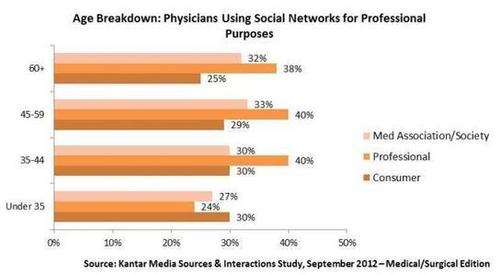
Kantar Media just launched a new healthcare insights blog at www.kantarmedia-healthcare.com. Does this insight surprise you?
See on pharmamkting.blogspot.ie

Our next HCSM Buddy Mentoring Twitter chat (#hcsmbm) takes place this Wednesday at 6 pm GMT (12pm CT, 10am PT, 1 pm ET).
Quick Reminder…
#Hcsmbm is about developing a buddy mentoring system to help those who are in need of assistance to navigate social media sites for healthcare information.
Margaret Whitehead in the early 1990s wrote that:
Equity in health implies that ideally everyone should have a fair opportunity to attain their full health potential and, more pragmatically, that no one should be disadvantaged from achieving this potential, if it can be avoided.*
We believe this now extends to access to online healthcare information and support.
We are grateful to Randy Chalfant for providing the inspiration for this week’s chat, which will focus on how we can engage doctors, nurses and other healthcare professionals (HCPs) in the discussion.
Randy points out that we all have individual needs when it comes to healthcare information, so this will be the point of focus of our first topic.
T1 How do we assess what a patient needs in terms of online healthcare information and support?
Health literacy is defined as the cognitive and social skills that determine a person’s motivation and ability to access, understand and use information in ways that maintain or enhance health. So our next topic for discussion will focus on motivation.
T2 How do we motivate patients to take an active role in their healthcare?
T3 How do we motivate HCPs to partner with patients in achieving their healthcare goals?
We will finish our discussion with some brainstorming.
T4 How can we help patients to access, understand and use online healthcare information and support to attain their full health potential.
We hope you will join us for this unique Twitter chat (hashtag #hcsmbm) and help us brainstorm ideas to get a HCSM Buddy Mentoring system off the ground.
Marie (@JBBC), Vanessa (@Irl4Livestrong), Patty (@topsurf), Shu (@shumilne)
See on Scoop.it – Health Care Social Media Monitor
In part 4 of his patient engagement series, author Leonard Kish describes how social networks give both patients and caregivers what they need.
See on www.hl7standards.com
See on Scoop.it – Health Care Social Media Monitor
In the first of a series of blogs leading up to the HealthXL Global Gathering 2013, Johnny Walker, Director at HealthXL, looks forward to a new era of patient engagement and empowerment.
See on www.startupbootcamp.org