For healthcare communicators, demonstrating the value of your social media efforts can be challenging but essential to securing buy-in, allocating resources, and achieving long-term success.
The Challenge: Proving Social Media Return on Investment (ROI)
Defining ROI in Healthcare Contexts: Unlike direct-to-consumer businesses, where ROI often translates into sales or conversions, healthcare ROI can be more nuanced. Metrics might include increased awareness, patient engagement, or referrals—intangibles that can be hard to quantify.
Data Overload: With countless metrics to track (likes, shares, comments, reach, impressions, click-through rates, etc.), it’s easy to get overwhelmed or lose focus on the most meaningful indicators of success.
Attribution Issues: Patients rarely make decisions based on a single social media interaction. Tracking the journey from initial engagement to appointment booking can be complex and indirect.
Limited Resources: Many healthcare organizations have lean marketing teams juggling multiple priorities, leaving little time for in-depth analytics.
Solutions: Actionable Strategies for Measuring Social Media ROI
1. Define Clear Objectives
Start by identifying what success looks like for your organization. In healthcare, these might include:
Brand Awareness: Growing your follower count or increasing post reach.
Patient Engagement: Encouraging interactions like comments, shares, or messages.
Conversions: Tracking leads to website visits, newsletter sign-ups, or appointment requests.
💡 Tip: Use SMART goals—specific, measurable, achievable, relevant, and time-bound—to frame your objectives.
2. Focus on Key Metrics
Not all metrics are equally valuable. Prioritize those that align with your goals:
Awareness Goals: Track impressions, reach, and follower growth.
Engagement Goals: Monitor likes, shares, comments, and direct messages.
Conversion Goals: Use click-through rates, form submissions, or website analytics to measure tangible actions.
January 12th marks National Pharmacist Day, a time to celebrate the vital role pharmacists play in healthcare. Today, social media can be a powerful tool for pharmacists to make an even bigger difference. They can use it to educate the public, connect with patients, and even advocate for better healthcare. This article will explore how pharmacists can effectively and ethically use social media in their practice, from building a strong online presence to influencing healthcare policy and improving public health.
The Expanding Role of Social Media in Pharmacy
Social media has become a cornerstone of modern communication. For pharmacists, this medium offers unparalleled opportunities to expand their influence and provide critical health education. This section explores how social media empowers pharmacists to contribute to public health, enhance patient care, and address pressing healthcare challenges.
Enhance Medication Adherence: By creating dynamic and interactive campaigns about the importance of proper medication use, pharmacists can address one of the leading causes of poor health outcomes while building trust with their audience.
Promote Public Health Initiatives: From vaccination drives to chronic disease prevention programs, pharmacists can amplify critical public health messages to large, diverse, and often underserved audiences.
Foster Inclusivity and Accessibility: Social media offers an unparalleled opportunity to break down barriers in healthcare communication. Pharmacists can create content in multiple languages, incorporate captions in videos, and ensure health literacy for all audience levels.
Strengthen Crisis Communication: In times of public health crises or natural disasters, pharmacists can leverage social media to provide timely updates, dispel panic-driven misinformation, and coordinate community responses.
No healthcare organization or practitioner is immune to negative feedback. Whether it’s a critical review on Google, a frustrated comment on a social media post, or a negative mention on a patient forum, navigating these situations requires careful consideration and a thoughtful response.
However, by approaching these situations with a proactive and patient-centered approach, you can turn these challenges into opportunities for growth. Let’s explore some strategies for effectively managing negative feedback.
By establishing a strong foundation of engaging content, healthcare organizations can effectively leverage social media to improve patient care, enhance their reputation, and strengthen their online presence.
This article outlines 10 key content pillars that should form the cornerstone of any successful healthcare social media strategy, along with real-world examples.
1. Patient Testimonials and Success Stories
St. Jude Children’s Research Hospital shares patient recovery stories on Facebook, often featuring photos and heartfelt quotes from patients or families.
Purpose: To inspire and connect with audiences on an emotional level.
Why It Works: Personal stories humanize healthcare and foster trust. They also serve as social proof, showcasing successful outcomes and patient satisfaction.
How to Create: Collaborate with patients who are willing to share their experiences. Use video or written testimonials accompanied by photos to maximize emotional impact. Obtain written consent from patients. Focus on authentic, relatable stories.
2. Educational Content
American Heart Association pairs educational content with captivating graphics.
Purpose: To inform audiences about health topics, treatments, and preventative care.
Why it works: People actively seek credible health information online. Educational posts establish your organization as a trusted authority. These posts can also drive traffic to your website or blog, where you can provide in-depth resources.
How to Create
Create short, informative videos or infographics.
Share articles and blog posts on relevant health topics.
Use simple, easy-to-understand language.
3. Behind-the-Scenes Content
Johns Hopkins Medicine’s TikTok videos provide a glimpse into a day in the life of their healthcare professionals, from lab researchers to ER nurses.
Purpose: To showcase the people and processes behind healthcare organizations.
Why It Works: Humanizing your team builds trust and relatability. Audiences appreciate seeing the faces and stories behind the organization.
How to Create: Share photos or videos of staff at work, team celebrations, or day-in-the-life content. Highlight the dedication and expertise of your team and the organization’s culture and values.
Effective content planning is the cornerstone of any successful healthcare marketing strategy. It ensures you create content that addresses the unique needs of patients, caregivers, and healthcare professionals while aligning with your organizational goals.
In an industry as dynamic and sensitive as healthcare, strategic content planning is more critical than ever. By planning your content for the year ahead, you can:
Prioritize patient-centric efforts: Focus on creating content that informs, supports, and empowers your target audience.
Enhance trust and credibility: Build a reputation as a reliable source of health information.
Optimize resources effectively: Streamline the creation of high-quality, impactful content within available budgets and timelines.
The Peril of “Random Acts of Content”
Without a clear plan, healthcare organizations risk producing inconsistent or irrelevant content. This “random acts of content” approach can:
Undermine patient trust
Waste valuable resources
Make it difficult to track and measure outcomes
Consequences of Random Acts of Content:
Misalignment with patient and professional needs
Overlapping or redundant messaging
Missed opportunities to provide timely and impactful information
7 Types of Content Planning for 2025 Success
1. Weekly/Monthly/Quarterly Content
Strategy: Establish a consistent schedule of content tailored to your audience, such as blogs on medical advancements, newsletters with health tips, or videos addressing common patient concerns. Benefits: Builds trust, keeps your audience informed, and reinforces your role as a healthcare leader. Example: A monthly newsletter with health and wellness tips, patient success stories, and updates on new treatments or services.
2. Seasonal Content
Strategy: Align content with health observances, seasonal trends, and community health needs. Benefits: Promotes timely health awareness and engages audiences with relevant topics. Example: A flu season campaign emphasizing vaccination benefits, or educational content for Breast Cancer Awareness Month.
3. Event-Related Content
Strategy: Develop content around key healthcare events, such as health fairs, medical conferences, or patient support group meetings. Benefits: Increases event participation and drives awareness. Example: Social media posts, email campaigns, and live-streams promoting a health screening day or participation in a global healthcare summit.
Social media provides a platform to connect with patients, build brand awareness, educate the public, and enhance patient engagement. However, effective healthcare social media marketing requires a strategic, data-driven approach that goes beyond sporadic posting.
This article outlines 10 essential questions to guide your healthcare organization’s social media journey. By carefully considering these questions and implementing the insights gained, you’ll be well-equipped to build a strong online presence and achieve your healthcare marketing goals in 2025 and beyond.
1. Who Is Your Target Audience?
Before embarking on any social media strategy, you must clearly understand your target audience.
Analyze your existing audience: Examine your current social media followers and website traffic to identify their demographics, health conditions, and online behavior. Tools like Google Analytics, Facebook Insights, and Twitter Analytics provide valuable insights into your audience’s characteristics and engagement patterns.
Develop detailed patient personas: Create fictional representations of your ideal patients, including their demographics, health conditions, concerns, and online behavior. These personas will serve as valuable guides for your content creation and targeting efforts.
2. What Are Your Social Media Goals?
A cornerstone of any successful healthcare social media strategy lies in defining clear, measurable, and achievable goals.
Use the SMART goal-setting framework: Ensure your goals are Specific, Measurable, Achievable, Relevant, and Time-bound.
Example: “Increase patient appointment bookings from social media by 10% within the next quarter.”
Align social media goals with overall healthcare objectives: Ensure your social media efforts contribute to broader healthcare objectives, such as improving patient satisfaction, increasing brand awareness, or promoting healthy behaviors.
Set regular benchmarks: Track your progress towards your goals regularly and adjust your strategy as needed.
Identify where your target audience spends their time: Conduct thorough research to determine which platforms your target audience frequents most.
Consider the nature of each platform:
LinkedIn: Ideal for connecting with other healthcare professionals, sharing industry insights, and recruiting talent.
Facebook: A versatile platform for reaching a broad audience, sharing patient stories, and promoting health awareness campaigns.
Instagram: Excels for visually-driven content, showcasing the human side of healthcare, and engaging with younger audiences.
X: Excellent for real-time communication during health emergencies, sharing breaking news, and engaging in discussions about health issues.
TikTok: Ideal for creating short-form video content, engaging health education videos and reaching younger demographics.
Focus on a few key platforms: Avoid spreading your resources too thin. Concentrate your efforts on the platforms where your target audience is most active and where you can achieve the greatest impact.
4. What Content Will You Create and Share?
Create a diverse content mix that resonates with your target audience and aligns with healthcare best practices.
Prioritize valuable and informative content: Share health tips, educational resources, patient testimonials, and engaging stories that address your audience’s health concerns.
Experiment with different content formats: Include a mix of text posts, images, videos, infographics, live streams, and interactive content.
Ensure content accuracy and compliance: Ensure all content is accurate, evidence-based, and complies with relevant healthcare regulations and ethical guidelines.
Plan and schedule your content: Use a content calendar to ensure consistent and timely posting. Consider using social media scheduling tools to automate your posting schedule.
Analyze content performance: Regularly review your content performance data to identify what’s working and what’s not. Adjust your strategy based on these insights.
5. How Will You Measure Success?
To measure the effectiveness of your healthcare social media efforts, track key performance indicators.
Website Traffic: Track referrals from social media platforms to your website and analyze user behavior on your site.
Patient Engagement: Monitor website visits, appointment bookings, and patient feedback received through social media channels.
Brand Mentions: Track mentions of your brand and engage in relevant conversations.
Health Literacy: Track the reach and impact of your health education campaigns.
Reputation Management: Monitor online reviews and respond to patient feedback to maintain a positive online reputation.
6. How Will You Engage With Your Audience?
Social media is a two-way street. Building strong relationships with your patients is paramount.
Respond promptly and empathetically: Respond to comments, messages, and mentions in a timely and compassionate manner.
Go beyond superficial interactions: Engage in meaningful conversations, address patient concerns, and offer personalized support.
Encourage patient interaction: Host Q&A sessions, polls, and contests to encourage active participation.
Showcase patient success stories: Share inspiring patient stories (with patient consent) to build trust and demonstrate the positive impact of your care.
Monitor and respond to patient reviews: Address both positive and negative reviews to demonstrate your commitment to patient satisfaction.
While the core social media platforms are free, building a successful healthcare social media presence often requires investment.
Consider your healthcare goals: More ambitious goals may require a larger budget.
Evaluate platform costs: Reaching specific demographics on certain platforms may require paid advertising.
Assess industry competition: If your healthcare market is highly competitive, you may need to invest more in paid advertising and high-quality content.
Factor in internal resources: Determine if you have the necessary internal resources (time, personnel) or if you need to hire freelancers or agencies specializing in healthcare marketing.
Start with a modest budget: Begin with a manageable budget and gradually increase your investment as you gain experience and see positive results.
8. How Much Should Time Should You Spend On Social Media Marketing?
Successful healthcare social media marketing demands a significant time commitment.
Consider the time required for each task: Content creation, audience engagement, platform monitoring, and strategy analysis all require time and attention.
Assess your available resources: Determine if you have the internal resources to dedicate to these tasks.
Explore time-saving strategies: Consider hiring a social media manager, outsourcing content creation, or utilizing social media management tools to streamline your workflow.
Prioritize your efforts: Focus on the platforms and activities that deliver the greatest return on investment for your healthcare organization.
9. How Will You Stay Updated On Social Media Changes and Trends?
The healthcare and social media landscapes are constantly evolving.
Stay informed about healthcare industry news: Regularly read industry publications, attend healthcare conferences, and stay updated on the latest healthcare trends.
Monitor platform algorithm changes: Keep abreast of updates to platform algorithms and adjust your strategies accordingly.
Analyze competitor activities: Monitor your competitors’ social media activities to identify best practices and areas for improvement.
10. How Will You Integrate Social Media with Other Marketing Efforts?
Social media should not operate in isolation.
Maintain a consistent brand voice and visual identity: Ensure consistent messaging and branding across all marketing channels, including social media, website, email, and print materials.
Leverage social media to support other healthcare marketing campaigns: Use social media to promote health screenings, patient education events, and community outreach programs.
Track cross-channel performance: Analyze how social media contributes to overall healthcare marketing goals and identify opportunities for cross-channel synergies.
By addressing these 10 key questions, you can develop a robust and effective healthcare social media strategy. Remember that flexibility and continuous improvement are essential. By adapting to the evolving healthcare and social media landscapes and consistently refining your approach, you can achieve significant success in your healthcare social media marketing endeavors.
What are your biggest challenges when it comes to healthcare social media marketing? Share your experiences and insights in the comments below.
Artificial intelligence (AI) is rapidly transforming the healthcare landscape, offering the potential to revolutionize diagnosis, treatment, and patient care. From AI-powered diagnostic tools to personalized treatment plans, the applications of this technology in healthcare are vast and promising.
However, the complex terminology surrounding AI can be a barrier for healthcare professionals seeking to understand and embrace these advancements. This glossary is designed to provide a clear and concise introduction to key AI terms. By familiarizing yourself with these essential concepts, you can gain a deeper understanding of the AI landscape and its implications for your practice.
Algorithm: A set of instructions or rules followed by a computer to perform a specific task or solve a problem.
Artificial Intelligence (AI): A broad field encompassing the development of computer systems capable of performing tasks that typically require human intelligence, such as learning, problem-solving, decision-making, and language understanding.
AI Bias: Systematic errors in AI models that lead to unfair or inaccurate predictions, often due to biased training data or algorithmic design.
Clinical Decision Support (CDS): AI tools that assist healthcare professionals in making informed decisions about patient care by providing relevant information and recommendations.
Data Privacy and Security: The protection of sensitive patient information from unauthorized access or misuse, crucial in the context of AI applications in healthcare.
Deep Learning: A type of ML that utilizes artificial neural networks with multiple layers to analyze complex patterns in large datasets, often used for image and speech recognition.
Ethical Considerations: The responsible and ethical development and deployment of AI in healthcare, ensuring patient safety, privacy, and fairness.
Explainable AI (XAI): The ability to understand and interpret the reasoning behind an AI model’s decisions, crucial for building trust and ensuring transparency in healthcare.
Machine Learning (ML): A subset of AI that focuses on algorithms enabling systems to learn from data and improve their performance on specific tasks without being explicitly programmed.
Model: An AI system trained on data to perform a specific task, such as diagnosing diseases or predicting patient outcomes.
Natural Language Processing (NLP): A field focusing on the interaction between computers and human language, enabling tasks like text analysis, translation, and chatbots.
Neural Network: A computing model inspired by the human brain, composed of interconnected nodes (neurons) that process and transmit information, enabling pattern recognition and learning.
Precision Medicine: The tailoring of medical treatment to individual patients based on their genetic, environmental, and lifestyle factors, often aided by AI analysis of large datasets.
Predictive Analytics: The use of AI to analyze patient data and predict future events, such as disease progression or readmission risk.
Training Data: The dataset used to teach an AI model to recognize patterns and make predictions.
AI-Enabled Medical Devices: Devices that incorporate AI algorithms to enhance their functionality, such as diagnostic imaging equipment or wearable health monitors.
You may also be interested in reading this publication which I co-authored.
The first time I read this quote from Dana Lewis, moderator of #hcsm the premier tweet chat on healthcare, I was gripped by the notion of how Twitter and in particular tweet chats could influence the way we practise healthcare.
Social media is a radical shift in the way we communicate. The healthcare conversation is no longer a one-way narrative but is evolving into a global, participatory discussion. One of the most powerful ways I see this happening is in the modality of the tweet chat. The role Twitter plays in breaking down patient/provider barriers, disseminating and expanding the reach of healthcare information, widening social networks and co-creating a collaborative model of shared health information is one of the most exciting developments in social media.
What Is A Tweet Chat?
For those who may be unfamiliar with the phenomenon of a tweet chat – it is a pre-arranged chat that happens on Twitter through the use of updates called tweets. It includes a predefined #hashtag which links the tweets together in a virtual conversation. Most tweet chats follow a common format of a moderator who introduces pre-arranged topics relevant to the chat and keeps the conversation on track. The chats usually last one hour and a transcript of tweets is available after the chat has ended.
Symplur is doing an impressive job of compiling all of the healthcare hashtags and providing chat transcripts in The Healthcare Hashtag Project. The goal of the project is to make the use of healthcare social media and Twitter more accessible for the healthcare community as a whole (a full list and a tweet chat calendar of meeting times can be found on the Symplur website).
What Is The Impact Of Tweet Chats On Healthcare?
As a relatively new technological innovation, the use of Twitter as a modality for health communication is only now beginning to be explored with particular emphasis on the role Twitter may play in contributing to health based conversations directed at individual, community, and societal levels.
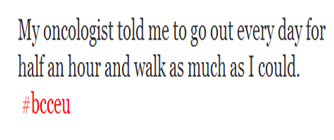
Many times, people’s choices in terms of Personal Health Practices (PHP) are context dependent and socially constructed. Healthcare tweet chats have tremendous potential to motivate participants and encourage change. Much of this change comes from peer-to-peer support which has been shown to be highly effective in motivating change. Many participants share conversational and informational knowledge that they believe is valuable both to themselves and others.
Tweet from participant in the #BCCEU (Breast Cancer Social Media Europe) tweet chat
Studies show that individuals enrolled in meaningful social networks have protective properties in terms of overall health and wellbeing. Healthcare tweet chats provide participants with a sense of community and valuable opportunities for meaningful exchange and positive interactions.
The impact of digital technology in healthcare is leading to changing expectations by health consumers who, along with a desire to share information and connect with others, increasingly want to interact and engage with their healthcare providers. Twitter has also facilitated the emergence of the “patient opinion leader” an individual who is seen as an expert in chronic conditions such as cancer. Gunther Eysenbach refers to this group as “Apomediaries” – individuals that assist in the process of information searching but do not act as a gatekeeper.
So, what’s in it for healthcare practitioners?
Dr Bryan Vartabedian (@Doctor_V) of Baylor College notes of social media “the greatest value of this medium is the breakdown of barriers that have traditionally come between doctor and patient.” It is encouraging to see the increasing participation by doctors in many healthcare tweet chats, reaching out and sharing information, but also listening too.
Twitter offers opportunities for healthcare to reach out to patients in new and valuable ways.
These [social media] tools help us reach so many more people; we can bring shared interactions into our practice and that is powerful … This isn’t an addition to your job. This is part of your job. This is a conversation, and that is what we are trained to do … This is where our patients are these days and this is where we need to reach them. We can engage learners, patients and peers, and we are not limited by geography or time – Farris Timimi, M.D., medical director for the Mayo Clinic Center for Social Media.
Another striking feature is Twitter’s crowd-sourcing capacity which allows health consumers, researchers and practitioners tap into a global source of advice, support and information. Twitter also provides a unique opportunity to learn from patients’ direct experience shared during these chats.
If healthcare innovators and providers wish to remain relevant and connected to digitally enabled patients, they need to go where the conversations are – more and more those conversations are happening on Twitter and the evolving dynamic of the tweet chat is the best place to find them.
Reference
Eysenbach, G. (2008). Medicine 2.0: Social networking, collaboration, participation, apomediation, and openness. Journal of Medical Internet Research, 10(3), e22. doi:10.2196/jmir.1030
I was delighted to have the opportunity to share the stage with Dr Kendall Ho, a practicing emergency medicine specialist and founding director of the eHealth Strategy Office of the University of British Columbia, at the Universitas 21 Health Sciences Group annual meeting held recently at University College Dublin. In a lively and engaging presentation Dr Ho spoke to delegates about how medical educators can embrace social media.
Also presenting was consultant rheumatologist, Dr Ronan Kavanagh, speaking on how doctors can use the tools of social media in their practice.
And my own presentation on the digital revolution and the era of the e-patient.
Some interesting data in the following presentation by Lee Rainie, Director of the Pew Internet Project, on how patients and their caregivers seek health information in the digital age and crucially how that information informs their healthcare decisions.




 Health Care Social Media