See on Scoop.it – Health Care Social Media Monitor
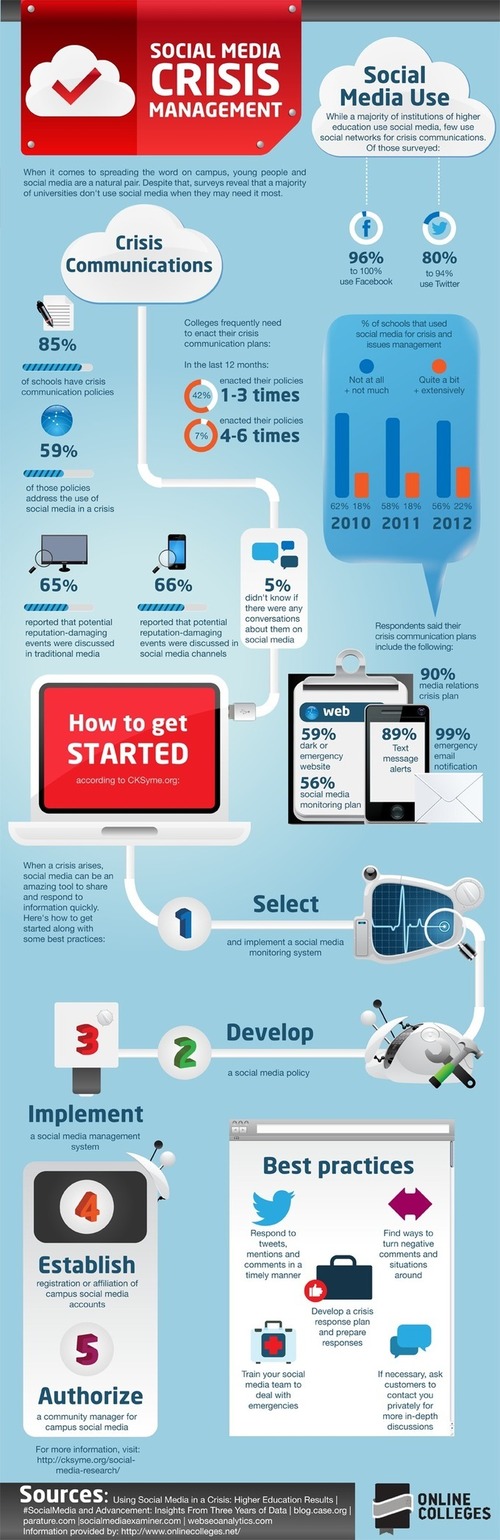
Check out these 4 social media crisis management infographics worth your attention!
See on www.melissaagnes.com
See on Scoop.it – Health Care Social Media Monitor
Check out these 4 social media crisis management infographics worth your attention!
See on www.melissaagnes.com
According to new research from the University of Sydney, micro-blog-based services such as Twitter could be a promising medium to spread important information about public health.
The research, by Professor Robert Steeleand PhD candidate Dan Dumbrell, indicates social media networks such as Twitter have distinct and potentially powerful characteristics that distinguish them from traditional online methods of public health information dissemination, such as search engines. This research is part of Professor Steele’s broader investigations on the impacts of emerging technologies on health and health care.
Using new communications technologies to allow people to directly receive relevant and up-to-the-minute public health information could benefit the health of millions and change the paradigm of public health information dissemination ~ Professor Steele, Head of Discipline and Chair of Health Informatics at the University’s Faculty of Health Sciences.
Twitter has a powerful characteristic in that it is members of the public who distribute public health information by forwarding messages from public health organisations to their followers.
According to Professor Steele, this provides a new way for public health organisations to both engage more directly with the public and leverage individuals’ networks of followers, which have ‘self-organised’ by topic of interest. Major social networks currently have hundreds of millions of users and continue to grow rapidly.
While most public health information is sought through online search engines, it has previously been found that relevant public health documents are not always successfully located and disseminated due to the user’s search methods.
Important public health information that may benefit from micro-blogs could include communicable disease outbreaks, information about natural disasters, promotion of new treatments and clinical trials, and dietary and nutrition advice.
When you look for information on a search engine, algorithms and computers determine the most important results. With social media networks, you have a ‘push’ mechanism, where interested individuals are directly alerted to public health information. You also have a prodigious network of users whose time and effort to find and follow relevant accounts, and to filter which information is forwarded or retweeted represents a powerful aggregate human work effort.
The researchers examined a sample of more than 4,700 tweets from 114 Australian government, non-profit and for-profit health-related organisations. Each of the tweets was categorised according to the health condition mentioned, the type of information provided, whether a hyperlink was included, and whether there were any replies or retweets.
Non-profit organisations made up almost two-thirds of the group, and had a much higher average following than their for-profit counterparts. The majority of tweets in the sample, 59 percent, were non condition-specific, followed by tweets about mental health, cancer and lifestyle (fitness and nutrition).
“Most major health conditions were present in the twittersphere, but we were somewhat surprised by the proportions,” says Professor Steele.
“Four of the government’s National Health Priority Areas were underrepresented in our sample, including asthma, arthritis and musculoskeletal conditions, injury prevention and control, and obesity. These conditions only made up 1.7 percent of health-related tweets.”
For-profit organisation tweets were dominant in the maternity, pharmaceutical and dental areas, most likely because of their potential as a source of commercialisation or potential profit.
However, despite having the largest average number of tweets, for-profit organisations also had the lowest number of average followers, indicating consumers were more likely to reject sites they considered promotional or sales-based.
Non-profit Twitter accounts provided the majority of tweets in the sample, with a large number of fundraising and awareness-raising tweets.
However, despite having a far lower average number of tweets, government accounts were found to be the most successful at disseminating public health information, with the greatest number of average followers and re-tweets.
There were also a number of common characteristics to highly re-tweeted public health advice tweets.
Actionable tweets, which provided readers with information to act upon in relation to their health, were highly successful, along with time relevance and relation to particular events, a personally directed style of language and rhetorical questions.
Interestingly, perceived acuteness of health risk and need for others to be informed also drove information dissemination.
“The real-time insight Twitter gives us into exactly how consumers react to and spread public health information is unprecedented,” says Professor Steele.
“With further research, it’s likely Twitter will change how we disseminate public health information online. In addition, our ability to analyse pathways, reach, and the identity of information recipients could provide new possibilities for analytical techniques and software tools to further improve public health information dissemination.
See on sydney.edu.au

Some fascinating opinions are shared in this Medscape video featuring Eric Topol MD, Cardiologist and author of the Creative Destruction of Medicine.
I think this highlights how important it is to challenge accepted wisdom because whilst the home may be “a lot more comfortable” it’s not always going to be “a lot less expensive”.
Whilst I don’t personally share Eric’s opinion that office and hospital visits will be of little use in the future (because I think they will be used far more appropriately by patients who we know need to be using them), his appreciation of the failings of the conventional undocumented rushed revolving door style of office consultation that neither patient or Doctor are prepared for are spot on:
“Let’s also look at the physician office visit. The average office visit in the United States is somewhere between 7 and 12 minutes, and the average…
View original post 247 more words
See on Scoop.it – Health Care Social Media Monitor
While Facebook and Twitter remain the post popular social media platforms for healtcare engagment, Pinterest is fast gaining ground.
If pharma choose to engage on Pinterest, they need to do it right. Like all social media platforms, Pinterest is not about advertising. Don’t just jump on board without a clear strategy. Learn lessons from those who are getting it right, understand what your audience is looking for and know the related industries or topics they are interested in.
See on healthworkscollective.com
See on Scoop.it – Health Care Social Media Monitor
Eric Ding of Harvard created Campaign for Cancer Prevention, the first online platform where visitors can donate directly to cancer prevention research projects.
Within weeks of its creation, several thousand people visited the site. After six months, there were two million members. Now, four years later, Campaign for Cancer Prevention counts more than six million members who have raised more than $400,000 for cancer prevention research.
See on well.blogs.nytimes.com
See on Scoop.it – Health Care Social Media Monitor
Thirty-five percent of American adults said they have used the Internet to diagnose a medical condition for themselves or someone else, according to a new Pew Research Center study. Women are more likely than men to turn to the Internet for diagnoses. Other groups more likely to do so are younger people, white adults, people with college degrees and those who live in households with income above $75,000.
The study, released by Pew’s Internet and American Life Project on Tuesday, points out that Americans have always tried to answer their health questions at home, but that the Internet has expanded the options for research. Previous surveys have asked questions about online diagnoses, but the Pew study was the first to focus on the topic with a nationally representative sample, said Susannah Fox, an associate director at Pew Internet. Surveyors interviewed 3,014 American adults by telephone, from August to September 2012.
Of the one in three Americans who used the Internet for a diagnosis, about a third said they did not go to a doctor to get a professional medical opinion, while 41 percent said a doctor confirmed their diagnosis. Eighteen percent said a doctor did not agree with their diagnosis. As far as where people start when researching health conditions online, 77 percent said they started at a search engine like Google, Bing or Yahoo, while 13 percent said they began at a site that specializes in health information.
See on well.blogs.nytimes.com
See on Scoop.it – Health Care Social Media Monitor
Much has changed over the last 20 years for people with cancer. Pat Elliott describes how far things have come for patients while also shedding light on how more improvements are still necessary.
It’s striking that virtually all of the improvements have come from sources outside the healthcare systems. Astute healthcare leaders recognize that the next wave of improvements can and should come from the healthcare providers themselves.
See on www.forbes.com
See on Scoop.it – Health Care Social Media Monitor
The growth of the Internet and the rise of social networks have changed the way we communicate, interact, find information, shop, learn, and more, including the way we learn about healthcare pharmaceuticals and medical devices
See on www.parkerwhite.com
See on Scoop.it – Health Care Social Media Monitor
Primary care physicians need to be better integrated into care of cancer survivors, the American Society of Clinical Oncology urged, and the group has a plan to help that happen.
See on www.medpagetoday.com