Posted in #HCSM

Healthcare Marketing in 2017: What to expect

I was delighted to be asked recently to contribute to a article at Austin Marketing on what to expect in healthcare marketing in 2017.

My prediction is that demand for live video will grow in 2017 as consumers want a more immediate and real connection to healthcare brands. Marketing will be less about pre-produced, scripted videos, and more about delivering an authentic experience that people can connect with and feel part of.

In 2016 we saw the rise of mobile video consumption on platforms such as Snapchat and Periscope. In addition, the main social media platforms all rolled out new features and products around live streaming.

With the launch of Facebook Live, Facebook, in particular, is putting greater attention on live video in its algorithm – a move marketers cannot afford to ignore. The ability to reach and engage consumers will increasingly be driven by video, and this, in turn, will expand to include better marketing and advertising options for healthcare brands in 2017.

Read more predictions

What do you predict will happen in the coming year?

Posted in #HCSM

How Google Search Has Changed in 2016

Google’s search engine is displaying fewer organic results on it first page this year than it was last year, and it’s increasingly presenting different experiences for desktop and smartphone users, according to recent research from Searchmetrics.

The report was based on 2016 data from 500,000 general, frequently searched keywords. The researchers examined the first Google search results page for each term and analyzed how 11 features (text results, product listing ads, images, news, maps, etc.) were integrated.

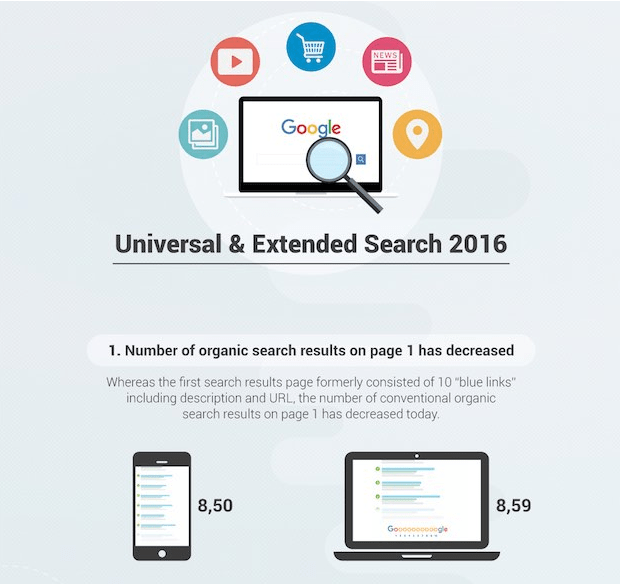
Whereas Google used to almost always display 10 standard, text-based organic results on its first page, the search engine now usually presents fewer results: 8.59 results are presented to desktop users, on average, and 8.5 are presented to smartphone users, on average.

google1.png

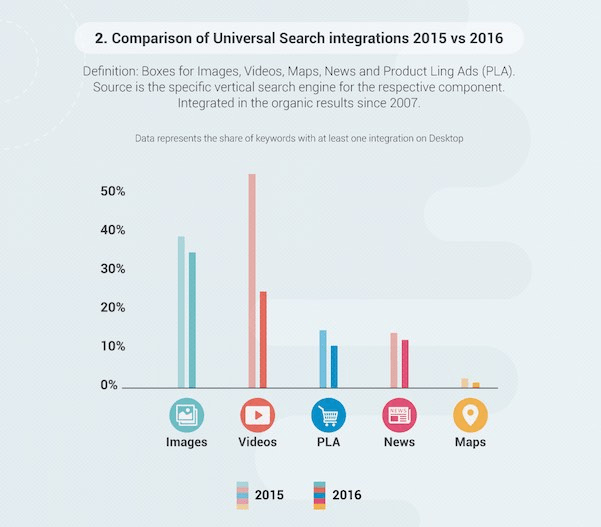
A key reason for the decline in the number of traditional search results presented on the first page is that Google is integrating an increasing number of supplementary boxes/features. Some 34% of the desktop results for the keywords examined by the researchers included image results, 24% video results, and 20% Knowledge Graph results.

Consumers searching on desktop computers are more likely than smartphone searchers to receive Google results with images, product listing ads, and fact/answer boxes; smartphone searchers are more likely than desktop searchers to receive results with video, map, social, and mobile app integrations.

google2.png

Source: Marketing Profs

Related Reading

Posted in #HCSM

4 Ways to Build Trust and Influence on LinkedIn

Do you want to grow your LinkedIn network? Interested in practical, scalable ways to establish your professional credibility?

A recent article from Social Media Examiner shares four great ways to build trust and grow your influence on LinkedIn.

#1: Optimize Your LinkedIn Profile

A strong professional LinkedIn profile creates opportunities for meaningful connections and interactions with other professionals. The article recommends securing your vanity URL, selecting a professional profile image, using industry keywords, avoiding jargon and buzzwords, and including recommendations.

#2: Proactively Grow Your LinkedIn Audience

If you want to grow your LinkedIn audience quickly, you can’t sit on the sidelines waiting for people to notice you.Make an effort to increase the quality and quantity of your connections by inviting your existing contacts on LinkedIn and finding potential contacts to connect with.

#3: Publish Content on LinkedIn

Sharing content on LinkedIn helps you stay top of mind with your core network. It positions you as an influencer who constantly delivers value with high-quality, engaging content. Consider too, publishing your own original content on LinkedIn Pulse  – a super way to showcase your expertise.

#4: Foster Your Community

Simply growing your network on LinkedIn isn’t enough. While more connections mean better social proof, gaining real trust requires an ongoing relationship-building effort. You can do this by commenting on people’s posts and updates, endorsing their skills, and participating in groups discussions.

LinkedIn is an excellent platform for establishing influence and thought leadership, but building influence doesn’t happen overnight. It takes time and effort to expand your network. Many people give up before they achieve significant progress. Follow the advice in this article and you will soon start to see results.

Are we connected on LinkedIn? Send me a message and let’s reconnect if we are. Or if we are not yet connected, send me an invite and I’ll be pleased to connect with you.

https://ie.linkedin.com/in/marieennisoconnor

Posted in #HCSM

What Does the Future Hold For Social Media?

I love these kinds of articles which predict the future of social media. As marketers we need to keep an eye on trends and be ready for future changes in the social media world.

This article from Marketing Land presents six high-level possibilities for social media’s next phase of evolution.

1. Monopolization – one platform coming to dominate the social media landscape – Facebook anyone?
2. Pay-only visibility – are we in the end times of social media’s free lunch?
3. Individualization – Already, social media platforms are recognizing the demands for customizability and personalization in their user bases.
4. Niche segmentation – niche specialists will provide more novel experiences than their massive, slow-moving counterparts – think Snapchat.
5. Virtual and augmented reality – futurists have been including VR and AR in their predictions for the future of social media for a while now – this one is definitely on the future cards.
6. Streamlining  – social media apps becoming one-stop shops for everything you’d want on the internet.

What do you think of these predictions? How do you see the future of social media evolving?


You might also like to read: What You’ll Need to Build the Agency of the Future

Posted in #HCSM

The Other Side of the Firewall: Social Media Developments in Other Specialities #ESCP2016

Buongiorno from Milan this week where I’ve been attending #ESCP2016, the European Society of Coloproctology Annual Meeting. On Wednesday I was part of a social media panel – the only non-clinician (and female!) speaker on the panel.

escp3.png

The title of my talk The Other Side of the Firewall: Social Media Developments in Other Specialities concerned how patients are using new digital technologies to tear down the medical firewall to access health information.

We’ve now entered a new era of networked knowledge, meaning knowledge in the form of ideas, information, wisdom – has broken out of its traditional confines and now exists in a hyper-connected online state.

And this is also true of medicine.

In the new medical paradigm, Web technologies and applications are radically transforming established notions of what it means to be a patient. We’ve entered an era of self-empowerment and self-advocacy amongst patients facilitated by digital technology.

I spoke about the growing recognition of a particular subset of patients who have become specialists in managing their own health and are sharing their expertise not just with other patients, but with physicians and researchers too. Finally I shared some of my favourite examples of this from the ePatient world.

I really enjoying listening to the other panellists who spoke about how they engage online in surgical social media, and I’ve been impressed with their work in actively encouraging surgeons to embrace the digital era. And finally, it’s always fun to see how the numbers stack up thanks to Symplur’s analytics.

escp3r.png.

esCP.png

Catch up with a Storify curation of tweets from the conference.


Posted in #HCSM

Medical Marketing Matters: What’s New This Week In Social Media?

unnamed (1).jpgMy weekly healthcare marketing newsletter has just gone out to subscribers.

In this week’s issue:

  • How to create marketing content that patients find compelling
  • Tapping into trending news as a content strategy
  • Creating a plan for sharing good news on social media
  • 10 common social media marketing challenges – and how to solve them
  • Everything you need to know about Twitter’s latest update
  • How to change LinkedIn’s default settings

Click here to read and subscribe

Posted in #HCSM, Marketing

Medical Marketing: What Does Your Audience Value Online?


alex-membrillo-head-shot
Alex Membrillo

By now, people know that it is imperative that you market your medical practice online. According to a 2013 Pew Research Center report, over three-quarters of consumers start their search for a new doctor online. By ensuring that you have the sort of marketing content that patients find compelling, you can increase your chances that you are the one that they choose.

A few of the best digital marketing assets to have:

1. Testimonials and reviews.

Search Engine Land found that 88% of consumers trust online reviews as much as they trust a personal recommendation. Ask happy patients to provide reviews that can help show your high level of care to new individuals. You can ask in person, include a link to your review page in emails or post on social media. You can include links to common review sites on your site or showcase a few of your best reviews directly on your website. By offering this sort of social proof, you can show potential patients how well your service is regarded by people already seeing your physicians.

2. Answers to common health questions.

About seven in ten individuals has searched online for answers to health questions in the past year. By providing information about common health issues that your patients may face, you can help them be more informed patients and live healthier lives. This sort of content can also make it easier for patients to know when symptoms indicate that they should make an appointment with their doctor. Not only will they be more likely to come in for a visit, they will also have more positive health outcomes by getting care more quickly.

3. A strong social media presence.

A study about social media in healthcare found that 41% of those questioned would choose a healthcare provider based on their social media reputation. By keeping up with what people are saying about your practice on social media and getting in touch with people who have had issues, you can manage your reputation online and keep your image positive and appealing.

Others in healthcare have had success publishing authority articles through platforms like LinkedIn. These sorts of articles establish your credibility and skill in your field and make people feel more comfortable trusting you with their health.

4. Easy to understand visual content.

Many individuals find that they have an easier time grasping health concepts that are learned through images and videos as well as text. By including diagrams, images and videos as part of your online marketing, you can empower patients with knowledge about their health and build a stronger and more comfortable relationship. You can even do live Q&A sessions using services like Facebook’s live streaming. This can help potential patients with some of their health questions and showcase your authority and expertise in your area of practice.

5. Practical content like checklists.

Content like printable checklists can make it easier for patients to do the right things for their health. For instance, a sheet on ways to protect yourself from the common cold can be a popular offering when it’s time for kids to head back to school. A summer break checklist can help your patients pack the right things in their travel first aid kit and keep themselves safe from sunburns and heat stroke.

Posting frequently and serving up a wide variety of medical marketing content can make your presence online helpful and informative to both current and prospective patients. By focusing on what materials will be most useful to them, you can begin building the trust that leads to strong relationships before they ever make their first appointment with your practice.


About the Author

Alex Membrillo is the CEO of Cardinal Web Solutions, an award winning healthcare marketing agency based in Atlanta, GA. His innovative approach to digital marketing has transformed the industry and delivered remarkable results to clients of all sizes and markets. Membrillo has extensive experience with healthcare and physician marketing.  Cardinal has been 3-time consecutively named on Inc. 5000 list of fastest growing privately-held US companies. Visit www.CardinalWebSolutions.com to find out more about Cardinal Web Solutions.  Follow him on Twitter @Alex_Membrillo


Posted in #HCSM, weekly round up of news

What Role Will Marketing Play in the Evolution of Healthcare?

My weekly marketing newsletter has just gone out to subscribers. In this week’s newsletter you can catch up on an interview with Ritesh Patel, Chief Digital Officer of Ogilvy CommonHealth Worldwide, who shares his views on the role marketing will play in the evolution of healthcare.

The modern healthcare marketer has to combine the knowledge and skills of marketing, brand building and customer experience, as well as work within a highly regulated environment and navigate the new media landscape that most other marketers in industries like consumer goods take for granted. – Ritesh Patel

cmworld-influencers-2016-600-2-1

There’s a round-up of wisdom and insights shared at last week’s gathering of marketers at Content Marketing World including quotes like this one:

Marketers should opt for sustainability over speed. — Ann Handley, Chief Content Officer, MarketingProfs

Plus an investigation into which marketing channels have the best ROI measurability, three social media marketing legal issues you should be aware of, the latest updates on Twitter’s new, longer tweets, and six key changes implemented this week by the leading social channels.

Catch up with this week’s newsletter here


Posted in #HCSM, social spotlight

Social Spotlight: Professor Brian Dolan

facebook_c9198e6a15

This week it was my great pleasure to catch up with fellow Irish man and global citizen, Brian Dolan.  A director of Health Service 360, Brian has a career that spans more than 30 years working as a nurse and nursing leader with a background in both acute mental health and emergency nursing.

Hi Brian, I am keen to learn more about the role social media plays in your work. Has it led to any exciting projects? 

BD: For some years now I’ve been talking about the last 1,000 days – the time left if you’re an 80-year-old woman whose life expectancy is 83 years or 76-year-old man whose life expectancy is 79 years – and why patient time is the most important currency in healthcare. In July my blog on this topic was published by @FabNHSStuff and curated by the wonderful @PeteGordon68 and @ECISTNetwork. It seems to have taken on a life of its own through twitter, LinkedIn and Facebook and will now the subject of my next book, ‘The Last 1,000 Days’. Thank you social media!

That’s really exciting Brian! So when did you start using social media. What prompted you to get started?

BD: I started using Facebook 7-8 years ago mainly for staying in touch with family and friends, as I work and live in New Zealand and the UK, as well as having extensive travel to Australia. With cousins in California it means I can chat with loved ones up to 19 time zones away!

I think that’s certainly true of many of us – we are led into social media for personal reasons, but then we discover a whole other side to it. Professionally, which platform do you enjoy using the most?

BD:  While Facebook has been wonderful for reconnecting with friends and family from childhood and beyond, I really enjoy Twitter as the single best source of Continuing Professional Development I’ve known in my career. I also love that you can create personal connections with so many eclectic, interesting and generous folk – like yourself Marie! – whom one might not otherwise meet.

I agree! Meeting like-minded people has been one of the most rewarding aspects of social media for me too. Which topics interest you? Do you take part in any particular twitter chats?

BD:  While unsurprisingly nursing is my main interest, quality and service improvement, all things Irish and PhD research are also places I live on twitter. Time zone constraints mean I don’t get to enjoy as many twitter chats as I would like but I like to catch up via their hashtags.

What advice would you give someone just starting out on social media?

BD: Twitter is not just about Kardashians and the waters of healthcare Twitter are warm, kind and generous, so jump right in. Always be your best self on social media and don’t be tempted to feed the trolls!

Great advice! Finally, would you like to share a favourite quote with us?

No matter how educated, talented, rich or cool you believe you are, how you treat people tells everything. Integrity is everything.

Thanks so much Brian for taking the time to share with us your experience of using social media in your work.  It’s been a pleasure to get to know you better through this interview and I look forward to hearing more about your new book when it’s published.


Read: The last 1,000 days: What happens when patient time becomes the most important currency in healthcare #last1000days

Follow Brian on Twitter @BrianwDolan