In the era of big data, the presence of cancer in social media is undeniable.
Last October at the European Society for Medical Oncology (ESMO) 2018 Congress, a group of researchers from Spain presented findings on how Twiter users talk about breast cancer on the social media platform.
Study author Dr. Rodrigo Sánchez-Bayona of Clinica Universidad de Navarra in Pamplona, Spain, said: “Many of the patients we see in daily practice use social media to search for information about their disease, so, as care providers, we wanted to know what kind of content they find there. At the same time, the sheer volume of posts on Twitter represents a rich pool of data we can use to assess attitudes and discourses surrounding cancer.”
Twitter is one of the biggest networks worldwide, therefore, it establishes an enormous real-world data field of interest when studying health issues.
The study involved analyzing all tweets posted with the hashtag #BreastCancer over a 7-day period, grouped into four subthemes: diagnosis, treatment, prognosis and prevention.
The data collected included 3,703 original tweets and 2,638 retweets.
The most frequent motive was patients sharing their experiences, followed closely by patient advocacy. The most common subtheme by far was prevention (44.5% of tweets)
“When examining the original tweets, we found that only one in three had medical content,” said Sánchez-Bayona. “However, 90% of this medical information was appropriate, which is likely owed to the fact that 40% of tweets came from institutions and public accounts.”
Classification of Tweets
A total of 1,137 tweets (30.7%) contained content relating to a patient’s experience, while 96 tweets (2.6%) contained an experience from the perspective of a relative of a patient.
Sixty percent of tweets came from private accounts, while 40% came from institutions or public accounts.
The aims of tweets included scientific (17.3%), advertising (15.8%), fundraising (8.3%), and patient advocacy (25.3%).
Description of tweets (%) containing #BreastCancer in a 7-day period
Leveraging A New Social Media Reality
Commenting on the study, Marina Garassino, MD, of Istituto Nazionale dei Tumori in Milan, noted the presence of patients in large numbers on Twitter. “We should take that as corroboration of a new reality,” she said.
Patients now use the web to find information, and social media must be an integral part of our communication with them. Academic institutions and key opinion leaders need to be even more active in spreading their findings through these channels to counteract the many ‘fake news’ circulating online.
Dr. Evandro de Azambuja, ESMO Executive Board member, further commented: “Healthcare professionals and organisations really need to use appropriate social media as a way of sharing relevant information – both between them and with patients – because that is where it has the potential to be picked up fastest and most broadly.”
When it comes to bringing the best evidence available in cancer research to the attention of as many people as possible, this platform is as powerful a tool as it gets.
Conclusions
The authors noted that this was part of a larger study on discussion of diseases more generally on social media, in which they found that cancer was the most mentioned pathology on Twitter around the world.
The results of the study may be useful in assisting advocacy organisations to provide information about resources, support and raise awareness.
In particular, advocacy organizations can draw on them to create relevant medical content and counseling about cancer that will be more accessible to patients already using Twitter for information and support.
I love learning about new tools to make social media marketing more creative and effective, so I’ve decided to share some of my favorite tools with you at the start of each week. This week I’m recommending a digital storytelling tool called Apester.
Described as a novel way to tell any story visually and natively blend it into any webpage, Apester’s plug and play tool mixes text and images with interactive content to create compelling stories. More cool features include the ability to create interactive content such as polls and quizzes.
Amazingly for such a super cool tool Apester is totally free! Check it out at apester.com
This week’s interview shines a spotlight on the work of BioPharma Consultant, Dr Nora Cutcliffe.
One of the many things that delight me about this series of interviews is when interviewees come back and tell me they enjoyed the exercise of reflecting on why they use social media. Nora is one of those for whom this process was a chance to reflect and she came back to me with so many rich insights, that for the first time, I’m splitting an interview into two parts.
After working for a decade with a biotech company (Hemosol Inc.) in Toronto, Canada, Nora has been freelancing as a consultant in the field of Biologics for over 15 years. In this first part, I ask Nora about the role social media plays in her work and she shares some tips on getting the most out of Twitter and LinkedIn.
Hi, Nora, I’m excited to have you share your social media story with us today. I know you have many thoughts, so let’s get started right away.
NC: First, I want to say right out of the starting blocks that you, Marie, have been such a powerhouse of knowledge, skill and generosity of spirit in sharing your social media talents – and I’m indebted to you for these gifts! You’re an inspiration to all those in the health care social media (#HCSM) space, and I feel honoured that you’ve invited me to do this interview.
Oh, I’m blushing now. And it’s also true that you have been very generous in sharing information with me, for which I too am most grateful. Can you tell us something about the role that social media plays in your work?
For the past 10 years, I’ve focused exclusively on vaccines and immunization, primarily as a medical writer. I use social media to keep up-to-date as a subject matter expert, and also to share resources with immunization experts, pharmacists and other health care providers, as well as health-related organizations.
To walk you through to the core of my current interests and future direction, if you can picture two overlapping circles (as for a Venn diagram), then the first circle would be pharmacy practice – this field is rapidly expanding its scope in the areas of immunization, smoking cessation, management of hypertension and treating minor ailments, while facing challenges in deprescribing and overuse of opioids, to name a few relatively new specialties.
The second circle would be the field of immunization, which involves vaccine access and delivery by multi-disciplinary health care providers (HCP), all of whom can help increase vaccine coverage. The intersection of these two circles would then include trained pharmacists who offer immunization services (i.e. “Pharmacists-as-Immunizers”, PAI), or alternatively, it could be described as the subset of vaccine delivery that is handled through pharmacies.
That’s really interesting. This is the first time I’ve come across the role of “Pharmacists-as-Immunizers”, can you expand on this for us?
NC: While the concept of Pharmacy-Based Immunization Services is a newly burgeoning field in academia in its own right, I see this area as a current gap in the literature and likewise on social media. Researchers tend to publish in one camp (circle) or the other, often without setting the data in the context of the broader landscape.
Also, it appears that some vaccinators (e.g. MDs, RNs, public health providers, and pharmacists) are still relatively “in the dark” regarding each other’s contribution and/or challenges, and some providers may not function with the mindset that they’re all part of the same team.
So I strongly agree with a key message put forward by @DrVivienBrown, who states that “Immunization is a team sport” – and she also emphasizes that participation is required by both immunizers and patients, as advocates for themselves. While Dr. Brown has focused on Canada, these are common themes on health agendas in other developed countries.
Given this situation, my topline goal for using social media is to help health care professionals and policy-makers become more aware of the research and evidence to demonstrate that PAI are already “moving the dial” towards greater vaccination coverage, particularly for adults.
It sounds to me as if you are a pioneering voice in taking this discussion online. What kind of things are you posting to spread this key message?
NC: In addition to sharing reports describing the progress being made by PAI (in targeting other HC professionals), I also post resources targeting PAI themselves, to help them keep abreast of changes in vaccine market access, etc. For example, I like to share updates on new vaccines being approved and/or publicly funded for specific age cohorts across Canada’s provinces and territories (such as new flu vaccines tailored specifically for adults over 65 years; the new recombinant shingles vaccine; and the 13-valent pneumococcal vaccine).
Whether these new vaccines are publicly funded, or available only on the private market, they are being requested more frequently at the pharmacy by the general public. Since pharmacists are positioned as highly accessible HCPs who can educate patients with up-to-date information, they need to stay nimble and constantly update their reference tools. So that’s what I hope to contribute – and to support PAI consultations with patients that lead to informed decision-making on immunization.
This year I’m excited to be working on several manuscripts with a team from the University of Waterloo School of Pharmacy – a group that also has a strong digital footprint on several platforms (e.g. Pharmacy 5in5; @UWPharmacy; and @open_pharmacy). Together with a small group of pharmacists across Canada, we’re planning to produce a series of approximately 8 papers on the topic of PAI, to be published in a special issue of the Canadian Pharmacists Journal (CPJ) in 2019.
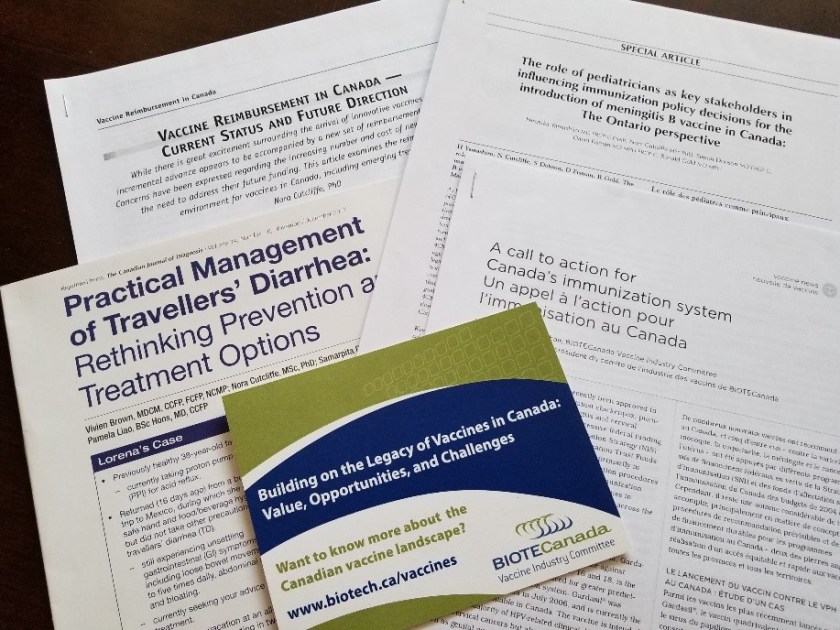
A selection of Nora’s recent publications in Immunization
So this is a fascinating project for me, in which my client work will align almost perfectly with my interests on SM/Twitter, and some of my new Twitter contacts will become my working team. In this case, since the CPJ journal is in the public domain, we’ll be able to share the final deliverable(s) widely on Twitter, LinkedIn, and potentially other channels.
I love this! It reminds me of a quote from Frederick Buechner – “Your vocation in life is where your greatest joy meets the world’s greatest need.”
So now, take us back to when you first started using social media – what prompted you to get started?
NC: I’ve been using LinkedIn for more than 10 years in tandem with growing my consulting business, and I started dabbling with Twitter and Instagram more recently, in 2016. I was initially motivated to use Instagram and Twitter @NoraCutcliffe as part of my volunteer role as Co-Captain of Advertising for the massive annual Flea Market at Kingsway-Lambton United Church, which has generated over a million dollars in proceeds for charity since its inception several decades ago.
I then realized I could easily transfer my social media skills & tools to my ‘day job’ as a medical writer, both to facilitate access to the latest research and news items, and to increase my visibility across my target client base through my own posts. In general, I also wanted to become more digitally literate, and take the opportunity to apply my career experience in immunization in new ways that could continue to grow/expand into the foreseeable future.
A great turning point came for me when I attended a terrific breakfast session in mid-2016, hosted by the Ontario Pharmaceutical Marketing Association (OPMA), entitled “Harnessing the Power of Social Media Marketing in Pharma”. One of the workshop panelists was Yaz Maziar, Senior Director, Marketing & Communications, Prostate Cancer Canada, who is a fabulous role model for wildy successful Twitter awareness campaigns – and from whom I continue to learn as I’ve followed him @ProstateCancerC ever since.
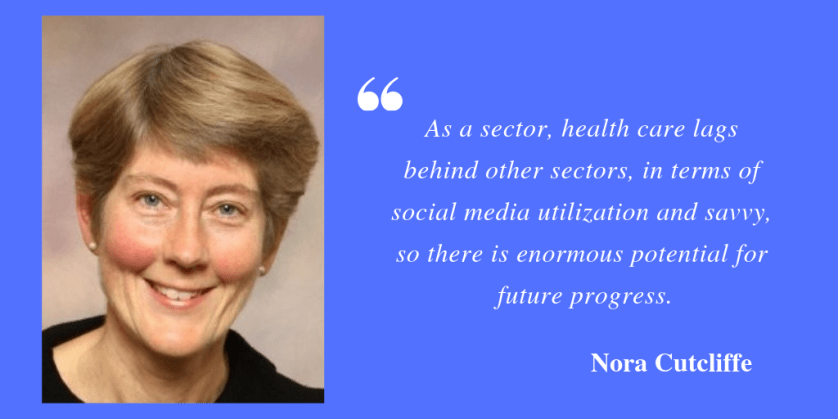
Among other lessons learned that day, I had two key takeaways from that workshop on HCSM. First, as a sector, health care lags behind other sectors, in terms of social media utilization and savvy, so there is enormous potential for future progress. And second, on a more practical “how to” level, I learned that one of the best ways to build a base of followers, say on Twitter, is to simply dive in and consistently post accurate content, building your reputation as a reliable source of timely, useful information. In those early days, Marie, I must reiterate what a tremendous font of knowledge and guidance you were for me – in leading by example, and demonstrating how to become a more competent Twitter user!
Blushing again 🙂 As you know I’m a Twitter evangelist and I love to see how people use it for good. How does Twitter fit into your marketing mix?
NC: My main marketing strategy is to attend conferences to keep acquainted with old contacts and constantly develop new relationships. I feel I’m in a very fortunate position to have more potential work than I can reasonably handle, so I can select projects while declining others. So at this point, I don’t devote any budget to SM activities. However, this may change, with many things on my list to learn, including better use of Twitter (or other) analytics, Twitter lists and surveys, to name a few.
I would also love to test the waters with using Twitter for ‘crowd sourcing’ of data or opinions, as you did, Marie, when you created your article on “How to Read and Understand a Scientific Paper”. I was totally intrigued to see how efficiently you requested input across your Twitter base, compiled replies (including my own), and published this piece!
Nora & colleagues at Holiday Reception@BioSciencePEI (PEI BioAlliance, promoting the growth of the BioTechnology sector in Prince Edward Island, Canada)
While Twitter is the mainstay for most of my posts, I routinely check LinkedIn for content posted by my connections. I rarely use Instagram, except in my volunteer role with the church Flea Market as mentioned above. Since joining Twitter, I’ve also created several “Twitter Moments” to capture conference or other event highlights. In addition, I really enjoyed using the Storify platform and its ability to consolidate posts across various SM platforms (e.g. from Facebook, Twitter, and Instagram) all into one ‘Story’. So after learning how to use Storify based on your online tools posted @JBBC, I was really disappointed to see this platform was discontinued in 2018.
I really like that aspect of using Twitter to curate conference highlights and I too miss Storify greatly. Twitter Moments, while not as good, is still an effective curation tool. Can you tell us some more about your audience on Twitter?
NC: Currently, I have a very modest number of Twitter followers, but in keeping with my client work, many of my followers are organizations, on both the pharmacy side (including provincial and national pharmacy associations) and pertaining to immunization (including national/provincial public health, research and advocacy groups). The upside of this situation is that a single RT of one of my posts by one of these organizations can have a great reach, across their large membership base(s). Occasionally, even with just 4 or 5 RTs, one of my tweets may reach 20-50K followers, which is quite gratifying for me. In general however, my goal is to increase impact, rather than absolute number of followers.
You’ve hit the nail on the Twitter head here Nora. One of the most powerful things about Twitter is this network effect – the exponential reach of a single tweet. How about health-related Twitter chats? Do you take part in any?
NC: Overall, I consider myself a neophyte on SM. To date, I haven’t contributed to Twitter chats per se, but I have participated in several Twitter campaigns to support advocacy months/weeks/days on both pharmacy and immunization topics.
What I like most about Twitter is that it keeps me up to date, as the single best and most timely source of information in my areas of interest. A second big attraction for me is that tweeting is the antithesis of creating lengthy, confidential reports that I typically develop for consulting assignments. On Twitter, I can quickly share URL links to many resources (including some of those I use in compiling client deliverables), and voilà – instant gratification!
It’s a fun challenge for me to keep within the allotted 280 characters, and a very different reward system in my brain compared to sending out to a client my bread-and-butter “long form content”, a new buzzword I learned recently from you Marie, @JBBC!
Thirdly, wearing my consulting hat as a knowledge broker, it’s important for me to keep an excellent paper trail to retrieve key data that I want to reference later on. Recently, I realised that when I post an update as a Tweet, I’m more likely to remember the data and source – or in other words, “I tweet, therefore I remember”. This may be because I’ve taken a few brief moments to process the info, and repackage it for others. So to some extent, my Twitter feed doubles as a progressive reference library for my own use as well.
Now that’s a super idea. I tend to do the same thing through favoriting tweets. I know you’re also active on LinkedIn. Tell us some more about how that works for you.
NC: I haven’t yet posted any content re pharmacy-based immunization on LinkedIn since my network is much broader (500+ lifetime career contacts) and not many of these folks would be interested in this specific niche area. However, I love that LinkedIn allows me to automatically stay connected with colleagues who move to new positions (which happens constantly in health care), and it’s the perfect opportunity to send “Congratulations” and stay in touch.
Also, since my work involves a lot of teleconferences (TCs) with groups of up to 10 people, another benefit of LinkedIn is that I can look up new contacts prior to ‘meeting’ them by phone, even if we are not yet “linked”. I like to check out research interests and see if I have any contacts in common with new colleagues. If I mention specific publications or contacts during a first TC, this creates an instant connection, and I find that to be very powerful.
Even seeing a LinkedIn profile with photo – to get a sense of character and personal style – is helpful in identifying new voices and understanding team dynamics during a fast-paced phone call. This can be especially important when I need to hastily distill action points for myself and/or other TC participants before winding up the call. Then, immediately following a TC, I send invitations to connect on LinkedIn, while the discussion is still fresh in everyone’s mind.
Another note on LinkedIn is that after using this platform for several years, I attended a very inspiring workshop in 2017, as led by Ross McPherson, targeting Oxford alumni living in the Toronto area. One excellent piece of advice Ross gave us, among many other tips, was to ensure that you review the format of your LinkedIn profile on your cell phone before finalizing new edits. He underscored the fact that your ‘Headline’ (the blurb that appears immediately under your name) has capacity for 100-odd characters, and this should be used optimally to market yourself. Note that your ‘Headline’ is different from the longer ‘Summary’, which is truncated on the cell phone display. To be blunt, some browsers may never read beyond a brief Headline, so be sure to nail this one upfront!
I also want to mention Jade Pluck as a terrific expert on using the LinkedIn platform. In early 2017, Jade graciously and efficiently guided me (via online messages) through what I needed to know to maneuver through the new user interface that was being rolled out that time. I would highly recommend her training videos and/or services for those looking to improve proficiency on LinkedIn.
Nora, this has been a fascinating discussion – but we’re not done yet. Join me next time for Part 2 of this interview.
This post is part of an ongoing conversation that explores how patients, healthcare professionals, and researchers use social media to communicate their work. For more interviews, click here.
I love learning about new tools to make social media marketing more creative and effective, so I’ve decided to share some of my favorite tools with you at the start of each week. This week I’m recommending online banner maker Banner Stack.
Banner Stack is a cloud-based, easy-to-use, professional banner maker compatible with all the main social media platforms. You have everything you need to build creative static, animated and/or interactive web banners in minutes, including stock photos, drag and drop text, images, buttons, cliparts and high-quality fonts.
The free plan allows you to design 10 banners. Pro Plans start at $7 per month.
This week I caught up with Chris Lewis, patient activist extraordinaire.
Over a decade ago Chris was diagnosed with stage4 Mantle Cell Lymphoma (a rare blood cancer) and given six months to live. Aggressive chemotherapy followed plus a stem-cell transplant from an unrelated donor via the Anthony Nolan charity.
The next few years was a rollercoaster of hospital stays as Chris battled medical complications. He saw first-hand how disjointed the cancer support sector is and so he started to address the issues he found most concerning through his blog – Chris’s Cancer Community.
This has become the most popular cancer blog in the UK and Chris is frequently invited to speak around the world about his experiences. Most recently, he has set up simPal, a unique charity that gives free phones and sim cards to anyone affected by cancer.
This is Chris’s social media story.
Hi Chris, I’d like to start off by asking you to tell us something about the role that social media plays in your work.
CL: I am the founder of Chris’s Cancer Community and Co- Founder of SimPal, the only charity in the world providing free mobiles and pre-paid simcards for people affected by cancer. None of this would have been possible without social media. My work is known across the globe and I do several international speaking trips every year. I am now the most influential cancer patient in the UK.
When did you start using social media – what prompted you to get started?
CL: My illness started in 2007, and I had absolutely no knowledge of social media. My health was unreliable and I was in and out of hospital. I began to see how poor support was for people living with cancer and wanted to know if it was only me who felt like that. I have a business background and started asking around. Friends of mine created a very simple blog to start with. My ‘community’ started to grow, my work was winning awards, and the rest as they say is history.
It’s wonderful to see how far you’ve come since those earliest beginnings. You now have a presence on several platforms, which is your favourite?
CL: No competition here, it is Twitter! I use Facebook and Instagram too but Twitter works best for me. Short and sharp engagement is key. I have a reasonable following which is continually growing. Although cancer is a big part of what I do, I like to mix things up a bit and speak on current issues, whatever they might be. Also my big love of football! I have been using social media for more than 7 years now, and wherever I am speaking in the world, there are people in the room who follow me, and that is a nice feeling!
Which topics hold your interest the most on social media?
CL: I am particularly interested in the subject of ‘patient engagement’ As a business guy I was shocked when entering the cancer sector, how little effort was put into this. It seems it was mostly box ticking. We are customers of the system, in whichever country you live. Rarely do we have and serious role in designing systems and tools to help us. I don’t know any business that does not talk to its ‘customers.’ Surely they are the most important part of your work? I used to do many twitter chats but as my work has exploded I have so little time to get involved. I find I must limit myself on social media or the entire day can be gone before you know it!
Do you have any advice for others who are just starting out with social media?
CL: Firstly establish what you want to achieve on social media! Many people are purely there because they feel they have to be. Ask yourself what does success look like for you? Most people are on there to ‘sell’ something, be it a product or a service, but just like in real life it is how it is done is the real key. Unless you listen and engage with others they won’t with you. Remember to listen more and speak less, that way you will learn quickly. Finally, we all started with no followers!!
Oh that’s so true Chris!
So, I like to end these interviews by asking for a favorite quote. Do you have one you’d like to share with us now?
I think kindness is my number one attribute in a human being. I’ll put it before any of the other things like courage or bravery of generosity or anything else. Kindness—that simple word. To be kind, it covers everything to my mind. If you’re kind that’s it.
― Raold Dahl
We sure could do with more kindness in the world – thank you for the reminder Chris! And thank you for taking the time to share your social media story with us.
If you’d like to learn more about the global work that Chris is doing you can find more information at Chris’s Cancer Community and SimPal.
This post is part of an ongoing conversation that explores how patients, healthcare professionals, and researchers use social media to communicate their work. For more interviews, click here.
Welcome to this week’s quick social media tip. Today I want you to think about how you can tap into cultural trends to create “in-the-moment” marketing.
Tapping into cultural trends is all about marketing in the moment. This works because people are most interested in “what’s happening now.”
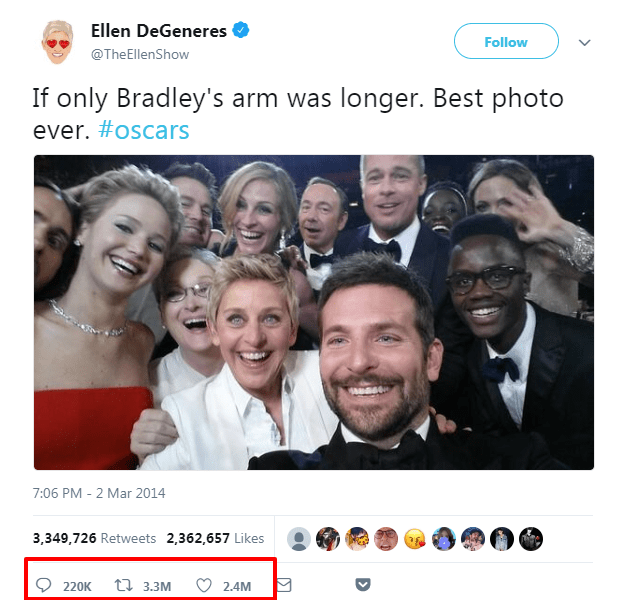
Ellen DeGeneres’s 2014 Oscar selfie, retweeted by more than 2.9 million Twitter users fits the scenario of leveraging a cultural trend — the word selfie was crowned Oxford Dictionaries’ Word of the Year in 2013.
Similarly, the #nomakeupselfie campaign, in which women posted pictures of themselves without make-up in order to raise money for cancer research, tapped into the selfie trend. The campaign raised (Stg)£8 million for Cancer Research UK in its first week alone. This campaign wasn’t even the charity’s idea. The organization leveraged a cultural trend that was already sweeping the Internet.
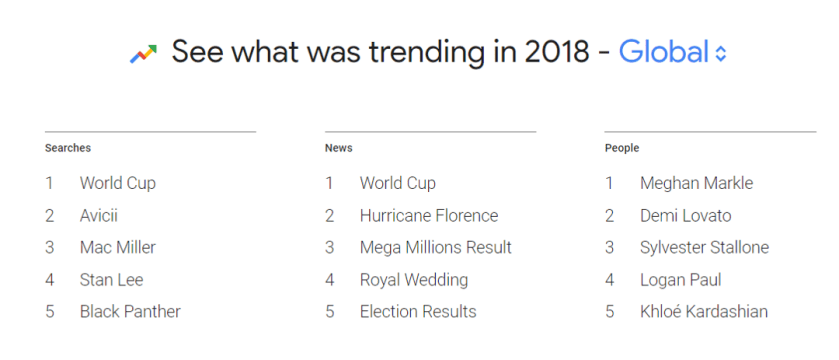
While the Oscar selfie took us by surprise, there are other trends which are more predictable, for example, major sporting events like the Super Bowl in the US, or the World Cup.
Twitter is an obvious place to check what’s trending on a daily basis, but you could also try one of the following tools too:
Google Trends — filter your search by country, topic, category, specific topic, content type, and more;
Buzzfeed — its trending section is perfect for searching for hot topics;
Buzzsumo — search for the most shared web content on a specific topic;
Reddit — aggregates trending content from all over the internet and shows the hottest (most upvoted) topics on the main page.
Your homework for today – find one trending topic and think about how you can leverage it to create engaging content relevant to your own audience.
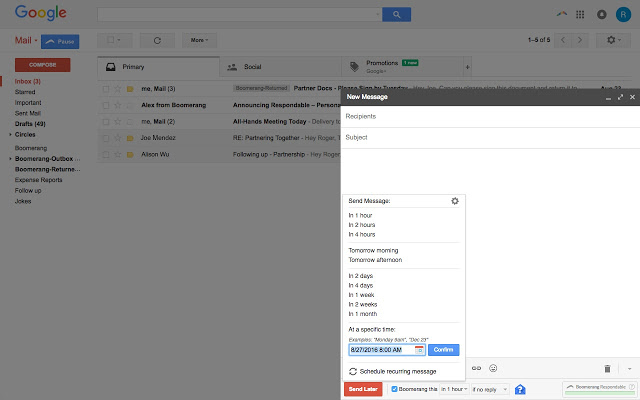
I love learning about new tools to make social media marketing more creative and effective, so I’ve decided to share some of my favorite tools with you at the start of each week. This week I’m recommendingBoomerang for Gmail.
Boomerang allows you to schedule messages to be sent or returned at a later date. Write a message now, send it whenever, even if you’re not online. Track messages to make sure you hear back, and schedule reminders right inside Gmail and know whether your email got read with cross-platform read receipts.
Boomerang also helps you to postpone (“snooze”) incoming emails, by making them disappear from your Inbox into a folder or label, then bringing them back to the top of the message list at the specified time. It helps you keep your Inbox clean, without losing track of important messages. I also like to use the Inbox Pause feature to temporarily pause my Inbox so I can work more productively.
I love learning about new tools to make social media marketing more creative and effective, so I’ve decided to share some of my favorite tools with you at the start of each week. This week I’m recommending InShot a mobile video editor for iOS or Android.
InShot allows you to add music, effects, voiceovers, emojis, and text. You can also adjust the video speed, and control where elements you add appear on the video timeline. This app will work perfectly for any videos you create for Instagram, Facebook Stories, Facebook news feed, and so on.
The app can work with vertical, landscape, and square video formats. It can even transform one format into another. Unlike some mobile video apps, you don’t have to record video within the InShot app. You can import video, and even merge separate videos from your camera roll and arrange them in a specific order.
The InShot app is free, but with in-app purchases, you can add effects, filters, stickers, and stamps
Your reputation is one of your most valuable business assets in today’s digitally driven world.
Social media has an increasingly important role to play in maintaining an organization’s reputation and image.
Not only are patients seeking health information online, but many also say their choice of a specific doctor, hospital or medical treatment is influenced by social media.
One-third of health consumers use social media sites to research health information, track and share symptoms and vocalize how they feel about their doctors, drugs, treatment plans, insurance, and medical devices. Many say their choice of a specific doctor, hospital or medical treatment is influenced by social media.
And with the advent of patient review sites, and online discussion forums, you risk leaving your brand reputation in the hands of others.
Don’t think because you don’t appear online doesn’t mean you aren’t being talked about.
The fact is that patients are talking about you online whether you are there or not!
You can’t opt out of reputation management – whether you have a social media presence or not, a patient who has a bad experience with your organization is only one tweet or Facebook post away from sharing it with the world.
It is far better to take control of your reputation by responding to these conversations yourself and correcting any misinformation or misperceptions. Responding in real time strengthens public perception that your focus is firmly on patient satisfaction.
A successful social media presence hinges on the trust between you and your followers.
Becoming a trusted source of health information for your patients and proactively developing a strong, consistent, and credible image online will increase patient trust and confidence in your organization.
It’s a lengthy post but if you’re serious about marketing your medical practice online in 2019, I highly recommend you take some time to read it over the coming days.
Below I’ve highlighted five of these trends which I think will have particular relevance to medical marketing.
Social media is continually evolving. Every year, everything from algorithm updates to emerging trends shapes and informs the myriad ways we interact online. As you plan your social media marketing for the coming year, consider how you can implement some or all of these trends in your own online strategy.
Final Thoughts
No matter how you approach your marketing efforts to take advantage of the digital marketing trends coming in 2019, never lose sight of the fact that in healthcare your reputation as a credible, and trusted source is paramount.