What makes the perfect Tweet?
SocialBro and Hubspot delved into the science of Twitter to come up with some answers shared in this infographic.

You might also like: 9 Science-Backed Tips to Double Your Twitter Engagement

What makes the perfect Tweet?
SocialBro and Hubspot delved into the science of Twitter to come up with some answers shared in this infographic.
You might also like: 9 Science-Backed Tips to Double Your Twitter Engagement
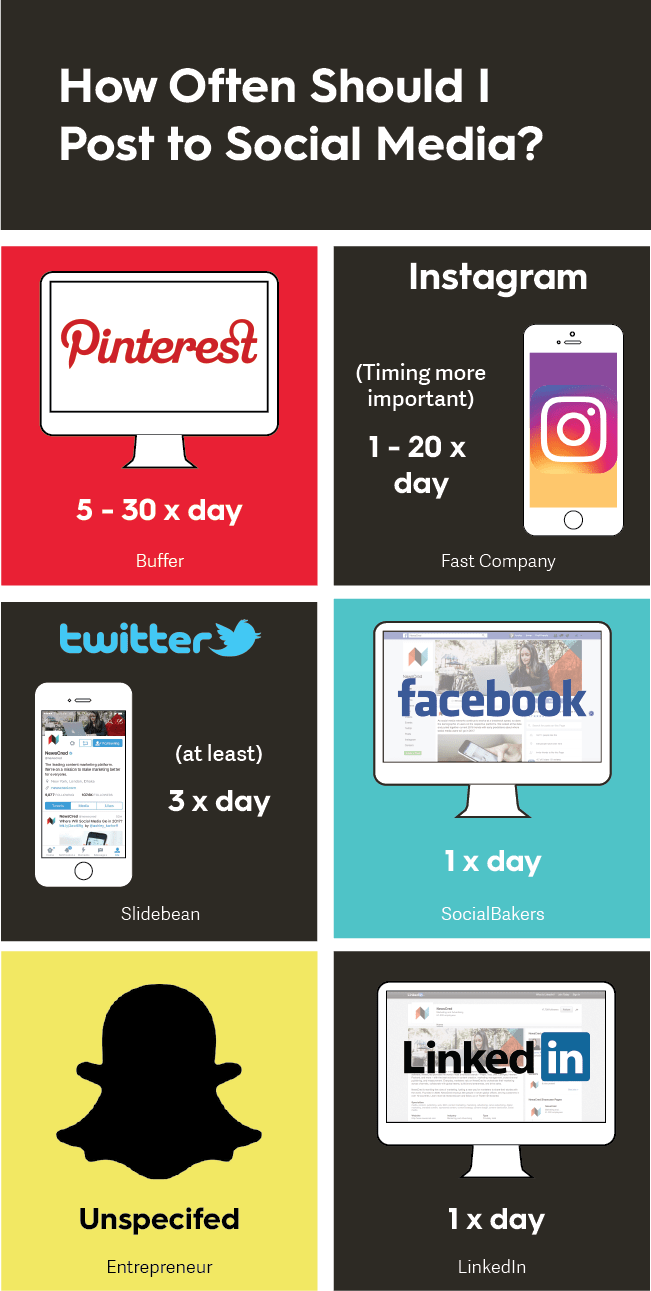
Marketers are often surprised by recommendations on how often to post to social media. They fear they’ll be viewed as spam by their followers. What they’re not realizing is that any single post reaches a small fraction of your target audience, regardless of how effectively you time your posts. This Newscred article offers a comprehensive guide to the optimum time and place to post your updates online.
Related Reading:

Late last year Twitter removed the share counter displayed alongside the Twitter icon on websites and blogs. Why was this such a big deal? It mattered because in one move, Twitter destroyed a basic tenet of social proof. For those players who can afford the premium service GNIP (owned by Twitter) this won’t be an issue, but it is a blow for those of us who operate on small social media budgets. With this change, Twitter has moved from its original premise of open sharing to one in which we will have to to “pay to play” if you want to compete on a level playing field.
But there’s good news! A service called New Share Counts promises to restore your Twitter count for free. The service can only provide access to 7 days of Twitter history from the day you add your website to tracking. Shares that happened before might not be counted, but further shares are counted properly.
Read How To Get Your Twitter Share Count Back to find out how to register for and use the service.

This week it’s my great pleasure to catch up with James Legan, MD, an Internal Medicine Physician, now in his 23rd year in Private Practice in Great Falls, Montana, USA. James blogs regularly about patient care and technology, and was an early adopter of live video streaming platforms Periscope and Blab. A talented painter, James is also one of the friendliest, kindest and most welcoming persons I have met online.

Hi James, I know you have a passion for combining technology with patient care, could you begin by sharing an example of how you do this.
JL: My passion has been sharing my experience with #ProjectedEHR, an approach that I have been using for the past two and a half years at the point of care with my patients. I use a wall mounted 24 inch screen in each exam room and as I walk in and greet the patient, hook the 14″ Acer Chromebook via HDMI cord to the large screen. Instantaneously the patient and I can look at their own data/information contained in their electronic record. I have had such a positive response with my own patients, I share this approach whenever I can get the chance.
When did you start using social media. What prompted you to get started?
JL: About 2 years ago I started with Twitter, which has been the “nest” for my Social Media Platform with links to my Periscope, Blab and WordPress sites. Desiring to share #ProjectedEHR as a way to give back to the Profession, with the intention of hopefully helping others in the medical arena is what got me started.
Which platform(s) do you enjoy using the most?
JL: I think all the platforms are a bit different and reach different followers, some merge, some separate. I like to blog for disseminating things learned along the way. I like Periscope to share fun things primarily, mostly on the weekends. Blab is a great way to brainstorm in small groups, and the next best thing to being together IRL (in real life) and better because of the connections world wide. So I like all of the platforms and don’t have any particular favorite, just mix it up depending on how I want to connect and with whom.
Which topics interest you – eg do you take part in any particular twitter chats?
JL: I particularly like topics regarding technology and patient engagement, and #HealthXPH, #HITsm #IrishMed and #HCLDR are twitter chats I have been most involved with
What advice would you give someone just starting out on social media?
JL: Don’t share anything you would not if printed on the front of your local newspaper, and have fun. Read Marie Ennis-O’Connor’s rules of social media, and don’t break them. 😉
Finally, would you like to share a favourite quote with us?
JL: “Listen to your patient, he is telling you the diagnosis,” from Sir William Osler.
Thanks James for taking the time to share with us your experience of using social media in your work. Your commitment to patient care shines through in everything you do.
Follow James on Twitter @jimmie_vanagon
I really like this Infographic from Salesforce on how to handle different types of comments on social media. I’ve highlighted some key takeways at the end.
Click To Enlarge
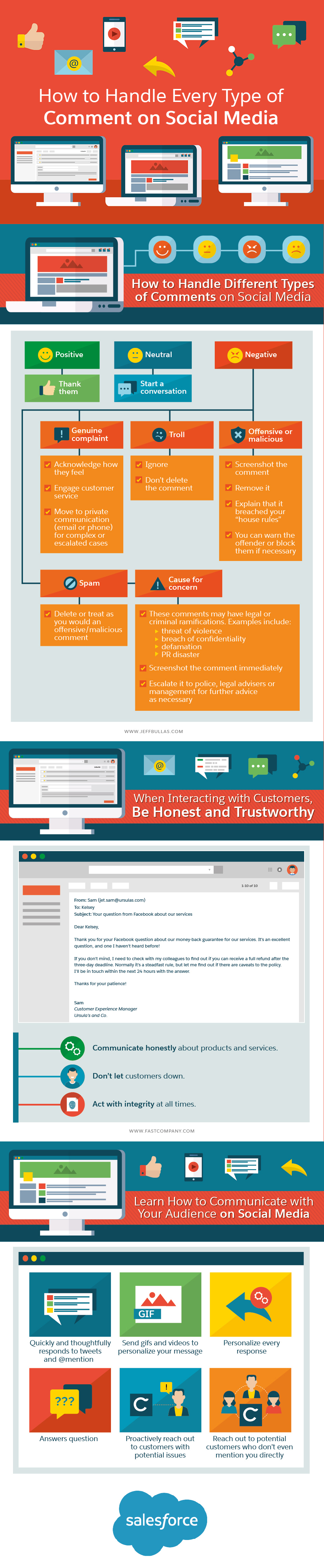
Via Salesforce
Key Takeaways
Respond in Your Brand’s Voice
It’s important to be consistent with your voice on social media: It should match what you convey through customer service, your website, and any other advertising or channels where a customer may be exposed to the brand.
Respect Their Emotions
When people are upset, they often just want to feel validated; even when you don’t understand where people are coming from, it’s important to respect how they feel.
Create an Answer Library
Take comments from your social media users and turn them into content, and think of how you can provide content that’s a valuable service and invites your customers and fans to be part of your brand’s story.
Personalize Your Replies
Personalizing your answer and making it interactive through gifs, hashtags, and @mentions makes a difference.
Further Reading
3 Creative Ways to Address Consumer Criticism on Social Media
According to Hubspot inbound marketing is about using marketing to bring potential customers to you, rather than having your marketing efforts fight for their attention. By creating content specifically designed to appeal to your dream customers, inbound attracts qualified prospects to your business and keeps them coming back for more.
Why is inbound marketing so valuable for health care-related industries?
It’s simple, says the Inbound Marketing Blog – your customer base is one that is seeking answers from a trustworthy source. It is through that thought leadership and valuable content that you can attract and impress qualified leads—the cornerstone of inbound marketing. The blog outlines four fundamentals to guide your inbound marketing including:
Read: 4 Fundamentals of Inbound Marketing for Health Care
You might also like:
This week it is my very great pleasure to interview Vanessa Carter. Vanessa is an internationally recognised South African Facial Difference and MRSA ePatient speaker. She is also the founder of hcsmSA which is an acronym for Health Care Social Media South Africa.
Hi Vanessa, can you tell us a little about the work you do.
VC: I am an ePatient advocate (Empowered Patient) from South Africa and I speak internationally at various events about facial differences, antibiotic resistance (MRSA) and web 2.0 from a patient perspective. I am an ambassador and advisory board member for Doctors 2.0 and You, Paris which is associated with the Stanford Medicine X conference. I am the founder of #hcsmSA which is a South African eHealth TweetChat and I am also in the process of developing it into a course locally. I am a panel advisor to EyeforPharma, an international event focusing on the future of digital pharmaceuticals, as well as an ePatient advisor to Docola, a virtual platform for patient engagement. I am a member of the Walking Gallery (an ePatient movement that focuses on participatory medicine and eHealth) and a member of The Society for Participatory Medicine.
Your work is impressive Vanessa. When did you start using social media. What prompted you to get started?
VC: I first used social media in 2008. I owned an advertising business for 18 years in Johannesburg which specialised in brand development for small businesses as well as search engine optimisation (SEO), online marketing and website design. I always believed in the value of networking in business and therefore was a member of several chambers of commerce. In some ways, I view social media as a virtual version of that.
Concurrent to my business, in 2004 I was involved in a severe car accident which caused many injuries. The most significant was a facial difference (disfigurement). I spent close to 10 years using the web to research the varying specialists as well as to understand the sequence of surgeries. The reconstruction required certain steps for it to be successful. During the course of these years, I experienced a scarcity of resources online which included doctor’s websites, patient education and patient stories which I could compare myself to. I suffered multiple complications and after my 7th year, a 3D printed implant became infected with antibiotic resistant bacteria (MRSA) which had to be removed, my progress was forced back by several years. I then committed my time to compiling my 600 page medical history into a 4 page summary and I emailed it around the world to leading facial surgeons.
One day, a light of hope shined on me, I received a reply and I was able to have a Skype consultation with a world-leading face transplant surgeon in the US who dealt with cases like mine daily. The direction that he gave me, empowered me to find the right specialist in South Africa. Ironically, the professor who performed the bone surgery was several kilometres away to where I lived, but I couldn’t find him because he didn’t have a website. Within 8 months, 3 surgeries and 5 doctors, my disfigurement had been restored to an acceptable state.
The game changer was having that direction so that I was able to understand my injuries and make confident and informed decisions going forward. This experience prompted me to diversify my advertising business and I shifted my focus to health care. I established a division which offered medical websites and social media to encourage online participation and improve access to patients in terms of finding local resources. I formed partnerships with companies like Nucleus Medical Media in the USA so that we could offer the integration of visual media like animated videos. Instant access to patient education on a physician’s site could reduce the need to search online and reduce disorganisation between doctor and patient, among other things. In 2013, I was nominated in the top 25 entrepreneurs in South Africa at the NSBC awards in recognition of the innovative achievement.
In 2013 I also created the FaceSA Project, which was a Facebook page to promote awareness for facial differences in South Africa. My objective was to promote acceptance for patients who were unable to receive corrective surgery, as there is limited support. Programs such as the Johannesburg Craniofacial Unit operate from private hospitals because there is limited funding to establish a multi-disciplinary team in the public sector, this inflates the costs excessively. Many people associate facial differences to cleft lip and palate, which is correct, but some more severe cases can be caused by rare disease, Cancer, congenital abnormalities, burns, trauma and more. Legal Acts also don’t state clearly when a facial difference is a disability and often patients lose their rights because they themselves are unsure. Another reason I created the Facebook page was to promote medical technology, where we lagged behind. I found a large gap between what I had researched online and what my physicians knew. I believed it was important to create awareness about that.
After reaching out to several Universities to curate articles for the page, I connected with an emerging technologies librarian called Patricia Anderson, she was wonderful to spend some time mentoring me and one day popped the big question “Have you tried Twitter?” I was a little edgy at first, because I perceived Twitter as a platform for celebrity gossip. I gave it a try and within several weeks had hundreds of followers. I was also invited to attend the #hcldr TweetChat which I woke up weekly for at 2.30am SAST out of genuine dedication to learn. I then connected with Symplur‘s, Tom Lee, one of the co-founders who spent time mentoring me about analytics and The Health Hashtag Project which I now use daily.

After several months of using social media to build awareness, I submitted the #FacialDifference hashtag to Symplur and started to build that patient community. I also submitted #hcsmSA (Health Care Social Media South Africa) so that I could diversify the work I was doing on a broader scale. This year #hcsmSA launched as the first South African TweetChat for eHealth. I have also started writing a series of eBooks in order to develop a course locally to train physicians and health workers how to use the web and social media correctly. I believe the slow adoption to participate is partly due to education and this could help towards accelerating that. As an example, I am providing a skills development workshop in October to a group of women in Johannesburg, at the Women Advancement Forum; these women want to grow their community projects in rural areas, the right web skills could make a major impact to their projects if someone takes the time to show them how.
Which platform(s) do you enjoy using the most?
VC: It’s difficult to choose a favourite, I like Linkedin, Facebook and Twitter for varying reasons. They each have their own unique set of tools and target different demographics. While one might be superior on a marketing level, another may be on a technical level. In terms of innovation, education and network building for eHealth, Twitter would be my first choice.
Twitter offers a range of tools which are useful:
Which topics interest you? Apart from #hcsmSA, do you take part in any other twitter chats?
VC: I have numerous interests; I am definitely a “tech-junkie” and some of my favourite experts for that are Eric Topol, Bertalan Mesko and James Canton. I also following genomics very closely, I spent some time this year in Edinburgh attending various lectures about genomics. Precision medicine is another area of interest, because I believe with all of the digital tools we have available now, if it were re-organised and re-designed right, we have a good chance of accomplishing that. In terms of TweetChats, I have taken part in the past in #healthXPH (Phillipines), Pharmaphorum which has a wonderful webinar series, #hcldr (Health Care Leader – Global), #PatientChat and #doctors20. Some of the chats have been difficult time zones, but I have made a point to listen to the on-demand recordings or downloaded the transcript from Symplur. I have recently launched the #hcsmSA TweetChat which I moderate and it is based on the same model as my neighbouring geographic communities (e.g. #hcsm, #hcsmCA, #hcsmANZ), of course focusing on South African health.
What advice would you give someone just starting out on social media?
VC: Be persistent to learn because the world is changing and we are moving towards a digital revolution, don’t get left behind in whatever area of medicine you are now in. Try new platforms for the sake of experience. Don’t be reluctant because of fear. For example, if you decide to give Twitter a try, you don’t have to tweet immediately, you can simply listen in by following hashtags and other users. Not everyone is built for networking. The value that social media holds goes beyond that, the most important value of understanding health 2.0 lies in the knowledge you gain, and it is much easier to access that wisdom on social media than it is when you are Googling away, choose one platform, learn to use the tools and expand from there. Don’t let time be the issue, if you Google and search in web 1.0, next time try web 2.0.
Finally, would you like to share a favourite quote with us?
“The most effective way to do it, is to do it” – Amelia Earhart
“The only way to learn it to try, to fail, and to try again, but we have to be bold enough to take the first step. The world isn’t waiting for us”
What a wonderful note to end our interview on Vanessa. Keep up the wonderful and important work you are doing and thank you for taking the time to share your experience with us today.
Follow Vanessa on Twitter @_FaceSA


This week I caught up with Dr Richard Brady, advanced intestinal failure / abdominal wall reconstruction Fellow and owner of website and app development company Research Active, to find out more about the role social media plays in his work.

Hi Richard, I’m a keen follower of you on Twitter and I’m curious to know when did you start using social media?
RB: Strangely, although never really actually meaning to be, I’ve always found myself an early adopter and a “techie”. For me, social media is an obvious, rapid means to engage in global communication, keep up with events and developments within my interests and help to level the traditionally conservative hierarchical and cultural barriers to open and free information.
Very early on, I found that social media was remarkably absent of such barriers. There was a general willingness to learn, engage, support, grow and communicate by everyone, from medical student to professor. I was also really interested in the dynamics of this game-changing technology on the interactions and behaviours of surgical communities.
Since then, I have been performing research in the field, managing a range of social media accounts for medical businesses, giving advice and consultancy, and speaking regularly at conferences. It has certainly opened up a world of interest, fascination and opportunity for me.
I agree with you that social media breaks down traditional barriers. It’s one of the things that I have found most empowering about social media. Can you think back to what initially prompted your interest in social media?
RB: Twitter has opened so many personal opportunities for me, from job offers, to research, to consultancy, to invitations to speak at conferences and many, many more. I guess I’m keen, given so very many good things are happening out there, that other trainees and surgeons can experience the world of opportunity. I also think that the medium is a massive leveler; with open, free communication, no pay-walls, transparency, making distance an irrelevance and providing unedited, immediate and concise information. It transcends economics, background and borders, and with instant translators, language is no longer a barrier. It has the potential to connect surgery, speed up adoption of new techniques and disseminate good practice, like no other technology in history. The next 10 years will be an exciting time in surgical education.
Your enthusiasm for the future is infectious Richard! I’m curious to know of any projects you are currently involved with that leverage social media?
RB: I initially experimented with a LinkedIn group amongst surgical trainees. This was generally well supported but it was an eye-opener, resulting in a diversity of social media behaviours within a very focused user group of trainee surgeons, all of similar age and grade. From those who avidly shared far too much, to the deafening and inhibitory presence of silent lurkers, to the ultra-conservatives who refused to even join, warning others the sky would fall in! It was a good and early experience, but in retrospect, it was perhaps slightly ahead of its time and the cultural curve which existed then but it served as a useful experience.
Since then, as more medics have become comfortable with social media, Twitter has become an amazing medium for highlighting and sharing high quality information quickly and efficiently. Those who have engaged with this platform have gained access to the immediate and intimate opinions of experts, news and developments from the best centres, societies and associations, and I have been struck by the frequency by which these interactions have forged friendships, projects and collaborations in the real world.
I’ve also undertaken and written a number of studies in which we have investigated contemporary social media usage in specific specialties, including colorectal, vascular, and hernia surgery, and others which are due to be published. Recently, social media has been the link within a number of projects I am involved in, where Twitter is used as the medium of choice between massive numbers of collaborators.
Just 12 weeks ago, a number of colorectal surgeons formed an informal campaign to assist those with an interest in finding information relevant to the specialty, by using the hashtag “#colorectalsurgery” in Twitter posts related to this subject. After lots of word of mouth and following a collaborative multimedia video campaign to encourage more understanding, we have gathered more than 20 million impressions/views on over 6000 tweets, involving nearly 1000 different people on the #colorectalsurgery hashtag.
Whilst acknowledging that social media is clearly not for anyone, the next stage is to encourage those who are “offline” and haven’t quite realised its potential, with an education campaign through traditional means and surgical associations. Indeed, many associations have shown interest in getting involved.
It’s really interesting to hear about how you are using Twitter as a collaboration tool. Of all the many social platforms out there, which do you enjoy using the most?
RB: Undoubtedly Twitter – conversation is focused (in its 140 character limits) and by its nature is less formal, easy to understand and highly collaborative. It also has its own particular brand of humour and culture – some of which takes a little getting used to.
Twitter is my favourite too. I see it as THE place for healthcare conversations. Which topics particularly interest you? Do you take part in any specific twitter chats?
RB: I have a keen interest in medical technology and mobile apps and have spoken widely on regulation and potential dangers within this field. There are often mobile health chats that are very interesting to engage with. In colorectal surgery there are a series of professional “Twitter chats” planned in the coming year and I look forward to either being involved or watching their progress. The key will be to provide a supportive atmosphere and encourage a diverse and enthusiastic engagement and conversation.
I know you are keen to get more healthcare professionals involved in social media. What advice would you give someone just starting out on social media?
Don’t expect results immediately, and have patience – it takes time to learn the language and culture of social media and build strong connections. I also really like the 12 words of advice from Farris Timimi MD, the medical director for the Mayo Clinic Center For Social Media, “Don’t lie, don’t pry, don’t cheat, can’t delete, don’t steal, don’t reveal”. Stay true to this and you will rarely go wrong.
Finally, would you like to share a favourite quote with us?
A favourite and one I think is relevant here, attributed to Grace Murray Hopper is
“The most dangerous phrase in the language is “we’ve always done it this way!”
I think this applies equally to surgery, the NHS, and innovators everywhere.
Thanks Richard for taking the time to share so generously with us your thoughts on using social media in your work. It’s been illuminating and inspiring.
Follow Richard on Twitter @researchactive
I recently surveyed a Facebook audience for an answer to a marketing survey I was conducting for a client. While polling a Facebook audience is never going to take the place of a thorough market survey, it’s a quick and accessible way to get answers to some of your marketing questions.
Try one of these three tools next time you want to run a Facebook poll.
For more tips like these, subscribe to my weekly newsletter.
 Health Care Social Media