One of the key things we must do in healthcare social media marketing is to know who our target audience is and tailor our content accordingly. The following infographic categorizes social media followers into 7 different types and suggests ways of reaching them.
Category: HCSM
Facebook Helped Boost Organ Donor Registration Rates
See on Scoop.it – Health Care Social Media Monitor
A Facebook project has helped significantly increased organ donor registration rates, according to a report published in the American Journal of Transplantation.
For the study, researchers from Johns Hopkins Medical Center — which helped launch the initiative — compared organ donor profile updates with donor registration data from 43 states and the District of Columbia (Lopatto, Bloomberg, 6/18).
The study found that on the day the Facebook feature went live:
More than 57,000 individuals added the organ donor label to their profiles ("Capsules," Kaiser Health News, 6/18); and13,054 individuals registered online to become organ donors, a 21.1-fold increase over the baseline average at that time of 616 registrations (Wiley, Medical News Today, 6/18).
After one year, 30,818 U.S. residents had registered online to be organ donors, about five times more than rates before the initiative, according to the study. The study authors said the increase in organ donation awareness is a step toward resolving a chronic shortage of organs available for transplant ("Capsules," Kaiser Health News, 6/18).
See on www.ihealthbeat.org
140 Health Care Uses for Twitter
See on Scoop.it – Health Care Social Media Monitor
Twitter’s simplicity of functional design, speed of delivery and ability to connect two or more people around the world provides a powerful means of communication, idea-sharing and collaboration. There’s potency in the ability to burst out 140 characters, including a shortened URI. Could this power have any use in healthcare? After all, for example, doctors and nurses share medical information, often as short bursts of data (lab values, conditions, orders, etc.).
Mega list from Phil Bauman on how Twitter may be used for healthcare
See on philbaumann.com
Mobile Health Applications for the Most Prevalent Conditions by the World Health Organization: Review and Analysis
See on Scoop.it – Health Care Social Media Monitor
Mobile Health Applications for the Most Prevalent Conditions by the World Health Organization: Review and Analysis
New possibilities for mHealth have arisen by means of the latest advances in mobile communications and technologies. With more than 1 billion smartphones and 100 million tablets around the world, these devices can be a valuable tool in health care management. Every aid for health care is welcome and necessary as shown by the more than 50 million estimated deaths caused by illnesses or health
See on www.jmir.org
Online support for parents of preterm infants: a qualitative and content analysis of Facebook ‘preemie’ groups — Thoren et al. — ADC – Fetal and Neonatal Edition
See on Scoop.it – Health Care Social Media Monitor
Abstract
Objective To qualitatively evaluate the content of communication in Facebook communities dedicated to preterm infants.
Facebook groups related to preterm birth have become a popular tool for fundraising and awareness-raising. However, most group members use these forums for information sharing and interpersonal support. Given their popularity and reach, further research is warranted to understand the motivations, implications and risks of dynamic online communication among parents of preterm infants.
See on fn.bmj.com
Beyond16,000 #ASCO13 tweets: leveraging the use of social media for ASCO and the oncology community
See on Scoop.it – Health Care Social Media Monitor
For those who have been actively tweeting during the 2013 American Society of Clinical Oncology (ASCO) Annual Meeting, Twitter may have made their 2013 ASCO experience a little different–researchers who did not know each other quickly started a conversation online, oncologists who missed a session found key data through a simple Twitter search, journalists realized it was so much easier to track down a spokesperson by sending a tweet, pharma companies were thrilled that resources dedicated to maintaining an active Twitter presence earned significant impressions.
See on thoughtsfrombroadstreet.com
4 reasons why patients should blog
See on Scoop.it – Health Care Social Media Monitor
Writing a blog about one’s experience as a patient can be cathartic.
See on www.kevinmd.com
Doctors in the Age of Social Media
See on Scoop.it – Health Care Social Media Monitor
ByAnas Younes, MD
Recently, a 26-year-old woman from Georgia came to my clinic to discuss her treatment options for her relapsed Hodgkin lymphoma. At the end of the visit, she said, “and by the way, I follow you on Twitter.” The clinic nurse and the medical oncology fellow were a bit surprised. Last week, another new patient came for a second opinion to discuss clinical trials for his refractory diffuse large cell lymphoma. His wife spoke with admiration of how they heard about me through social media, and how they became followers of my tweets (@DrAnasYounes) and medical posts on my facebook page (https://www.facebook. com/pages/Anas-Younes-MD). It is now well established that more than 60% of Americans get their health information online. Patients and their families read about their disease, learn about disease prognosis and standard treatment, search for physician, and research clinical trials. Patients and caregivers also exchange information on disease-related experiences, including treatment outcome, with others using a variety of social media outlets.
See on chicago2013.asco.org

Doctors and Social Oncology: The MDs most active in leading online cancer conversations
See on Scoop.it – Health Care Social Media Monitor
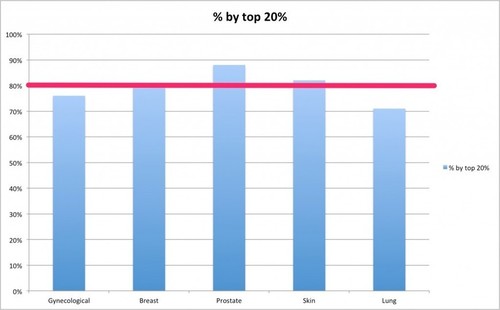
One of the key findings of the Social Oncology Report was that cancer conversations have become increasingly fragmented, specific and sophisticated.
This is the second in a series of 4 posts on the subject, which will hone in on conversations about breast cancer, gynecological cancers, prostate cancer, skin cancer, and lung cancer.
See on blog.wcgworld.com
Health Literacy Depends on Reliable Information
See on Scoop.it – Health Care Social Media Monitor
Finding reliable healthcare information on the Internet can be a real challenge. Much of the information I read online is oversimplified. On occasion, this information can be misleading or completely inaccurate.
See on www.drbrianstork.com