Posted in HCSM

Doctors and Social Oncology: Trends in physician conversations

See on Scoop.itHealth Care Social Media Monitor

One of the key findings of the MDigitalLife Social Oncology Report 2013 was that cancer conversations have become increasingly fragmented, specific and specific and sophisticated. The number of journal articles posted to PubMed has increased 349% since 1999 – and the number of cancer-related conversations has exploded in similar fashion. As those cancer-specific conversations continue to grow, we wanted to take a closer look at the physicians who are driving them. This is the first in a series of 4 posts on the subject, which will hone in on doctors’ conversations about breast cancer, gynecological cancers, prostate cancer, skin cancer, and lung cancer.

Marie Ennis-O’Connor‘s insight:

Interesting findings:

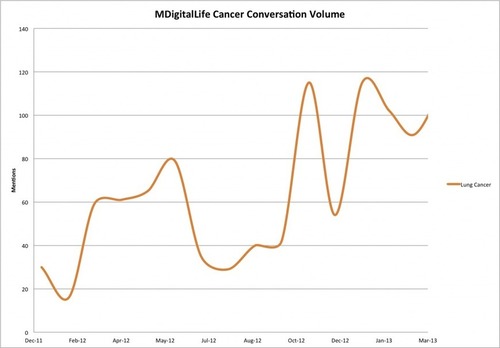
While breast cancer does drive the largest volume of physician conversations, the difference is not nearly so severe as it is among the general populace – and in fact is now rivaled by prostate cancer and skin cancer.The fastest-growing conversations are around gynecological cancers, and focus primarily on the issue of HPV vaccine. It will be interesting to monitor whether the awareness levels afforded these cancers (especially cervical cancer) during this period are sustainable, or whether they’ll fall to 2012 levels.Skin cancer conversations are highly seasonal, and reflect the fact that physicians have done an excellent job of focusing on the “high-risk, low-effort” prevention topics that make up so many of our ailments (e.g., wear sunscreen, give your kids swimming lessons, make sure to vaccinate your kids, etc.)Lung cancer, despite continuing to represent an enormous health risk, is lagging in terms of effective advocacy – due, we believe, to the current political incorrectness of its common association with smoking.

See on blog.wcgworld.com

Posted in HCSM

Social Media for Oncologists

See on Scoop.itHealth Care Social Media Monitor

Today we discuss the dissemination of research results, clinical trials, and other oncology news using social media, as well as what type of media oncologists use, how useful and relevant this type of information is for most oncologists, and where oncologists can plug into information and communication sources. We speak with Michael A. Thompson, MD, PhD, who was the medical director of cancer research at ProHealth Care Regional Cancer Center, in Wisconsin, and clinical trials lead investigator of the NCI Community Cancer Centers Program.

See on member.ubmmedica.com

Posted in Abstract, HCSM

Social media use among patients and caregivers [BMJ Open. 2013]

Abstract

To map the state of the existing literature evaluating the use of social media in patient and caregiver populations.


Studies reporting primary research on the use of social media (collaborative projects, blogs/microblogs, content communities, social networking sites, virtual worlds) by patients or caregivers.

Two reviewers screened studies for eligibility; one reviewer extracted data from relevant studies and a second performed verification for accuracy and completeness on a 10% sample. Data were analysed to describe which social media tools are being used, by whom, for what purpose and how they are being evaluated.

RESULTS:

Two hundred eighty-four studies were included. Discussion forums were highly prevalent and constitute 66.6% of the sample. Social networking sites (14.8%) and blogs/microblogs (14.1%) were the next most commonly used tools. The intended purpose of the tool was to facilitate self-care in 77.1% of studies. While there were clusters of studies that focused on similar conditions (eg, lifestyle/weight loss (12.7%), cancer (11.3%)), there were no patterns in the objectives or tools used. A large proportion of the studies were descriptive (42.3%); however, there were also 48 (16.9%) randomised controlled trials (RCTs). Among the RCTs, 35.4% reported statistically significant results favouring the social media intervention being evaluated; however, 72.9% presented positive conclusions regarding the use of social media.

CONCLUSIONS:

There is an extensive body of literature examining the use of social media in patient and caregiver populations. Much of this work is descriptive; however, with such widespread use, evaluations of effectiveness are required. In studies that have examined effectiveness, positive conclusions are often reported, despite non-significant findings.

See on www.ncbi.nlm.nih.gov