This week I’m recommending Keyword Surfer – a free Chrome extension that gives you keyword search volume in Google search results.
This intuitive tool seamlessly integrates with Google Search, providing real-time data without disrupting the user’s workflow. By simply typing a query, users can instantly access estimated monthly search volumes, so you can instantly check if a keyword is a good fit.
Key Features and Benefits
Real-time Search Volume Data: Keyword Surfer displays estimated search volumes directly within Google Search results, eliminating the need for separate keyword research tools.
Related Keyword Suggestions: The extension provides a list of related keywords with corresponding search volumes, enabling users to discover new content opportunities and expand their keyword portfolio.
Traffic Estimates for Top-Ranking Pages: Keyword Surfer offers insights into the estimated organic traffic of high-ranking pages, allowing users to gauge potential content performance and set realistic goals.
Content Optimization Guidelines: By analyzing top-ranking content, Keyword Surfer provides data-driven recommendations on optimal word count, keyword density, and related keyword integration, enhancing on-page optimization efforts.
Global Data Coverage: With support for 70 countries, Keyword Surfer facilitates international SEO strategies by providing location-specific keyword data.7
Considerations
While Keyword Surfer offers valuable insights, it is essential to acknowledge that the data provided are estimates. For comprehensive analysis and competitive intelligence, utilizing additional keyword research tools is recommended.
YouTube Shorts and Clips are dynamic tools that can significantly expand your audience, boost engagement, and drive views across your entire channel. While long-form videos provide depth and detail, relying solely on them can limit your reach and strain your budget. Short-form videos, like Shorts and Clips, offer a cost-effective way to create engaging content and tap into new audiences.
Here’s why short-form content should be a cornerstone of your YouTube strategy:
Cost-Effective Patient Education: Producing high-quality long-form videos can be resource-intensive. Shorts and Clips offer a more affordable way to create educational content, repurpose existing materials, and maximize your budget.
Reach a Wider Audience: Short-form videos are easily discoverable, appearing in YouTube’s Shorts feed, suggested videos, and even on users’ homepages. This allows you to reach potential patients who might not otherwise encounter your content.
Drive Engagement with Longer Content: Think of Shorts and Clips as entry points to your more detailed videos. By creating engaging short-form content that highlights key health tips, addresses common concerns, or offers a glimpse into your services, you can pique viewers’ interest and guide them to your long-form videos.
Stay Ahead of the Curve: YouTube’s algorithm favors short-form content. Incorporating Shorts and Clips into your strategy ensures you’re aligned with the platform’s trends and increases your visibility.
The Evolving YouTube Algorithm: Connecting Short-Form and Long-Form Content
YouTube’s algorithm has undergone significant changes since the introduction of Shorts in 2021. In August 2022, YouTube updated its algorithm to connect Shorts and long-form content. Previously, separate algorithms meant limited crossover between the audiences of these formats. Now, a unified algorithm ensures Shorts viewers are also exposed to your long-form videos, and vice versa.
How This Change Benefits You
Enhanced Discoverability: Viewers who engage with your Shorts can be recommended your long-form videos, increasing your content’s exposure.
Build Trust and Authority: Engaging Shorts can attract new viewers who might then be directed to your long-form content, where you can provide more in-depth information about your services, expertise, and patient care philosophy.
Content Synergy: Shorts and long-form videos work together to create a comprehensive content ecosystem. Use Shorts to promote longer videos, answer FAQs, or share quick health tips.
This shift emphasizes the importance of a holistic YouTube strategy that incorporates both short-form and long-form content to maximize your reach and engagement.
YouTube Clips: Creating and Sharing Engaging Snippets
Clips are shareable, short segments (5–60 seconds) you can create from your longer videos, showcasing key moments or highlights.
How to Create a Clip
Open a YouTube video (desktop or mobile).
Below the video player, click or tap the “Clip” button.
A pop-up window will appear, allowing you to select the start and end time for your clip (between 5 and 60 seconds).
Give your clip a title, and you’re done!
Tips for Promotion
Cross-Platform Sharing: Post Clips on social media to drive traffic back to your channel.
Foster Community Engagement: Encourage viewers to create and share Clips from your videos, boosting interaction.
Use Clips as Conversation Starters: Pair them with questions or calls to action to spark discussion in your comments.
Expanding Reach Beyond YouTube
While you can’t share Clips directly within YouTube, they are incredibly versatile for cross-platform promotion.
Here’s how you can share your YouTube Clips
Social Media: Share Clips and Shorts on Facebook, Instagram, LinkedIn, and TikTok.
Websites & Blogs: Embed Clips in posts to enrich your content and drive traffic to your channel.
Email Marketing: Include Clips in newsletters to add engaging visuals and boost click-through rates.
Repurposing Long-Form Content into Shorts
YouTube Shorts offer a fantastic opportunity to repurpose your long-form content and reach a wider audience.
Creating Shorts from Existing Videos
Use a Video Editing App: Edit your long-form video into a vertical, full-screen format (up to 60 seconds). Enhance it with filters, effects, and text overlays. Upload via YouTube Studio and include a link to the original video in the description.
Create Shorts Directly on YouTube: Open the long-form video in the YouTube app, tap the “Remix” button, and select “Edit into a Short.” Choose your clip (up to 60 seconds), enhance it with music, text, and effects, and publish it. YouTube automatically adds a link to the original video.
Tips for Creating Effective Shorts
Hook Quickly: Grab attention within the first few seconds.
Optimize Aspect Ratio: Ensure content fits the vertical format.
Include CTAs: Add verbal and visual cues directing viewers to your long-form videos.
Boost Discoverability: Use relevant keywords, hashtags, and engaging thumbnails.
Driving Long-Form Views with Shorts.
Include Clear CTAs: Guide viewers to your long-form videos with verbal and visual cues.
Create Compelling Content: Hook viewers with engaging snippets that leave them wanting more.
Optimize for Discoverability: Use relevant keywords and hashtags in your Short’s description.
By strategically creating and promoting Shorts and Clips, you can effectively leverage these formats to drive patient engagement, expand your reach, and establish a stronger online presence.
Healthcare marketing is highly competitive, and engaging your target audience requires more than simply sharing relevant content. To truly connect with patients and achieve your marketing goals, you must understand what resonates with them. A/B testing offers a powerful solution, allowing you to optimize your campaigns and drive meaningful results.
What is A/B Testing?
A/B testing involves creating two versions of your marketing materials (version A and version B) with one key element changed, such as the headline, image, or call to action. These variations are then presented to separate segments of your audience, and their performance is tracked to determine which version yields better results.
A/B testing empowers healthcare marketers to make data-driven decisions, ensuring that campaigns resonate effectively with their target audience. It allows you to:
Optimize Content: Discover what types of headlines, visuals, and messaging resonate most with patients.
Increase Engagement: Enhance patient interaction with your website, social media posts, and email campaigns.
Improve Conversion Rates: Drive more appointments, inquiries, and sign-ups for your services.
Implementing A/B Testing in Healthcare Marketing: A Step-by-Step Guide
Start with Research: Analyze your past marketing performance and identify areas for improvement. Examine your competitors’ strategies for inspiration.
Choose a Variable: Select one element to test, such as the headline, image, call to action, or email subject line.
Create Variations: Develop two versions of your marketing material with one key difference. Ensure both versions align with your brand and messaging.
Segment Your Audience: Divide your audience into two groups, ensuring a random distribution to avoid bias.
Launch and Monitor: Implement your A/B test and use analytics tools to track key metrics like website traffic, engagement, and conversions.
Analyze and Implement: Compare the performance of both versions. Identify the winning variation and implement its elements in your future campaigns.
Key Elements to Test in Healthcare Marketing
Headlines: Test different lengths, styles, and focuses (e.g., benefits-oriented vs. problem-focused).
Visuals: Experiment with different image styles, patient testimonials, or videos showcasing your facility and services.
Call to Action: Try variations in wording, placement, and urgency (e.g., “Book an Appointment Today” vs. “Learn More”).
Email Subject Lines: Test different approaches to increase open rates (e.g., personalized vs. informative).
Landing Pages: Optimize your website landing pages for conversions by testing different layouts, headlines, and forms.
Let’s see this in action!
1. Headlines
Version A: “Managing Diabetes? 5 Tips for a Healthier Lifestyle” (practical and informative)
Version B: ” reclaim Your Health: Diabetes Management Starts Now” (empowering and action-oriented)
2. Visuals
Version A: Image of a person with diabetes actively engaged in a healthy activity, like exercising or cooking a nutritious meal.
Version B: Infographic outlining the key benefits of the diabetes management program.
3. Call to Actions
Version A: “Download our Free Guide to Diabetes Management” (offers a valuable resource)
Version B: “Schedule a Consultation with Our Diabetes Specialists” (encourages direct engagement)
4. Email Subject Lines
Version A: “Important Information About Your Diabetes Management” (formal and informative)
Version B: “Living Well with Diabetes: Tips and Support” (supportive and patient-focused)
5. Landing Pages
Version A: Landing page with a detailed explanation of the diabetes management program and a contact form at the bottom.
Version B: Landing page with a video testimonial from a satisfied patient and a prominent “Schedule a Consultation” button above the fold.
These examples illustrate how A/B testing can be applied to various elements of healthcare marketing campaigns. Remember to tailor your tests to your specific goals and target audience to achieve the best results.
The Importance of Continuous Optimization
A/B testing is not a one-time activity; it’s an ongoing process of continuous improvement. Regularly test different elements, analyze the results, and refine your approach to stay ahead of the curve and keep your audience engaged.
Want to stay informed about the latest in healthcare marketing?
Subscribe to my newsletter for a curated selection of articles, tips, and resources delivered straight to your inbox.
With so many social media options available, it can be challenging to identify which platforms deliver the most impact for healthcare brands. In this context, ROI (Return on Investment) measures how effectively your social media efforts are generating value—such as increased patient engagement, service inquiries, or brand awareness—relative to your investment in time and resources.
Why Social Media ROI Matters in Healthcare
In healthcare, ROI goes beyond basic engagement metrics. Demonstrating the tangible value of social media initiatives to leadership, patients, and stakeholders is crucial for justifying budgets and optimizing marketing strategies. Measuring and analyzing ROI provides data-driven insights that allow you to focus your budget on the most effective channels, ensuring that you maximize the reach and influence of your healthcare organization.
How to Calculate Social Media ROI for Healthcare
Calculating ROI in healthcare marketing involves aligning your social media activities with measurable goals. Here’s a step-by-step approach:
Define Your Objectives: Determine what you want to achieve, such as improving patient education, increasing appointment bookings, or driving awareness of new services.
Track Key Metrics: Identify the key performance indicators (KPIs) most relevant to your goals, such as website traffic, form completions, patient inquiries, engagement rate, and reach.
Account for Investment: Include all costs related to social media efforts—ad spend, content creation, patient engagement tools, and staff hours.
Calculate Your Return: Assess the tangible results from your social media activities. In healthcare, this may include tracking appointment requests, sign-ups for wellness programs, or the number of patient interactions influenced by social media.
There are different ROI formulas, but a basic one is:
ROI = (Net Profit / Total Investment) x 100
Net Profit = Value gained (e.g., revenue) — Total Investment
Total Investment = Direct and indirect costs
Example: Suppose you invest $500 in a Facebook ad campaign and $200 in staff time for a total of $700. If this campaign brings in $1,000 worth of new patient appointments, your net profit is $300, giving a 42.9% ROI.
Which Social Media Channels Offer the Best ROI in Healthcare?
1. YouTube According to HubSpot’s 2024 Social Media Trends Report, YouTube ranks highest for ROI, making it a valuable platform for healthcare. With over 2.5 billion active users, YouTube offers a tremendous opportunity to connect with a broad audience through educational and patient-friendly video content. In healthcare, video content can demystify complex medical information, enhance patient trust, and educate audiences about treatments, conditions, and wellness practices.
Top Tip: Use a mix of long-form educational videos and short, patient-centered clips to engage diverse viewer groups and maximize both reach and engagement.
2. Facebook Facebook remains a strong channel for healthcare organizations, especially those seeking precise audience targeting. While organic reach has declined, Facebook’s advertising tools enable you to reach specific demographics, making it ideal for local healthcare providers and specialty clinics aiming to connect with target patient groups.
Top Tip: Focus on high-engagement posts that can be “boosted” to expand reach cost-effectively, helping you get the most out of your advertising budget.
3. Instagram With 2 billion active users, Instagram provides a unique way for healthcare brands to build an engaged community. Visuals and Stories are perfect for sharing patient success stories, showcasing wellness tips, or promoting health-related events.
Top Tip: Use interactive stickers in Stories to increase engagement. Try adding a Q&A or poll to answer common patient questions and build a stronger connection with your audience.
4. TikTok With over 1.5 billion monthly active users and rising, TikTok offers an exciting platform for healthcare brands targeting younger audiences. Educational, health-related videos can go viral, making TikTok an ideal space for short, impactful content that raises awareness or dispels myths about healthcare topics.
Top Tip: Engage with trends on TikTok to boost visibility. Whether it’s using popular music, hashtags, or participating in healthcare-related challenges, joining trends increases discoverability and helps your content resonate with users.
Final Considerations for Healthcare Social Media ROI
Attribution Challenges: Directly attributing appointments or outcomes to social media can be complex. Utilize tracking tools, such as unique links or patient intake forms, to estimate impact accurately.
Long-Term ROI: Not all healthcare ROI is immediate; some efforts, like building trust and educating patients, contribute to long-term engagement and loyalty.
Big-Picture Value: Remember that while campaign-specific ROI is helpful, the overall value of your social media presence in building trust and enhancing patient relationships is also significant.
Welcome to this week’s social media quick tip. This week I want to show you how to repurpose your existing content.
Do you struggle to find time to create fresh content for your website or blog?
One key to maintaining a steady stream of quality content is to re-purpose what you already have. Repurposing content simply means taking one asset and reusing it somewhere else.
The first step is to identify your most popular content through your blog analytics tool and by using Google Analytics. Perhaps the content can be turned into an infographic or a slide-deck. By re-purposing content you have already written, you can extend and breathe new life into your current and past content.
Source: TopRank Marketing
Pay special attention to the content you published some time ago. Is some of this content out of date? If so, update it, and simply republish it again as an updated post. It’s important to update older content to make sure it continues to be relevant to your readers.
By focusing on producing one piece of really great content for repurposing, rather than several lower-quality pieces, you will improve the quality of your marketing.
Today I want to share a tip with you for generating content ideas in under a minute using two similar tools. Use these tools as inspiration for topics you could write about.
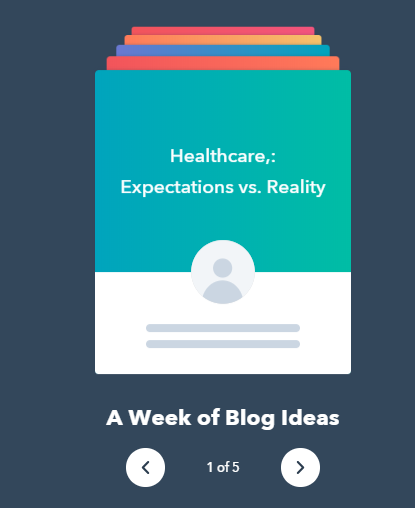
1. HubSpot’s Blog Topic Generatortool lets you input up to three different nouns and returns five blog topic ideas for you
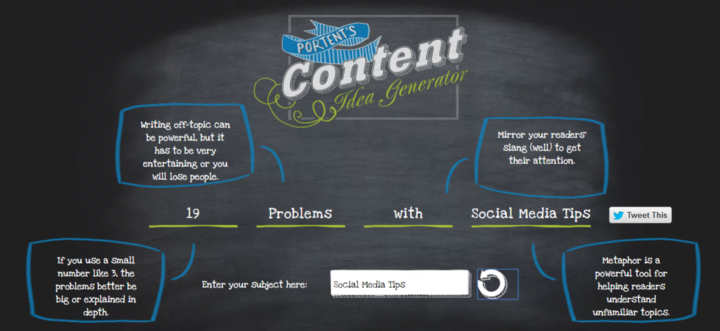
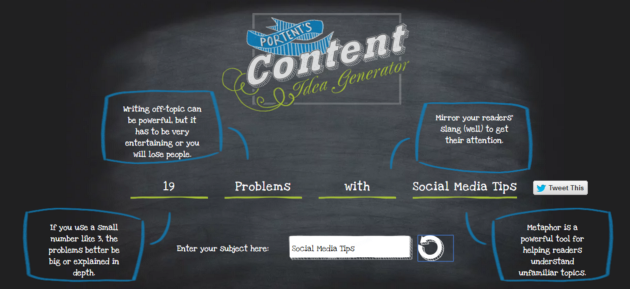
2. Portent’s Content Idea Generator allows you to generate content ideas with just one keyword. Be prepared that the tool can throw up some quirky suggestions, but don’t let that put you off. Keep playing around with it until you find one you can work with. I also really like how it shows you best practice tips, such as using metaphors in your writing.
Sometimes all you need is a little spark to get your creativity flowing again, and these tools may just the thing to get your creative juices flowing again.
Welcome to this week’s social media quick tip. This week I want to show you how to create a recurring content feature.
What is recurring blog content?
Recurring content is consistent content published on a regular schedule using a defined structure. This content has the ability to form hooks that keep readers interested in coming back to your site for more of the same.
I’ve experimented over the years with many different types of regular recurring columns on various blogs, for example the Cool Tool feature which I post each Monday morning.
Why create recurring content?
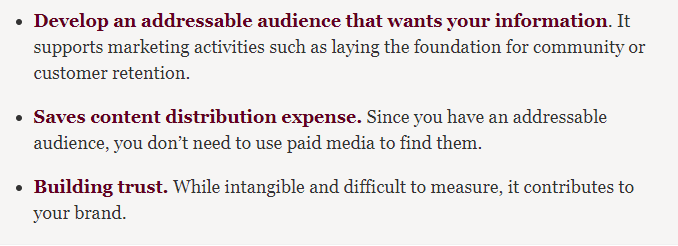
Marketer Heidi Cohen outlines the following three advantages to creating consistent content.
She goes on to outline the business value
Before you introduce a regular feature to readers, it’s important to take some time to choose a topic that matches your content strategy and crucially won’t have you running out of ideas after a few weeks. Ideally, your topic should be associated with your keyword phrases to support your organic search efforts.
Once you’ve decided on your topic, decide on the elements you will use to maintain consistency in the design and format of your content. Choose the same day and time to publish so readers know to expect it at that time each week – this helps build an audience for your content. To quote Cohen, “as the digital version of appointment media your audience depends on receiving your information at the same time every week. Over time, this builds share of audience attention.”
Finally, keep the format and design elements consistent.
Here are three types of recurring features to add to your content marketing.
1. Advice Column
Set aside one day a week to provide step-by-step instructions, or answer readers’ questions.
2. Interview Series
I ran an interview series, Social Spotlight, last year with healthcare thought leaders. It followed a consistent question format, with some tailoring to the interviewee, and was a popular addition to my content calendar.
3. Weekly Round-Up Post
I run several weekly round-up style posts for client blogs focussed on their niche. I curate the most helpful, interesting and topical news from their industry and publish them in a blog post, usually on a Friday. It’s always the most read content when I check the weekly blog stats.
Of course, your recurring content can live outside the written word. With the popularity of video, consider adding a regular vlog or even more popular, a Facebook Live recurring feature.
To sum up
Recurring posts of high value keeps your audience interested and coming back for more. By adding a regular recurring feature to your content marketing you give your audience something to look forward, while at the same time building a unique and recognisable element into your brand.
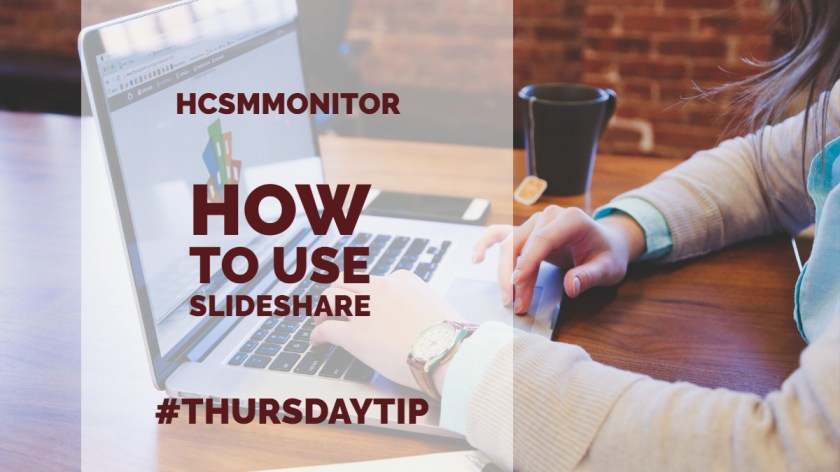
Welcome to this week’s quick social media tip. Today I want you to think about how you can add SlideShare to your content marketing strategy.
Owned by LinkedIn and with over 18 million uploads and 80 million users, SlideShare is the world’s largest professional content sharing community.
Surprisingly, given how the platform is optimized for social sharing, including the ability to embed presentations (as I’ve done below), it’s often overlooked and underused in healthcare marketing.
How To Use SlideShare
1. Use SlideShare for research.
Get up to speed on any topic. Instead of scrolling through pages of text, you can flip through a SlideShare deck and absorb the same information in a fraction of the time.
2. Share your insights and get noticed
Show what you know through a presentation, infographic, document or videos. When you upload to SlideShare, you reach an audience that’s interested in your content – over 80% of SlideShare’s 80 million visitors come through targeted search. This can help you build your reputation with the right audience and cultivate more professional opportunities.
Top Tip: The good news is that you don’t even have to create original content to do this. Simply find some content you have already written and get ready to breathe new life into it.
Welcome to this week’s social media quick tip. This week I want to show you how to generate content ideas when you are running out of inspiration.
Next time you’re stuck for something to write about, try brainstorming using a tool like HubSpot’s Blog Topic Generator. It lets you input up to three different nouns and returns five blog topic ideas that will exercise your writing muscles again.
Here are the suggestions generated for me when I input the terms “social media” and “marketing” into the tool.
A similar tool to Hubspot, Portent’s Content Idea Generator allows you to generate ideas with just one keyword. Be prepared that the tool can throw up some quirky suggestions, but don’t let that put you off. Keep playing around with it until you find one you can work with. I also really like how it shows you best practice tips, such as using metaphors in your writing.
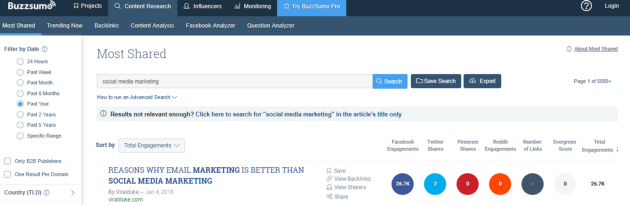
I also like to use Buzzsumo to find inspiration by searching which popular content is most shared right now on social media. These are the topics people want to read about so it’s worth brainstorming ideas around this content.
Today I want to show you how to use Twitter’s Tweet Reply conversation setting.
Last August Twitter rolled out this function to users to give people more control over the conversations they start.
Sometimes people are more comfortable talking about what’s happening when they can choose who can reply. Users in the test pool have said that they feel more comfortable tweeting, and more protected from spam and abuse, which has lead to them tweeting longer, more in-depth thoughts, particularly on sensitive subjects.
Here’s how it works
Before you Tweet, choose who can reply with three options:
Everyone (the default, standard setting)
Only people you follow
Only people you mention
Tweets with the latter two settings will be labeled and the reply icon will be grayed out for people who can’t reply. People who can’t reply will still be able to view, Retweet, Retweet with Comment, share, and like these Tweets.
I admit I haven’t used the feature, but it’s interesting to see how some brands are utilising it here.
How about you? Do you think this is a useful feature?









 Health Care Social Media