Posted in #HCSM, Infographics

Use These 5 Steps to See if Your Social Media is Profitable

What’s your business’s favourite social media platform? Maybe it’s Facebook; it’s popular for both personal and company use and has active participation in the billions. Perhaps you’ve set a goal of posting to your company’s Facebook page at least twice a week. That’s great—but it’s not enough specificity to your goal. Are those posts designed to drive people to a sale page or an email sign up page, or some other call to action?

That, in a nutshell, illustrates the thought journey that needs to happen in order for you to start measuring your social media’s return on investment. Of course there are traditional metrics—how much did efforts cost and how much did they bring in. But social media measurement also means setting up goals, tracking analytics, and analysing those against dollars, pounds, euros, and cents too. This detailed graphic can help you establish review processes to aid your business’s bottom line.

Use These 5 Steps to See if Your Social Media is Profitable

Posted in #HCSM, social spotlight

Social Spotlight: Dr Ollie Minton

facebook_7acbd97980

This week I am shining my social spotlight on Macmillan consultant, and honorary senior lecturer in palliative medicine at St. George’s University of London, Dr Ollie Minton.

Hi Ollie, I’m eager to learn more about how you are using social media in your work?

OM: As the saying goes no one reads your work except the reviewers and editor so sharing my interests and publications has gone a long way. I also think sharing articles and other things of interest is the best use of social media and by that I mean Twitter. I think some gentle campaigning such as Dying Matters and You Only Die Once (#yodo) pays dividends.

The more you make the connections, the more it pays off

We were able to promote our team at work and the  trust to a huge audience – you can’t buy that publicity – and demystify what we do. The rest is simply serendipity, but the more you make the connections, the more it pays off – I think for instance more of my work has been read since I tweeted links in the last year than ever before. I have enjoyed following and being followed by a wide cross-section of medical types and interest groups.

When did you start using social media. What prompted you to get started?

OM: I started during my PhD in earnest – feeling like a fish out of water – a clinician in the lab and the time any experiment took. I have then seen the proliferation of open data and access and feel that work both old and new can be shared equally. I also wanted to broaden my reading beyond my speciality and medicine to a degree.

Which platform(s) do you enjoy using the most?

OM:  Really for me Twitter offers it all and links take me to wherever I need to go. There is some mythical ratio of professional to personal interactions of either 80:20 or 70:30; and for the most part I think I stick to that. The only recent addition I have made is to write a few blogs – prompted by Twitter friends and m’learned colleague and friend Dr Mark Taubert who is also the associate editor of the BMJ Supportive and Palliative Care blog, so there’s a natural outlet and obviously you can then tweet the link to what you’ve written.

Which topics interest you; do you take part in any particular twitter chats?

OM: I’d hope I took the early lesson from the American Society of Clinical Oncology (ASCO) and hide in plain sight, with my interests, both clinical and academic, made explicit. I am interested in supportive and palliative care very broadly, which can encompass all aspects of health. I would focus on cancer care in particular, and long term effects of successful treatment. I take part in the relevant Twitter chats as a result – palliative medicine and radiation oncology journal clubs when the time difference internationally allow, and I do enjoy the debates in the @WeDocs chats both formal and impromptu.

What advice would you give someone just starting out on social media?

OM: Don’t agonise too much – create a profile that allows a personality to come through – photo and bio obviously straight away and jump in.  As I said we docs are very community focused.

The only decent set of “rules” I ever read were by the UK civil service

It’s not rocket science – we must use common sense about everything we publish on digital and social media. Once something has been sent, it’s public. Following these guidelines correctly will ensure that your social media activity will enhance your job as a civil servant, while also retaining the highest levels of integrity.

Or the ASCO – no one is anonymous online and hide in plain sight.

Finally, would you like to share a favourite quote with us? 

OM: I’d cheat and recommend the 42 Douglas Adams quotes to live by from the recent radio 4 revival. But out of all of them, I’d choose:  ” All opinions are not equal. Some are a very great deal more robust, sophisticated and well supported in logic and argument than others. The secular update of In God We Trust all others must bring data” (attributed to W Edwards Deming).

I really enjoyed learning more about your work and philosophy Ollie. I look forward to learning more from you on Twitter.  Thanks! 

Follow Ollie on Twitter @drol007


Posted in #HCSM, social spotlight

Social Spotlight: Dr Liam Farrell

facebook_f1fb8088feThis week it’s my great pleasure to shine a spotlight on the work of Dr Liam Farrell, an award-winning writer and broadcaster, an irrepressible humourist, and talented musician, and the founder of #IrishMed – Ireland’s first healthcare tweet chat.

Congratulations Liam on the success of #IrishMed.  Can you tell us what led you to start the tweet chat?

LF: I started the #IrishMed tweetchat over two years ago. I’d been taking part in other tweet chats such as #hcldr and #hcsm, and co-hosted a few, for #hpm and #dwdchat. On one of these (won’t say which, there was only one regular responder, which made it a long sixty minutes, so thanks Kathy Kastner for not leaving me high and dry). I’d found them interesting and stimulating, and then reckoned that we needed a similar chat on this side of the world.

I really like how you’ve brought an international audience together for #IrishMed. Was this your original intention?

LF: Initially I’d expected only Irish tweeps would get involved, but it rapidly grew into a global network, with regular participants from North America, Africa + Asia (we go out at 6 am in the morning in the Philippines, so fair dues to my good friends over there). It goes to show that health issues are universal.  Connecting with people and making friends from all across the globe has been a wonderful experience, all generous with their time and their wisdom, all trying to make the world a better place. #IrishMed is also non-hierarchical; all perspectives are valuable, whether specialist, generalist, patient, advocate, carer or general public, and it all helps to in breaking down the artificial barriers between healthcare professional and patients; after all every HCP (health care professional) will be a patient one day. And the dialogue goes both ways; HCPs learn about patient frustrations, patients can more appreciate the difficulties and limitations of medical care.

When did you start using social media? Were you an early adopter of any one particular platform? 

LF: My son Jack was a volunteer in Ohio for President Obama in 2012, and twitter was a great way of staying in touch with the pulse of the campaign. There is always a danger of twitter becoming an echo chamber, so I deliberately followed tweeps from all sides of the political spectrum. I’m a socialist, but like to think I’m ready to accept a persuasive argument from  a different point of view.

Which platform(s) do you enjoy using the most?

LF: I use Facebook mainly to keep in touch with my family and friends. Facebook was also handy to archive my columns in one place, and I’ve started a wordpress blog recently, as many of my journal columns are subscriber only and I thought they needed the light of day.  Twitter is my favourite platform, it allows rapid exchange of ideas, and at it’s best the format demands thought. The 180 character limit really forces you to make your responses punchy and concise; excessive verbosity is impossible. 

Which topics do you like to follow on social media? Do you take part in any Twitter chats outside of #IrishMed?

LF: “Doctors are the natural attorneys of the poor,” said Virchow. The contribution of medical care to population health is relatively minor; much more important are the social determinants of health #SDoH, sanitation, food, education, housing. The main cause of ill-health is poverty and doctors that don’t take a political stance are reneging on their responsibilities.

I’m particularly interested in palliative care, as in my rural practice we looked after our own patients, and I was also a postgraduate tutor in palliative care. Two thirds of patients die expected deaths, and there is simply no way the palliative care speciality can look after them all. Palliative care must become a generalist skill; often it’s not complicated, and the precious skills of the specialists should be reserved for difficult cases and for education. On a wider scale, educating the general population about death and dying is also critical; it should be a subject taught in schools.

As I write late at night and in the early hours (“What hath night to do with sleep?” Milton), #hcldr and #hscm are always good timing for me. The topics are wide-ranging and the opinions diverse, and I regularly learn something new and have my prejudices challenged. #HeathXPH is on Saturday afternoon, which unfortunately conflicts with watching horse racing. #hcldr was one of the inspirations for #irishmed; the other was the advice of the irreplaceable Marie Ennis O’Connor.

Twitter is such an accessible medium for rapid exchange of information, it’s very under-utilised at the moment; so many other disciplines could get involved. Myself and my maniacally energetic friend Sharon Thompson (@sharontwriter) recently launched #WritersWise – a tweetchat for writers and aspiring writers

I recognise that SoMe is soft power; words are cheap, and as we screen-writers say, “action reveals character.” but you never know when a message will have an effect, and someone, somewhere will be helped because of it.

What advice would you give someone just starting out on social media?

LF: There is so much information out there, it can initially be bewildering. Follow the platforms that suit you best, and read Marie Ennis O’Connor’s blogs.

You’re too kind;-) Methinks the student has surpassed the master these days.

Finally, would you like to share a favourite quote to send us on our way today?

“I’m too busy to be brief;” Samuel Johnson

(One of my favourite quotes – though I think a tad ironic when it comes to Twitter! Ed)

It’s been terrific to learn more about how and why you use social media Liam and I look forward to seeing what new delights you have in store for your faithful following.  


  • Follow Liam on Twitter @drlfarrell
  • #IrishMed takes place every Wednesday at 10 pm Irish time. To learn more and view past transcripts visit www.symplur.com/healthcare-hashtags/irishmed


Posted in #HCSM

Social Spotlight: Debra Bassett

facebook_cb182189da (1)

This week I interview Debra Bassett, a PhD Candidate at the University of Warwick. Debra’s research explores the creation of digital memories on the Internet and how digital immortality may affect how people grieve.

Hi Debra, I am fascinated by the research you’ve undertaken. Could you tell us some more about it.

DB:  My PhD research is looking at whether digital immortality being offered by the Internet will affect the way people grieve.  As part of this research I am analysing thanablogs (blogs written by terminally ill people).  I am analysing tweets from terminally ill people, and “death bed tweets”.  Facebook is being used by many to create memorial sites and virtual graveyards for people to visit, these also are part of my research.

When did you start using social media. What prompted you to get started?

DB: I have avoided using social media personally for many reasons (I only have 1 Facebook friend as I refuse all requests from people).  However, to do research I have to have Facebook in order to access the Facebook pages of others.

Which platform(s) do you enjoy using the most?

DB: I love using Twitter which I only started using as part of my research.  You were the first person to contact me on Twitter and gently suggested I needed to fill my profile in! I love Twitter!  My research does not sit comfortably within the Sociology department at Warwick, so I am alone in my area of research.  Twitter introduced me to other thanatologists and allows me to discuss my research with others who understand.  It also helps with participant recruitment (I hope).  It also helps you to be extremely concise with your ideas and how you explain them.  The “elevator pitch” but even more concise.

Which topics interest you – eg do you take part in any particular twitter chats?

DB: I like following political conversations, although sometimes I think Twitter creates an echo chamber (e.g. Brexit)

What advice would you give someone just starting out on social media?

DB: Just dive in, others will help and advise at you go along.

Finally, would you like to share a favourite quote with us?

DB: “Tomorrow is another day” Gone with the Wind

If you would like to contribute to Debra’s research, please visit her website debrabassett.co.uk for details on how you can take part. 

Posted in #HCSM

Social Spotlight: Deirdre Munro

facebook_9206c4479f

This week I turn the social spotlight on Deirdre Munro,  founder of The Global Village Networks, to find out more about how she uses social media in her work.

Logo created by my son Brian (aged 15)

Can you tell us about the The Global Village Networks project you founded?

DM: I would love to share our Global Village of Midwives story with you. Our story began at the International Confederation of Midwifery (ICM) Prague June 2014. I travelled to Prague with a fellow midwife Naomi O’Donovan, kindly sponsored by the Irish Nurses and Midwives Organisation (INMO).  I shared lots of new research on twitter and started to use a hashtag  #Globalvillagemidwives and later due to demand created @GlobalVillageMW

gv
This led to other global villages being born:
(This list comes under a Twitter Global Village Network)
  • The Global Village of Mental Health
  • Ability Global Village
  • The Global Village of Health Translation
  • Global Village of Nurses

And there are more in utero!

Which social networking platform(s) do you enjoy using the most?

DM: I am a proud member of many many fantastic platforms

    • The Global Village Network of course!
    • World Health Innovation Summit #WHIS
    • World Health Organisation
    • International Confederation Midwives
    • Maternity Experience #matexp
    • School for health Care Radicals #SHCR #EdgeClub
    • #TeamShiny
    • #wemidwives
    • England Centre for Practice Development International Fellows #ECPDF #mindfulofthegap
    • #whywedoresearch
    • @EhealthIreland
    • Council Clinical Information Officers (Ireland)  #CCIO

Too many conferences to mention! It’s a Twitter party out here so come on and join the fun!

Which topics interest you – eg do you take part in any particular twitter chats?

DM: I am passionate about midwifery, healthcare, research, sharing knowledge, designing research, reviewing methodology, innovation, improving health care and systems together, supporting each other and of course social media.

What advice would you give someone just starting out on social media?

DM:  Don’t be nervous. Just set up a Twitter account and start to follow people that inspire you. Find a twitterbuddy and nurture your confidence. Then start to join a conversation. It opened up a new GlobalVillage for me, the innovations and opportunities are endless.

Finally, would you like to share a favourite quote with us?

I am known as a Twitter induced wordsmith so here it goes;
‘Myometrium moment’ is that awe moment when your heart squeezes (and uterus if you’re female!) and hugs your very soul – #myomo
Innovation moment – I know moment #InoMo

That moment when you really need a hug and support … to increase the mood and love hormone oxytocin  #oxyhug

Thanks Deirdre for taking the time to share your passion and enthusiasm for social media with us.


Posted in #HCSM

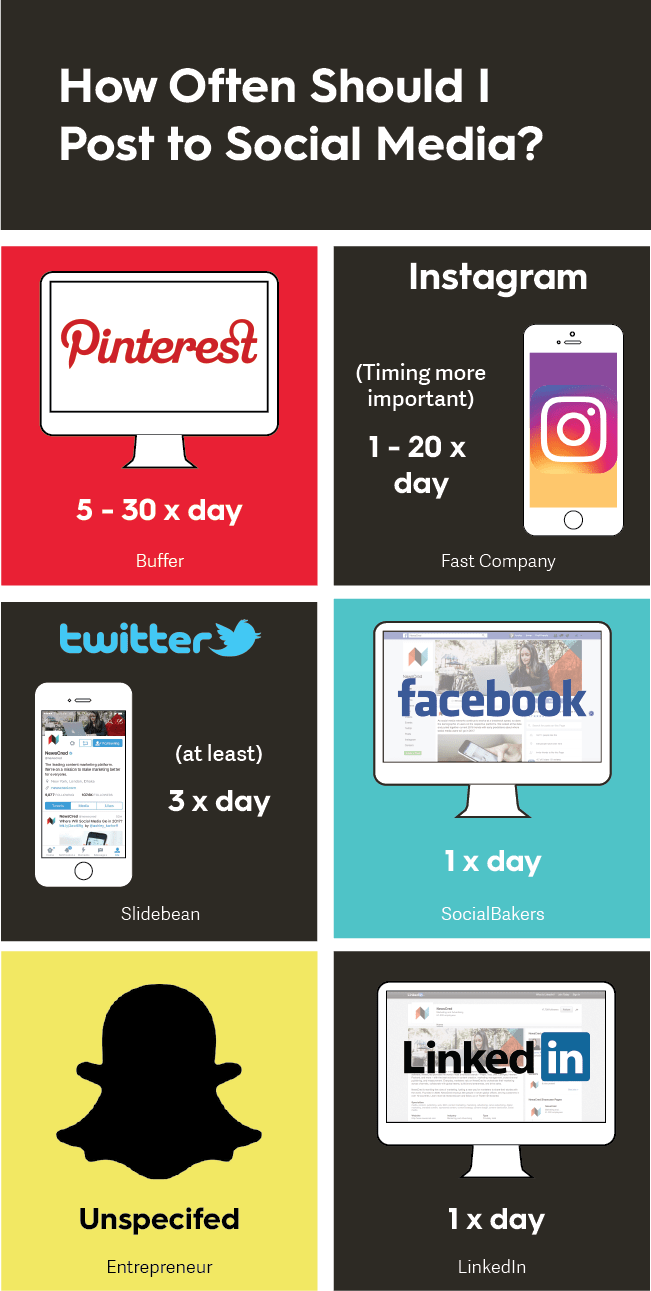
How Often Should You Post to Social Media?

how-often-should-you-post-on-social-media (1)

Marketers are often surprised by recommendations on how often to post to social media. They fear they’ll be viewed as spam by their followers. What they’re not realizing is that any single post reaches a small fraction of your target audience, regardless of how effectively you time your posts. This Newscred article offers a comprehensive guide to the optimum time and place to post your updates online.

Related Reading: 

Posted in #HCSM

Here’s How To Get Your Twitter Share Count Back

00e9a599-0429-43cc-bafa-c1be4a55502c

Late last year Twitter removed the share counter displayed alongside the Twitter icon on websites and blogs.  Why was this such a big deal? It mattered because in one move, Twitter destroyed a basic tenet of social proof.  For those players who can afford the premium service GNIP (owned by Twitter) this won’t be an issue, but it is a blow for those of us who operate on small social media budgets. With this change, Twitter has moved from its original premise of open sharing to one in which we will have to to “pay to play” if you want to compete on a level playing field.

But there’s good news! A service called New Share Counts promises to restore your Twitter count for free.  The service can only provide access to 7 days of Twitter history from the day you add your website to tracking. Shares that happened before might not be counted, but further shares are counted properly.

Read How To Get Your Twitter Share Count Back to find out how to register for and use the service.

Posted in #HCSM

Social Spotlight: James Legan MD


This week it’s my great pleasure to catch up with James Legan, MD, an Internal Medicine Physician, now in his 23rd year in Private Practice in Great Falls, Montana, USA.  James blogs regularly about patient care and technology, and was an early adopter of live video streaming platforms Periscope and Blab.  A talented painter, James is also one of the friendliest, kindest and most welcoming persons I have met online.

facebook_b6d52dd4a9 (1)


Hi James, I know you have a passion for combining technology with patient care, could you begin by sharing an example of how you do this. 

JL:  My passion has been sharing my experience with #ProjectedEHR, an approach that I have been using for the past two and a half years at the point of care with my patients.  I use a wall mounted 24 inch screen in each exam room and as I walk in and greet the patient, hook the 14″ Acer Chromebook via HDMI cord to the large screen.  Instantaneously the patient and I can look at their own data/information contained in their electronic record.  I have had such a positive response with my own patients, I share this approach whenever I can get the chance.

When did you start using social media. What prompted you to get started?

JL:  About 2 years ago I started with Twitter, which has been the “nest” for my Social Media Platform with links to my Periscope, Blab and WordPress sites. Desiring to share #ProjectedEHR as a way to give back to the Profession, with the intention of hopefully helping others in the medical arena is what got me started.

Which platform(s) do you enjoy using the most?

JL:  I think all the platforms are a bit different and reach different followers, some merge, some separate.  I like to blog for disseminating things learned along the way. I like Periscope to share fun things primarily, mostly on the weekends.  Blab is a great way to brainstorm in small groups, and the next best thing to being together IRL (in real life) and better because of the connections world wide.  So I like all of the platforms and don’t have any particular favorite, just mix it up depending on how I want to connect and with whom.

Which topics interest you – eg do you take part in any particular twitter chats?

JL:  I particularly like topics regarding technology and patient engagement, and #HealthXPH, #HITsm #IrishMed and #HCLDR are twitter chats I have been most involved with

What advice would you give someone just starting out on social media?

JL:  Don’t share anything you would not if printed on the front of your local newspaper, and have fun.  Read Marie Ennis-O’Connor’s rules of social media, and don’t break them. 😉

Finally, would you like to share a favourite quote with us?

JL:  “Listen to your patient, he is telling you the diagnosis,” from Sir William Osler.

Thanks James for taking the time to share with us your experience of using social media in your work. Your commitment to patient care shines through in everything you do. 

Follow James on Twitter @jimmie_vanagon


Posted in #HCSM, Infographics

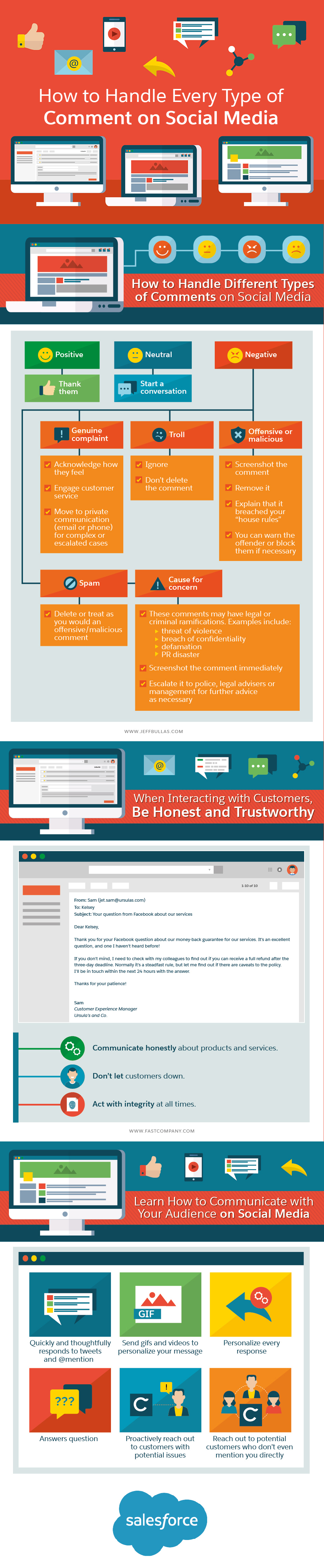
How To Handle Different Types Of Comments On Social Media [Infographic]

I really like this Infographic from Salesforce on how to handle different types of comments on social media. I’ve highlighted some key takeways at the end.

Click To Enlarge

How to Handle Every Type of Comment on Social Media

Via Salesforce

Key Takeaways

Respond in Your Brand’s Voice

It’s important to be consistent with your voice on social media: It should match what you convey through customer service, your website, and any other advertising or channels where a customer may be exposed to the brand.

Respect Their Emotions

When people are upset, they often just want to feel validated; even when you don’t understand where people are coming from, it’s important to respect how they feel.

Create an Answer Library

Take comments from your social media users and turn them into content, and think of how you can provide content that’s a valuable service and invites your customers and fans to be part of your brand’s story.

Personalize Your Replies

Personalizing your answer and making it interactive through gifs, hashtags, and @mentions makes a difference.

Further Reading 

3 Creative Ways to Address Consumer Criticism on Social Media