See on Scoop.it – Health Care Social Media Monitor

Dr. Ronan Kavanagh (@RonanTKavanagh) is one of the leading voices in the rheumatology conversation on the social web.
See on www.symplur.com
See on Scoop.it – Health Care Social Media Monitor
Dr. Ronan Kavanagh (@RonanTKavanagh) is one of the leading voices in the rheumatology conversation on the social web.
See on www.symplur.com
Almost half of Facebook followers of your brand expect a customer service component.
 Consumers are expecting brands to provide customer service options in their social networks. A survey conducted by Oracle found that online users of social networks expect pathways to customer service from the social media site. The expectations include click thrus to customer service departments and instant messaging.
Forty-six percent of Facebook users expected brands to provide customer service options through the social network. Twenty-nine percent of blog followers expected customer service options compared to just seventeen percent of Twitter followers.
Not only do consumers expect customer service options, they also expect quick responses. Over half of Facebook users and eight out of ten Twitter users expected responses within 24 hours or less. Social media is always on and responses to concerns and issues are expected quickly.
The most common reason to follow or like a…
View original post 115 more words
See on Scoop.it – Health Care Social Media Monitor
Are you telling stories that your audience wants to listen to?
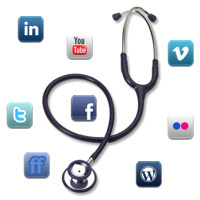
This infographic illustrates some of the many ways healthcare professionals are using social media in their careers.

Ed Bennett manages web operations at the University of Maryland Medical Center (UMMC). He is an active player in #HCSM (Health Care Social Media Community.
Consumer behavior is changing and social media is becoming increasingly relevant for individuals and organizations.
As the social media landscape expands and evolves, Facebook maintains its leadership despite IPO pains and mobile weakness.
Twitter at #2 is becoming a curator and potential media company while Google+ is becoming Google’s SoLoMo layer.
Newer players differentiate and create niches of their own, or seek exits. Despite the “success” of social media, public market investors are skeptical but social media’s impact on human behavior is undeniable.
Mobile is becoming the “first screen,” SoLoMo is growing in adoption, influence and importance and the SMMS industry is consolidating. Social media, and social advertising, is no longer a playground but a priority for major brands.
While marketers continue to experiment, efforts are much more strategic and studies are starting to show connections between leveraging social paid, promoted, owned and earned media, and changes in purchase intent. Ultimately, the social media opportunity lies in enhanced customer experiences.
Note: This presentation is a 2012 mid-year update to the original “State of Social” presentation by Esteban Contreras.
See on Scoop.it – Health Care Social Media Monitor
I want you to consider how private social networking for healthcare can help you improve the data you get from your patients, how it can save you time and how it can improve patient trust by using social networking for secure communications and connectivity.
See on pathcareblog.com
See on Scoop.it – Health Care Social Media Monitor
There are many ways for medical professionals to use social media in their work lives. Here are a few of the best social media channels and how to use them.
See on blog.healthecareers.com
See on Scoop.it – Health Care Social Media Monitor
Social media is a group of Internet-based applications that allows individuals to create, collaborate, and share content with one another. Practitioners can realize social media’s untapped potential by incorporating it as part of the larger social marketing strategy, beyond promotion. Social media, if used correctly, may help organizations increase their capacity for putting the consumer at the center of the social marketing process. The purpose of this article is to provide a template for strategic thinking to successfully include social media as part of the social marketing strategy by using a four-step process.
See on www.ncbi.nlm.nih.gov