Articles

Posted in #HCSM, Conference, Digital Health, Doctor, E-Patient, Ehealth

The digital revolution and the era of the e-patient

I was delighted  to have the opportunity to share the stage with Dr Kendall Ho, a practicing emergency medicine specialist and founding director of the eHealth Strategy Office of the University of British Columbia, at the Universitas 21 Health Sciences Group annual meeting  held recently at University College Dublin. In a lively and engaging presentation Dr Ho spoke to delegates about how medical educators can embrace social media.

Also presenting was consultant rheumatologist,  Dr Ronan Kavanagh,  speaking on how doctors can use the tools of social media in their practice.

And my own presentation on the digital revolution and the era of the e-patient.

Posted in #HCSM

Improving Patient-Physician Communication about Internet Use: Why “Don’t Ask, Don’t Tell” Doesn’t Work

See on Scoop.itHealth Care Social Media Monitor

A disconnect currently exists between patients’ use of the Internet and their consultations with their physicians. Too often, patients don’t tell their physicians about their Internet use and physicians don’t ask; both suffer due to the erosion of trust and missed educational opportunities. Better patient-physician communication about Internet use is needed to help patients become truly empowered healthcare consumers.

Marie Ennis-O’Connor‘s insight:

Patient use of the Internet disconnected from physician care can be detrimental. The benefits of Internet use can accrue with better design, education, and communication. More effective health Web site use can occur through improved design practices, physician and patient education, and patient-physician communication integrating patient Internet use. Better communication can be facilitated by questions on patient forms and guidelines on health Web sites. The next step is testing these hypotheses. The expected outcome is better informed patients whose Internet use is integrated into, rather than disconnected from, their medical care.

See on www.medicine20congress.com

Posted in #HCSM

Why More Health Experts Are Embracing the Social Web

See on Scoop.itHealth Care Social Media Monitor

Read on for some ways that social media can help doctors, health experts and everyday users.

Marie Ennis-O’Connor‘s insight:

We are standing at the precipice of a new online revolution in health care. As more and more health experts embrace the Internet and increase their social media activity, health information seekers will undoubtedly benefit in profound ways. Based on conversations and surveys conducted with experts and health information seekers, here are some of the benefits associated with a robust online community of active health experts:

See on mashable.com

Posted in #HCSM

Better Living Through Mobile: A Patient’s Journey

See on Scoop.itHealth Care Social Media Monitor

Who does mHealth really benefit?

mHealth, far from being impersonal and over-computerized, actually allows people to take charge of their health care more fully, and in greater detail, than ever before. Even occasional self-monitoring can prevent problems from occurring, and patients can get answers from their physicians at the precise moments when those problems arise.

There will be fewer doctor’s visits, and a lot less hassle. From the doctor’s point of view, mHealth systems reduce paperwork, red tape and the time it takes to gather data, allowing physicians to focus on treating and diagnosis. And medical researchers benefit as well, because they get a wealth of data, assuming patients are willing to share.

Rarely is mobile healthcare as coordinated as Adam’s, but it’s starting to happen, in pieces, all around the world. It’s not a perfect vision — there’ll still be incurable sickness, not to mention misdiagnosis — but every day, mobile technology is improving medical outcomes, and prolonging lives

See on www.business2community.com

Posted in #HCSM

How do you manage misbehavior in online health communities?

Important guidelines on how to handle undesirable behavior in online communities

Colleen Young's avatarColleen Young

Excerpt from JMIR publication Community Management That Works: How to Build and Sustain a Thriving Online Health Community

Man showing expression of surprise, aghastMany health organizations are concerned about disclosure of personal health or other sensitive information and the proliferation of misinformation. However, if your community has clear policies, proactive community management, as well as active moderation and community participation these concerns are largely unfounded for online communities associated with reputable organizations. Some communities, though, exist for the sole purpose of encouraging unhealthy behaviors, such as pro-anorexia groups [1]. I want to focus on online communities that support healthy behaviors and how they manage transgressions of their terms of use.

Clearly stated policies make it easy for moderators to modify—and in some cases remove—posts that contravene terms of use, such as commercial postings, advertisements, or impersonations; posts that relate to illegal activity; those that contain disrespectful language, etc [2,3]…

View original post 514 more words

Posted in #HCSM

4 Essential Steps to Healthcare Social Media Marketing Success

Crowd Clip ArtAs the Internet increasingly becomes the medium of choice for researching health information, social media has become an important channel for healthcare marketing.  In today’s social media-connected, content marketing rich environment, healthcare marketeers who are not using social media as part of their strategy are missing out.  In today’s post,  I will outline the four essential steps required for successful healthcare  social media marketing.

The first step is to gain a clearer image of who your audience is and what they are saying about you. Only then will you be able to create compelling, relevant and valuable content to fuel the social media engine.

(1) Identify and segment your online audience

Your healthcare marketing efforts will be much stronger if you can identify your target market and segment it so that you can tailor your content more specifically for them. Unless you take this first step, your social media marketing activities will remain unfocused. If you can clearly identify your target market, then you can plan the best combination of email marketing, social networking strategies, SEO, Pay Per Click, Banner ads, etc. You are looking to drill down deeper to discover their geographic location, their gender, level of education, family status, which social media sites they use, what conversations they are having online, how they are engaging with you, your competition and your online partners.

(2) Plan your social and digital media channels

Armed with this information you will now be able to plan which social media channels are most suited to your target market and direct your efforts accordingly. For example, if you identify that your audience is predominately female, you might direct some of your healthcare marketing efforts to Pinterest, a site whose rapid growth and success has been driven by women.

(3) Join in the online conversation

There is a support and community group for just about any medical condition or interest online.  To further expand their reach and focus on patient care, these groups need the input of qualified healthcare practitioners to help validate the information discussed on their sites and to ensure balanced views that are in the best interest of patients. Participating in these communities by providing advice, educational podcasts, guest contributions to widely read blogs and websites can help you broadcast your brand and build your reputation, while providing valuable support to the group.

(4) Monitor your online reputation

Consistency, credibility and connection are the cornerstones of maintaining your healthcare brand’s integrity.  It is important to listen to what is being said about your brand, not just to know what is going on and whether you are receiving any negative publicity or comments that need to be addressed, but also to know what you are doing right, so that you can do more of it. At a minimum keep an eye on tweets, comments and messages on your Twitter, blog and Facebook accounts. You should also set up Google Alerts for your brand and industry.

There’s no question that social media is growing in importance in the healthcare field and it is no longer an optional marketing strategy.  The conversation is happening online with or without you, so for the sake of your healthcare brand, join it!


Posted in #HCSM, Twitter

The Rise of Patient Communities on Twitter

I am a big fan of Symplur and the service they provide through their healthcare  hashtag project for those of us interested in the health conversations which take place on Twitter.  For over 2 years, Symplur has collected health conversations on Twitter and analyzed them across thousands of variables. The result is produced in this video, a visual representation of   c. 2,000 different health communities or topics.

The green dots symbolizes patient centric topics, while pink encompasses more professional/provider topics. Larger bubbles signifies larger volume of conversations within that community. The data are visualized dynamically over a 2 year period.

Here’s what Symplur research uncovered:

What we discovered was somewhat of a surprise for some. From the start, many considered Twitter as a kind of virtual water cooler, mostly used by healthcare professionals. It’s been thought that the need for privacy would push patients to more closed platforms. Twitter as you know, is totally public and should not be considered private.  However, from what you can clearly observe, the green bubbles have grown in numbers and significance quite dramatically in recent months. This indicates a strong growth of conversations in existing patient communities on Twitter and a strong growth of new patient communities on Twitter within our dataset.

Posted in #HCSM, Infographics

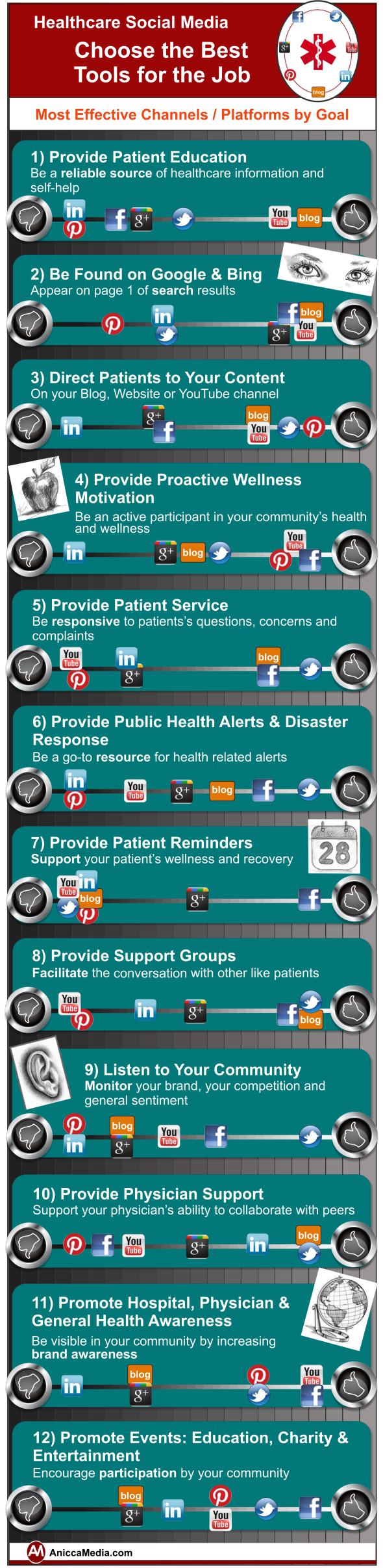
Guide To The Best Social Media Tools For Healthcare Goals

hosp social media

The temptation with social media can be to jump on the bandwagon and establish a presence on every platform – but some platforms match your goals better than others. Here is a useful infographic on choosing the most effective social media tools to fit your healthcare goals. From patient education to physician support and increasing the visibility of your website choosing the correct platform will enhance your marketing and outreach efforts.