Posted in #HCSM

Digital Health Checkup: 10 Signs It’s Time To Redesign Your Medical Practice Website

When was the last time you took a close look at your medical practice website?

Websites are meant to be living entities that grow along with your business. A website is not a “set it and forget it” type of investment.  Just like fashion, technology changes with the times. What once looked fresh and modern may now look old and outdated, giving your patients the impression that your practice is the same.

Why a website matters to your medical practice

In the online world, your website is a virtual office location and the face of your practice. It acts as the initial “touchpoint” for potential patients. It showcases who you are and what you do. A Facebook page is no substitute for a website (particularly given the current difficulties Facebook users face in terms of privacy and trust).

A well-designed website can:

  • Boost your online reputation
  • Increase search engine visibility
  • Attract new patients

You never get a second chance to make a good first impression

Your website has seven seconds to make an impression and your patients are making snap judgments based on what they see and read. Research Gate reports 94 percent of people are more apt to trust websites that boast good designs. Gaining trust is particularly important for medical practices, and you could lose it in a single glance with an outdated site.

In this post, I will take you through 10 signs to watch for to determine if it’s time to get your website upgraded or redesigned.

Take some time this week to look at your website with fresh eyes and ask yourself the following questions.

1. How does your website stack up against your competitors?

If your competitors’ websites are more streamlined, functional and fresher than yours, they may be drawing in more patients with a stronger online presence.  Make a list of their sites and critically evaluate them in terms of look, design, and functionality. Do they include a blog? Helpful checklists? Pre-registration forms patients can fill out to save time before their appointment? An online appointment system? Screenshot the design features you think work well and think about how you might incorporate them into your website. Look also at what your competitor might be missing. Do you have a key differentiator that sets you apart from the competition? Highlight that difference on your website.

2. Can visitors easily find what they are looking for when they visit your site?

When visitors land on your medical practice website, they’re typically looking for something specific.  You may be surprised to learn that research has revealed that easy navigation and accessibility are more important to patients than reputability.

Users should be able to use your website intuitively. Put yourself in the shoes of your visitors and ask yourself how easy it is to find key information on your site. How many clicks does a visitor have to make to get to the information they are looking for?

Think about the information someone is searching for when they visit your site—and make it easy for them to find it. If your site contains a lot of information (as some hospital websites do) consider creating separate landing pages for specific conditions.

Google has changed considerably over the years. The search engine giant constantly updates its algorithms to ensure users are provided with the best possible results. Each and every update that Google has made has been geared towards providing more user-focused and user-friendly results – Search Engine Watch

Here are some details your patients are likely looking for on your website.

  • A location map.  If there is a link to Google Maps, be sure it’s working. This section is one of the most used aspects of any website.
  • The services you provide — list any specialties here
  • A list of doctors and  nurse practitioners
  • The insurance plans you accept
  • Opening hours, plus emergency/after-hours contact details

Optional: Consider adding software which facilitates online scheduling of appointments.

3. Does your medical website communicate value?

Is your website nothing more than a glorified brochure? To attract patients to your website, you should be prepared to add more value in the form of information. Identify the most frequently asked questions in your practice and create blogs, videos, and FAQs for your website to answer those questions.

4. How well is your website performing?

The most common mistake I encounter when I work with clients, is they have no idea if their website is even attracting any visitors.  Unless you regularly track your website performance, you will have no idea whether it’s producing results or not.

Use a tool like Google Analytics to monitor your site’s performance. Has it declined over time? Are there fewer people coming to your site? Do they stick around or “bounce” off your site too quickly? Bounce rate is a contributor to your site’s search rankings, and it refers to the amount of time someone is on your site before “bouncing” off to another site. If you have a lot of people who look and quickly click away, it tells search engines you don’t have useful information on your site.

In order to increase conversions, you’ll need to have a clear and visible call to action (CTA) on your website.

5. Is your website design mobile responsive?

Mobile first-indexing is now fully underway and there’s no excuse for having a website that is not optimized for use across all platforms in 2018.  Most people aren’t looking at your website on a desktop or laptop anymore. They are looking at it on a phone or tablet.  It is projected that by 2020 there will be 2.87 billion smartphone users.

1_DIJ6jcZRM4tnd3sJeY5hAQ.jpeg

Recent studies show 52% of smartphone users gather health-related information on their phones, ranging from information around a specific medical procedure to diet and nutrition best practices. 

Having a mobile-responsive site (ie one that automatically changes its layout and placements of certain menus and buttons automatically) is important because firstly, over half of patients search online for health information on their smartphone, and secondly, Google now gives ranking priority to those sites that are mobile friendly.  In fact, Google has stated that it will penalize websites that aren’t mobile-responsive, so if your site isn’t optimized for mobile devices, you’ll likely lose out significantly in the organic search rankings.  To check if your site’s design is responsive, enter its URL into this Google tool.

Check how your website looks on a mobile device. If you need a magnifying glass to read it then your website is most likely not mobile responsive. You may have heard the term “mobile-friendly site” and be wondering if its the same thing. A mobile-friendly site is one where code is created that allows your website to scale to a smaller size. Mobile responsive sites, in contrast, “respond” to the size of device you are using, adjusting the website accordingly. Mobile responsive sites are greatly preferred over sites that are simply mobile-friendly.

Below are some tips from Search Engine Watch to ensure your website is mobile compatible:

  • Use a responsive website design that adapts to mobile devices or create a mobile version of your website that is properly redirected for mobile users.
  • Use Google Search Console to add and verify the mobile version of your website.
  • Make sure that all the content formats used on your mobile site can be crawled and indexed (check using the txt testing tool ).
  • Ensure that content is consistent across your mobile site and desktop site.
  • Test your page speed using PageSpeed Insights. If your page is slow, use an auditing tool to find and fix uncompressed content, page errors, and other elements slowing your website down.

Recommended Reading: What Is Mobile Responsive and Why Should You Care?

6. Is your medical website optimized for search engines?

Eight-in-ten online health seekers say they began at a search engine such as Google, Bing, or Yahoo. If you want more people to find you online, you need to optimize your website through good search engine optimization practices.

SEO (the ability to optimize your site for search engines),  is a detailed and sometimes confusing process, and you may want to hire an SEO expert to do it for you. If you don’t want to hire someone, there are search engine optimization tools available to help you do your own SEO — and many of them are free. I’ve put together this list of the best free SEO tools out there to help you instantly improve your online marketing.

A Note on SEO and Redesigning Your Website

One of the biggest misconceptions among website owners is that SEO only needs to be done once.  Numerous fractions are altered during redesign including code and pages. If they are not properly handled, it can negatively impact the website’s SEO and affect the long-term growth of the site. To find how to redesign your website without affecting SEO, read this guide.

7. Does your website take time to load content and images?

How fast your website loads is critical – a good site will load in 2 seconds. Alarmingly, research shows that a single second delay in site load time can reduce your conversions by 7 percent. If your site is taking longer than that, consider that around 40% of people will leave a website if it doesn’t load in 3 seconds.

3a4170f4-0857-4cf1-83ef-3d29d9ea80a6
Source: Salesforce

The faster your site, the better. Google announced back in July 2018, page speed will be a ranking factor for mobile searches too. Check your site speed: Google PageSpeed Insights. This tool gives you an overview of what aspects need improvement to boost the speed of a particular page.

Insider Tip! Optimize your images for faster loading. A lot of websites have images that are relatively large, which take a lot of time to load. Resizing your images can speed up the loading time.

Recommended Reading: Four of the Best Tools to Increase Website Speed

8. Does your site still use Flash?

There was a time when Flash was a key element of every new website, but nowadays Flash is seen an embarrassing relic of the past. It is no longer a matter of IF browsers will stop supporting Flash in the future, it is now a matter of WHEN they will do so, which means you need to take steps now if you want your site to be usable for the widest range of people in the future.

9. Have you included relevant imagery on your site?

High-resolution images are an important component of any website and require care and attention to make the best impression. Including photos of your the interior and exterior of your building, your logo, and your employees creates a welcoming and professional impression on prospective patients  Patients want a relationship with the people who will be caring for them.

If you are already using images, are they relevant to what you do? Or are you relying too heavily on generic stock images you can find in many other places on the web? These days there’s no excuse for using boring stock images. In this article, you’ll learn about my best recommendations for sourcing images you can use for free to enhance your medical marketing.

Insider Tip! Don’t forget to add relevant tags to your images. (i.e. don’t upload images as e.g. img_1234).  Image tags provide details when the images do not load, ensuring the user receives a similar UX irrespective of whether there is a picture or not.

10. Have you incorporated social media?

Not only are patients seeking health information online, they are also using social media to research health information. Ask yourself if it’s easy for visitors to share your content on social media? Have you included prominent social sharing buttons? Your average reader might never share your content unless you make it seamlessly easy to do so.

To Wrap Up

Your website is pivotal to your digital marketing strategy. And with more patients than ever searching online for you, it’s imperative that your website is optimized for them to find you.  It takes time and resources to optimize your site to deliver the best experience possible, but if you are serious about how your business performs, you need to get serious about the performance of your website too.

You might also like to read 

5 Conversion Elements Every Site Needs for Scoring High-Value Leads 

5 Ways to Create a More Engaging User Experience

10 Healthcare Website Design Tips that Deliver Patients 

40-Point Website Audit Checklist

Sign up for our mailing list to get helpful tips for growing your practice.


Posted in #HCSM, social media tools

18 Top Tools For Your Healthcare Blog

I love discovering new tools and apps which help make our social media marketing activities more manageable and more productive.  Each Monday  I share one of favourite social media management tools with you to try during the coming week. Today I want to put some of those tools together in this post organized around the theme of blogging. These tools will help you create, edit and promote your blog content more effectively.

So let’s get started right away with tool #1.

1.  Bit.ly

index

Bit.ly is a tool which creates shortened links to track the performance of your content once you promote it. Use it to create a custom short link for each post you create and share.

2. Buzzsumo

download.png

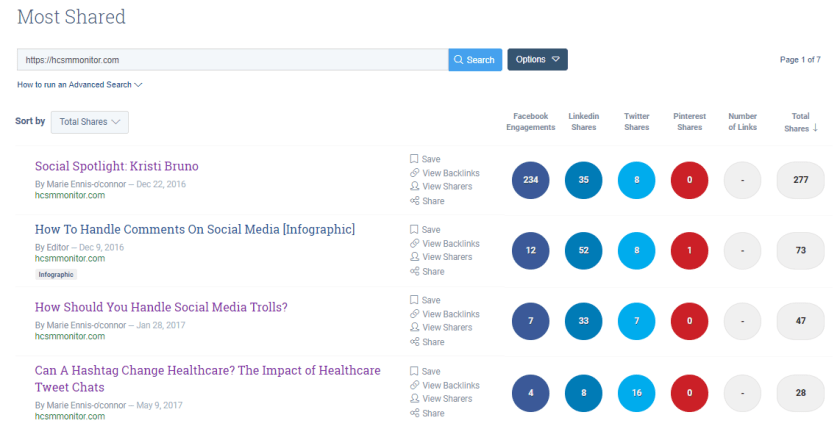
Buzzsumo is a useful tool to explore which pieces of content are popular on social media around a certain topic. Use it to brainstorm popular topic ideas based on keywords related to your topics. You can also input your own domain name (as I have done in the example above) into the search bar and see at a glance how often and where your content is most shared.

3. Canva

download.png

While the quality of your content is a vital factor for successful blogging, how you present your information is also very important. Visuals are a key component of a successful blog. Canva is one of my every-day go-to tools when I am creating visuals. It’s so easy and quick to use it with a multitude of layout options, fonts, images and illustrations to choose from.  Use the pre-set blog template to create header images for your bog.

4. ClickToTweet

clicktotweet3.png

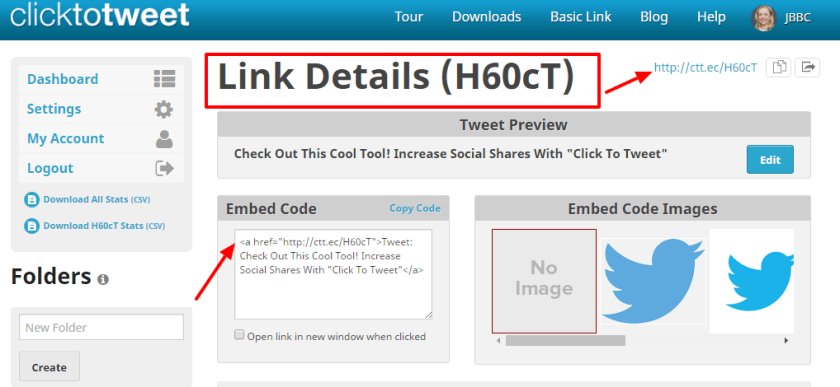
Click to Tweet is a cool free tool which generates one-click tweet boxes or links that can be shared through your website, your blog, or via email. It’s a powerful way to increase social shares and highlight quotes, stats, and key takeaways for your content marketing. It’s also available as a handy Chrome extension.

5. Emotional Marketing Value (EMV) Headline Analyzer

download (51)

According to Copyblogger, on average, 8 out of 10 people will read headline copy, but only 2 out of 10 will read the rest. Your headline is the first (perhaps only) impression you make on a prospective reader.  Use the EMV headline analyzer to calculate the emotional value of your headlines to create titles which will resonate with your audience.

Bonus Tool: Download a list of 90 headline power words here.

6. FreePik

download (2).png

FreePik offers users, high-quality graphic designs: exclusive illustrations and graphic resources. It operates on a freemium business model which means, the majority of the resources offered at Freepik can be used for free, only having to credit the author of the illustration to Freepik. In addition, for a small fee, you can subscribe to the Premium plan and use the illustrations without any accreditation whatsoever.

7. Hemingway Editor

download (18).png

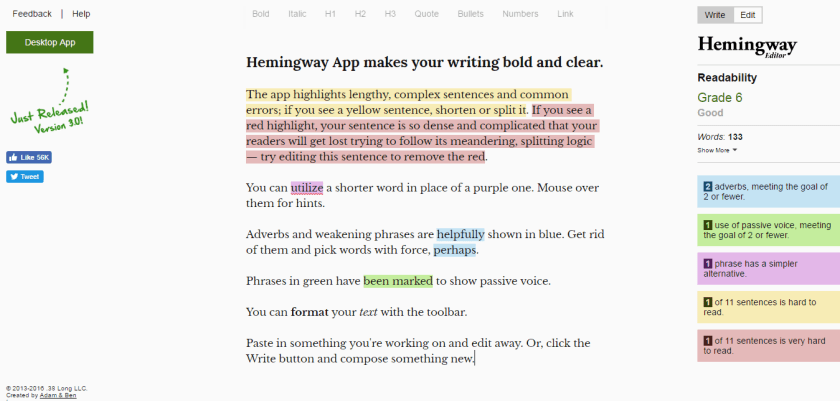
A proofreading tool which clears your copy of all unnecessary copy. Just paste your text into the editor and you’ll get an analysis that highlights lengthy, complex sentences, adverbs, passive voice, and common errors.

8.IM Free

Capture

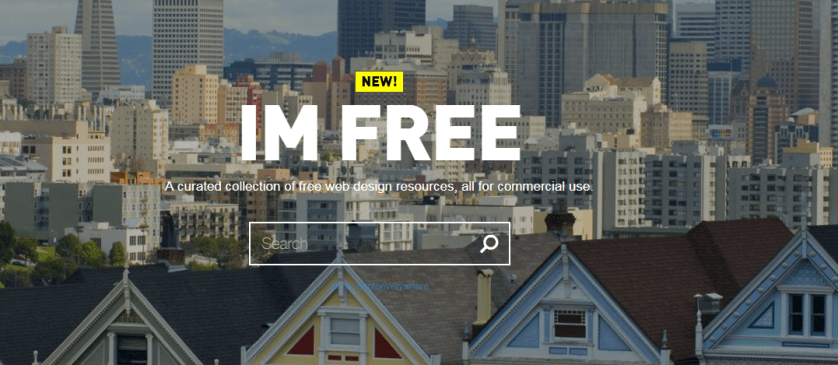
This site contains images (mostly from Flickr) organized by themes such as inspiration, recreation, and ambient. On the site, you’ll also find free templates, icons, button makers, and more.

9. Life of Pix  

download (1).png

Life of Pix offers free, high-quality images that are available for personal and commercial use. Each comes with a helpful color palette so you can plan your visuals accordingly.

10. Lumen 5

This is a cool tool that enables you to turn your blog posts into slideshow-type videos in minutes. The free plan includes unlimited videos, access to 10 million video files, and 480p-quality video with the Lumen5 watermark. You can also upload your own logo. Upgrading to the Pro plan ($49/month) lets you remove the Lumen5 branding, upload your own watermark and outro, and more.

Simply input your blog post’s url and Lumen 5 will import the text and images from that post and auto-create your video. You can then edit it, swap out images, upload other images and add music before you hit publish.  The video above is one I created with  Lumen 5 from an original blog post

11. Pexels

pexels-photo-573238.jpeg

Pexels provides over 3,800 high-resolution photos, collated from other free image sites — making it one of the largest free image directories. Pexels has also added a large library of stock videos to its site also under the Creative Commons license. Use the site’s list of popular searches to find the most in-demand stock video.

12. Pikwizard

73db96f8662102c3683d4e22acf167b9-m.jpg

Pikwizard hosts over 100,000 completely free images, with over 20,000 of those exclusive to the site. The site has a good selection of medical-themed images. The site is particularly good for aesthetic procedures and dentistry-related images.

13. Photofunio

download.png

With PhotoFunia you can edit photos online for free in a matter of seconds resulting in high-quality photo collages. As the name suggests, this tool is a lot of fun to use. It helps you make a mark with your photos by incorporating your photos into mock-ups of background images including billboards, magazine covers, and movie posters.

14. Snip.ly

download (72).png

Similar to Bit.ly, this url shortner tool allows you to enhance every link you share (whether your own content or someone else’s) with a call to action (CTA). When people click on the Sniply-generated link, they can view the article you shared and see a CTA.

15. Stencil

If you like sharing quotes on your blog you can take advantage of their ready to add quotes feature. It will save you a lot of time. You can save, download or share up to 10 images per month, for free.

16. Text Readability Consensus Calculator

txt

This tool takes a sample of your writing and calculates the number of sentences, words, syllables, and characters. It then takes the output of these numbers and plugs them into 7 popular readability formulas to help you find out the reading level and grade level of your materials and help you to determine if your audience can read what you have written.

17. Quora

1_SkmXdPaAk-bmdPc0aT4Kag

Quroa is a question and answer platform where you can either ask a question about your topic or simply do a search using your topic keyword to find what people are asking about that topic. It’s a super place for market research.

18.Unsplash

Capture

Unsplash gives you access to a bank of 50,000+ free-to-use photos. All photos are licensed under Creative Commons Zero, which means you can copy, modify, distribute and use the photos for free, including commercial purposes, without asking permission from or providing attribution to the photographer or Unsplash.

Do you have any favourite tools to enhance your blogging? I’d love to hear about them if you do.

Posted in #HCSM

10 Places To Find The Best Free Images For Your Healthcare Marketing

Do you want your content to stand out in today’s crowded social media landscape? Then it’s time to get visual with social media.

You probably don’t need me to tell you that great visuals make for great marketing. Visual content can be an incredibly powerful marketing tool, one that increases message association, brand awareness, and encourages engagement and shares. The brain processes visual data 60,000 times faster than text. Additionally, 90% of information transmitted to the brain is visual.

The continuing growth of visual platforms, such as Pinterest and Instagram, confirm that incorporating visual content into your social media strategy is a must. Not only do these platforms drive more traffic and shares, but research has also shown that tweets and Facebook posts with images encourage more engagement.  You should also add an image to every single blog post you write and use images to break up the tedium of text.

Whether it’s growing your brand identity or improving medication adherence through instructions, visuals are a key to interacting with and empowering patients. But when it comes to using images, don’t be tempted to reach for the nearest stock photo.

Patient-Role.jpg

These days, there’s no excuse for using boring stock images; you can find all over the web. In this article, you’ll learn my favorite recommendations for sourcing images you can use to enhance your social media posts – and best of all they’re free!

1. Freepik offers users, high-quality graphic designs: exclusive illustrations and graphics resources. It operates on a freemium business model, which means the majority of the resources offered at Freepik can be used for free, only having to credit the author of the illustration to Freepik. Additionally, for a small fee, you can subscribe to the Premium plan and use the illustrations without any attribution whatsoever.

nice-medical-situation-collection_23-2147539027.jpg

2. Gratisography is a collection of free high-resolution pictures you can use on your personal and commercial projects, free of copyright restrictions.

gratisography-397-thumbnail.jpg
Image Source: Gratistography

What I really like about this site is many of the images are quirky and fun — no cheesy stock images here!

3. ISO Republic provides over 3,000 images under the Creative Commons Zero (CC0) license. This means the pictures are completely free to use for personal or commercial purposes, with no attribution required.

nurse-doctor-surgery-1000x750.jpg
Image Source: ISO Republic

4. Life of Pix is a collection of free high-resolution stock images donated to the public domain by the Leeroy Advertising Agency in Montreal.

227a-ake-47433490-1-1600x1068.jpg
Image Source: Life of Pix

Their sister site Life of Vids offers royalty-free videos, clips, and loops for you to use to your heart’s content.

5. Morguefile is a free photo archive “for creatives, by creatives.” The photos have been contributed by a diverse range of creatives from around the world, including both amateur photo hobbyists and professionals.

bike.jpg
Image Source: Morgue File

6. Pexels provides over 3,800 high-resolution photos, collated from other free image sites — making it one of the largest free image directories.

pexels-photo-905874.jpeg
Image Source: Pexels

Pexels has also added a large library of stock videos to its site under Creative Commons license. Use the site’s list of popular searches to find the most in-demand stock videos.

7.  Picjumbo is free stock photo site created by designer and photographer Viktor Hanacek in 2013.

young-beautiful-blonde-girl-looking-out-of-car-window_free_stock_photos_picjumbo_HNCK0625-2210x1474.jpg
Image Source: PicJumbo

Users can click through the different categories of over 600 free high-resolution photos, with the option of upgrading to Premium for new unpublished images to power your social media marketing. No attribution is required.

8. Pixabay hosts over 650,000 free stock photos, vectors, and art illustrations free of copyrights under Creative Commons. On the home page, you’ll find a small, curated collection of images and a search bar for more targeted results.

sunflower-3554567_960_720.jpg
Image Source: Pixabay

Pixabay also has a collection of stock videos for use in your marketing.

9. Rawpixel prides itself on having the most diverse collection of stock photos on the web. It wants to change the face of stock photography by creating design resources that reflect today’s society as it really is. To this end, it has started the (one) world face project with the ultimate goal of photographing people from every nation in the world.

313-pai5547-eye.jpg
Image Source: Rawpixel

10. Unsplash gives you access to a bank of 50,000+ free-to-use photos. You can subscribe to receive ten new images every ten days directly into your inbox.

photo-1518717758536-85ae29035b6d.jpg
Image Source: Unsplash

Creating compelling visual content can be a powerful way to connect with your audience. People connect more emotionally with images than text, and in an increasingly crowded digital landscape, when our minds are attracted more readily to content that draws our eye, images can break through the online content clutter to quickly communicate your marketing messages.

Spend some time this week perusing these sites and download a selection of your favorite images to your desktop. Then get creative with the help of an image editing tool such as Canva and edit your chosen images into something more interesting for your brand. Save these images to a Dropbox folder so you now have your own library of unique images to draw on each time you write a new piece of content or post something to social media.

For more image editing tools check out my weekly cool tool recommendations.

Posted in #HCSM

Click, Like, Retweet: The Role of Social Media In Maintaining Healthcare Reputation

Social media has an increasingly important role to play in maintaining a healthcare organization’s reputation and image. Not only are patients seeking health information online, but many also say their choice of a specific doctor, hospital or medical treatment is influenced by social media.

Patients are also using social media to vocalize how they feel about their doctors, drugs, treatment plans, insurance, and medical devices. Don’t think if you are not on social media, patients aren’t discussing your organization. You can’t opt-out of reputation management – whether you have a social media presence or not, a patient who has a bad experience with your organization is only one tweet or Facebook post away from sharing it with the world.

Be Proactive in Managing Your Online Reputation

It is far better to take control of your reputation by responding to these conversations yourself and correcting any misinformation or misperceptions. Responding in real-time strengthens public perception that your focus is firmly on patient satisfaction.

Remember that everything you do online – every blog post, every tweet, every conversation – is a reflection of your brand. A successful social media presence hinges on the trust between you and your followers. Becoming a trusted source of health information for your patients and proactively developing a strong, consistent, and credible image online will increase patient trust and confidence in your organization.

Social Media Is An Essential Component of Healthcare Marketing

Realising social media’s potential in healthcare requires an organizational culture that values social media as central to its overall strategy. Social media should be viewed not as an add-on, but as an essential component of healthcare marketing. Unlike traditional marketing practices that have stayed constant for decades, social media is still a relatively new marketing channel with new networks, updates, and features constantly emerging. Marketing departments need to invest more of their budget in platforms and resources that takes full advantage of the opportunities presented by social media.

Create A Winning Strategy

The best social media accounts are precisely targeted, updated frequently, and foster an ongoing dialogue with followers. that’s why it’s so important to have a plan in place at the outset and monitor, measure, and adjust your progress as you go.

Recommended Reading: How To Develop A Social Media Strategy For Healthcare Marketing

Start by optimizing your website – think of it as your home-base to which you will be directing your social media followers to find relevant and engaging information. With more people accessing the Internet via mobile devices, make sure your site is optimized for mobile viewing. to increase the likelihood that your website will be placed at the top of google search results, thereby earning you trust with your audience, consider adding a blog to your site. A blog serves to proactively show your patients that you are a trusted source of healthcare information.

Recommended Reading: 9 Proven Ways To Increase The Visibility of Your Healthcare Website

Next, put a content promotion plan in place. In today’s noisy social media world, you need to amplify your content to be heard. Make it easy for people to share your site’s content on social media by incorporating social share icons prominently throughout your website.

Create lots of visual content such as infographics and videos and encourage people to share these on social media. Post updates about your hospital’s accomplishments, showcasing ground-breaking surgeries, cutting-edge research, and the work of high- profile staff members. Cross-promote each piece of content you create but do not copy and paste the same post on each platform—format each of them to meet the requirements of the specific platforms.

Recommended Reading: 10 Places To Find The Best Free Images For Your Healthcare Marketing

At the end of each week, take time to monitor and measure the impact of your social media activity. Monitor your engagement rates and pages views to see which channels get the most attention and measure the return on investment for paid ads and social media promotions.

Wrapping Up

Social media’s influence has still not reached its peak; it will continue to disrupt healthcare in ways we are only beginning to understand. It is equally important nowadays for healthcare organizations to communicate with patients online as it is through more traditional offline channels. Knowing how to leverage this opportunity is an essential skill for the modern healthcare organization. I like to use a quote from Erik Qualman: “We do not have a choice on whether we do social media, the question is – how well we do it”.

You might also like to read Ten Top Tips To Celebrate Social Media Day 2020


This is an edited version of an article that appeared in HealthManagement, Volume 18 – Issue 2, 2018

Posted in #HCSM

Social Media in Dermatology: A Review of Current Usage

In dermatology, as in other medical specialties, social media has become a platform for patient education, public outreach, and professional development and networking.

A review article published in Dermalogica Sinica sets out to investigate the use of popular social media platforms within dermatology along with the potential benefits and harms of these platforms when used by dermatology providers and their patients. 

Dermatology and Facebook

Facebook remains the most popular social media platform worldwide, with over 1.8 billion monthly active users. In the health-care field, Facebook introduces many new opportunities for networking, professional education, and patient education.

In a 2012 study, [1] Amir et al. showed that almost 13% of dermatology journals were present on Facebook and that number has increased to almost 18% in 2017.   Professional dermatology organizations have also increased their public and professional engagement through Facebook. Popular professional dermatology organizations with the most likes on Facebook include dermRounds, Dermatology, American Academy of Dermatology, and Associated Skin Care Professionals.

Facebook has also been used as an educational platform with the goal of helping providers to provide the highest-quality care to patients. Groups like DermLife and The Dermapaths, a group specifically for dermatopathologists, promote this goal. Another group, The Dermatologists, focuses on providers helping one another with particularly difficult cases.

The communication capabilities of Facebook are also used to improve medical education. In dermatology, reports describe the benefit of visually-oriented social media platforms, such as Facebook for use in medical student education.[2] Moreover, Facebook has found an avenue to enhance patient education and in some cases, patient care. There has been an increase in the number of dermatology journals and patient-centered groups that use Facebook to help educate the public. One study assessing public engagement using Facebook found online educational posts most effective.[3]

Dermatology and YouTube

YouTube is the second-most popular website in the world, hosting over 30 billion monthly users with an average viewing session of 40 min.   The presence of dermatology on YouTube is increasing, with most of its content being educational or advocacy.  One dermatologist, Dr. Sandra Lee (aka Dr. Pimple Popper), uses YouTube to post educational videos and interact with her audience of more than 5 million subscribers. This increase in availability of dermatologic information on YouTube demonstrates an opportunity for HCPs to inform the public about popular dermatologic topics.

Dermatology and Instagram

Instagram is a popular photo and video sharing media platform among teens and young adults.  Instagram “hashtags” allow users to search for and identify content related to a specific topic. In one study, researchers showed that the top three dermatology-related “hashtags” included #acne, #alopecia, and #eczema.[4] Physicians of all medical specialties including dermatologists have created Instagram profiles that allow their followers to see before and after procedure photos, patient education material, and advertisements for cosmetic lines and in-office promotions. In the academic environment, Instagram is used to connect and inform students of events, announce services, and provide public education; however, this tool is underutilized in dermatology. One study found that 7% of dermatology departments have an Instagram profile.[5] A recent study found that 5% of dermatologic focused Instagram posts were made by a board-certified dermatologist.[6] 

Dermatology and Twitter

In dermatology, Twitter has become a popular platform for users to communicate dermatologic concerns. One study shows that almost 85,000 tweets over a 1-year period communicated personal concerns with skin disease [7] while another study shows that the most common type of re-tweeted tweets (43.1%) are about acne.[8] Furthermore, medical schools have begun using Twitter to increase student engagement. For example, Northwest Ohio Medical University used twitter to post weekly dermatology quizzes and successfully increased student engagement from 23.8% to 55.9%.[9]  The authors note, one of the biggest challenges facing Twitter is the dissemination of misperceptions related to dermatologic diseases. With such a large young adult population communicating information through Twitter, there is a significant amount of incorrect information, empirical data, and myths circulating that may influence a patient’s approach to dermatologic concerns.[10]

Dermatology and Reddit

Reddit is a website that allows users to join communities of people with similar interests to share and learn information. There are over 150,000 “subreddits” containing threads of comments pertaining to a particular topic where users are able to comment and communicate with one another. Dermatology has several subreddits with the most common being cosmetic advice, disease identification, and medications.  The authors again point out that Reddit presents challenges as it allows members to post responses to medical questions, thus introducing the possibility for the dissemination of inaccurate or dangerous medical advice. But counter this by highlighting Reddit’s opportunity as an entry point for physicians to provide accurate information and dispel false information, promoting knowledge about common dermatologic topics as a public health measure.[11]

Dermatology and Pinterest

Pinterest started in 2009 as a platform designed to share images, GIFS, and videos.  Users are able to upload images, “pin” images, and create “boards” (collections of pins). With respect to dermatology, studies show that informative pins, advocacy, and home remedies compose the majority of dermatology related “pins” and “boards.” However, it is important to note that only 24% of these “boards” were created by M.D.s or advocacy organizations.[12]

Dermatology and Snapchat

Snapchat, developed in 2011, is a social media application that allows users to share photos and videos with other users for twenty-four hours. Snapchat’s interface of quick 10-second stories captures the attention of the audience and the story features allow millions of people to view the same story posted by a particular user. For example, Dr. Michael Salzhauer (a plastic surgeon better known as Dr. Snapchat) posts his surgeries live and receives over 700,000 views/day. He uses Snapchat as a tool to educate the public as well as generate new clientele, as over 60% of new patients in his office come from Snapchat and other social media.[13] The potential benefit of social media, specifically Snapchat, is clear in healthcare, but the use of Snapchat in dermatology is lagging behind that of other healthcare fields.

Social Media Opportunities in Dermatology

The study authors believe “there is a great opportunity for health care providers to enhance communities and disseminate information at a greater, more efficient rate, through platform interoperability. Improved interoperability would also allow for greater patient recruitment and social media-based research.”

Each platform is designed to function independently; however, there is a degree of interoperability among platforms, of which there is incredible potential.

An additional opportunity for social media in dermatology is patient recruitment for clinical research.

Considering each clinical study has a target population, social media provides tremendous opportunity to gather a large volume of patients.

Finally, dermatologic based social media communication, research, and outreach has tremendous value from a public health perspective.

Social media is one of the fastest means for the dissemination of information, especially when content goes “viral.” In fact, the dissemination of public health knowledge through social media platforms has demonstrated a positive impact on health outcomes and patient behaviors.

Challenges of Social Media and Healthcare

Among the challenges presented by social media in a healthcare context, the authors point to biased demographics.

The majority of social media users are white women between the ages of 30–49. [14] Therefore, social media-based research must be cognizant of the inherent biases that may be present.

Not surprisingly the authors consider “the most concerning challenge of social media use in healthcare is the spread of unreliable and sometimes incorrect medical information.”

Most authors of medical information on social media platforms have unverified credentials and are generally underqualified. Furthermore, the information put forth on these platforms is often incomplete, unreferenced, and based on personal anecdotes.

While most medical literature is evidence-based, medical information through social media focuses on individual stories and experiences that may not be generalizable to the population at large.[15]

Furthermore, professionalism is an additional, ongoing concern with the increased use of social media platforms. Other challenges of social media use in healthcare are centered on patient privacy and violations between patient-provider interactions. Social media has brought forth new challenges in this respect, specifically HCPs using identifying patient information in public posts. In one study, it was found that 17% of blogs written by HCPs describing individual patients had enough information to identify the patient or the provider.[16]

Further Reading: Social Media: Professional Boon or Bane? It’s Complicated

Conclusion

The authors conclude, these risks aside, the opportunity to promote public health, patient education, and professional interactions is impactful and should not be missed.

With 80% of people searching the Internet for health information, there is an onus on HCPs to maintain a presence on social media wherever possible to dispel misinformation and circulate evidence-based knowledge.

Notes

This is an edited version of the original review which can be accessed in full here.

[1] Amir M, Sampson BP, Endly D, Tamai JM, Henley J, Brewer AC, et al. Social networking sites: Emerging and essential tools for communication in dermatology. JAMA Dermatol 2014;150:56-60.

[2] Enhancing dermatology education with social media platforms: Are we there yet? J Am Acad Dermatol 2018;79:AB129.

[3] Enhancing dermatology education with social media platforms: Are we there yet? J Am Acad Dermatol 2018;79:AB129. Back to cited text no. 12.

[4] Braunberger T, Mounessa J, Rudningen K, Dunnick CA, Dellavalle RP. Global skin diseases on instagram hashtags. Dermatol Online J 2017;23. pii: 13030/qt7sk410j3.

[5] St Claire KM, Rietcheck HR, Patel RR, Dellavalle RP. An assessment of social media usage by dermatology residency programs. Dermatol Online J 2019;25. pii: 13030/qt5v62b42z.

[6] Park JH, Christman MP, Linos E, Rieder EA. Dermatology on instagram: An analysis of hashtags. J Drugs Dermatol 2018;17:482-4.

[7] Sarker A, Magge A, Sharma A. Dermatologic concerns communicated through twitter. Int J Dermatol 2017;56:e162-3

[8] Shive M, Bhatt M, Cantino A, Kvedar J, Jethwani K. Perspectives on acne: What twitter can teach health care providers. JAMA Dermatol 2013;149:621-2.

[9] Kunzler E, Graham J, Mostow E. Motivating medical students by utilizing dermatology-oriented online quizzes. Dermatol Online J 2016;22. pii: 13030/qt0p31j0z8.

[10] DeBord LC, Patel V, Braun TL, Dao H Jr. Social media in dermatology: Clinical relevance, academic value, and trends across platforms. J Dermatolog Treat 2019;30:511-8.

[11] Buntinx-Krieg T, Caravaglio J, Domozych R, Dellavalle RP. Dermatology on reddit: Elucidating trends in dermatologic communications on the world wide web. Dermatol Online J 2017;23. pii: 13030/qt9dr1f7x6

[12] Whitsitt J, Mattis D, Hernandez M, Kollipara R, Dellavalle RP. Dermatology on pinterest. Dermatol Online J 2015;21. pii: 13030/qt7dj4267p

[13] Patel S, Bewley S, Hodson N. Snapchat is not for sharing. BMJ 352 (2016): i1543

[14] Sadah SA, Shahbazi M, Wiley MT, Hristidis V. A study of the demographics of web-based health-related social media users. J Med Internet Res 2015;17:e194.

[15] Pirraglia PA, Kravitz RL. Social media: New opportunities, new ethical concerns. J Gen Intern Med 2013;28:165-6.

[16] Chretien KC, Kind T. Social media and clinical care: Ethical, professional, and social implications. Circulation 2013;127:1413-21


Posted in #HCSM, SEO

Why and How You Should Optimise Your Medical Website For Local Search

“Near me” searches have grown consistently since 2013, according to Think With Google

Your website is the hub of your digital efforts. You want your site to be optimized for search keywords, usability, and content. Doing so will help your website appear further up Search Engine Results Pages (SERPs) for the services you offer, and help increase the likelihood that users will remain on your site and get to know you better.

In the current digital age, most people find the services they are looking for, including healthcare, through search engines.  If you want more people to find you online, you need to optimize your website through good search engine optimization practices.

And if you want to attract new patients, your website also needs to be optimized for your local area. When someone uses the internet to locate a Medical Practice nearby, it’s critical that your website appears in those results (searches on mobile devices containing the phrase “near me” has skyrocketed in recent years).

internet-trends-report-2018-192-1024 (1)

In recent research carried out by BrightLocal, consumers were asked how they used voice assistants and voice search for local business. The top three most demanded voice search functions involve finding restaurants, grocery stores, and food delivery, with clothing, accommodation, and medicine following closely behind.

what-consumers-want-voice-search.png

The Voice Search for Local Business Study also revealed that 46% of voice search users use voice search to find local businesses daily.

how-often-do-people-search-for-local-businesses-using-voice-search.png

There are a few ways you can drive local engagement via digital channels. Here are a few tactics you should consider integrating into your local marketing strategy:

1. Create targeted advertising campaigns

Digital search or display ads offer you an excellent opportunity to target your audience using various parameters. You can leverage digital ad networks, such as Google Ads, and serve ads only to people within a specific geographic location, such as your town/city.

2. Develop a local SEO strategy

When creating content for your website, it’s useful to include long-tail keywords with your geographic location. Make sure your meta descriptions and keywords include location information. Include your location information on every page of your website, either in the header, footer, or elsewhere on the page. If you have more than one office location, have a separate webpage for each site and include the address and location for each. Finally, include Google maps and/or directions to your office

2. Claim Your Google My Business Listing

Google My Business (GMB) is a free, simple to use tool that allows small business owners  to increase their online visibility and promote their business information on Google Search.According to Google “Providing and updating business information in Google My Business can help your business’s local ranking on Google and enhance your presence in Search and Maps.”

GMB appears on desktop – just to the right of the organic and paid search results. If you’re on mobile, it appears as a top result before the organic results. If you haven’t set up your GMB listing, it’s time to do so. Follow these step-by-step instructions to get started right away.

Once you’ve set up your account, it’s time to optimise it. An optimised page helps Google understand more about your business: who you are, what services/products you sell, where you’re located, etc. The more Google knows about you, the more types of searches your GMB listing can appear in.

Conclusion 

Your website is pivotal to your digital marketing strategy. And with more patients than ever searching online for you via mobile devices, it’s imperative that your website is optimized for them to find you.  It takes time and resources to optimize your site to deliver the best experience possible, but if you are serious about how your business performs, you need to get serious about the performance of your website too.


Sign up for our mailing list to get helpful tips for growing your practice.

Further Reading: 

Posted in #HCSM, Thursday Tip

#ThursdayTip: How To Assign Admin Roles on Facebook

Welcome to this week’s social media tip. Today I want you to show you how to assign admin roles on your Facebook Page. 

Facebook allows five different administrator roles: admin, editor, moderator, advertiser and insights analyst. Each role has different capabilities.

27405598-3f14-4948-9887-fe65bb311b81

Admin can manage all aspects of the Page. They can publish and send Messenger messages as the Page, respond to and delete comments on the Page, post from Instagram to Facebook, create ads, see who created a post or comment, view insights, and assign Page roles. If an Instagram account is connected to the Page, they can respond to and delete comments, send Direct messages, sync business contact info and create ads.

Editor can publish content and send Messenger messages as the Page, respond to and delete comments on the Page, create ads, see who created a post or comment, post from Instagram to Facebook, and view insights. If an Instagram account is connected to the Page, they can respond to and delete comments, send Direct messages, sync business contact info and create ads.

Moderator can send Messenger messages as the Page, respond to and delete comments on the Page, create ads, see who created a post or comment, and view insights. If an Instagram account is connected to the Page, they can respond to Instagram comments, send Direct messages and create ads.

Advertiser can create ads, see who created a post or comment, and view insights. If an Instagram account is connected to the Page, they can create ads.

Analyst can create ads, see who created a post or comment, and view insights. If an Instagram account is connected to the Page, they can create ads.

To assign a role go to Settings on your Page, and click on Page Roles. Scroll down through the options above to choose which roles you wish to assign to your team members.

1693526a-0455-4aa9-baa9-c9bc64d55a5b

Here’s to your social media success!

Posted in #HCSM

How Social Media Can Inform Public Health Education and Outreach During COVID-19

A machine learning scan of popular social media platforms could help inform public health education and outreach during Covid-19, according to a new study published in the Journal of General Internal Medicine.

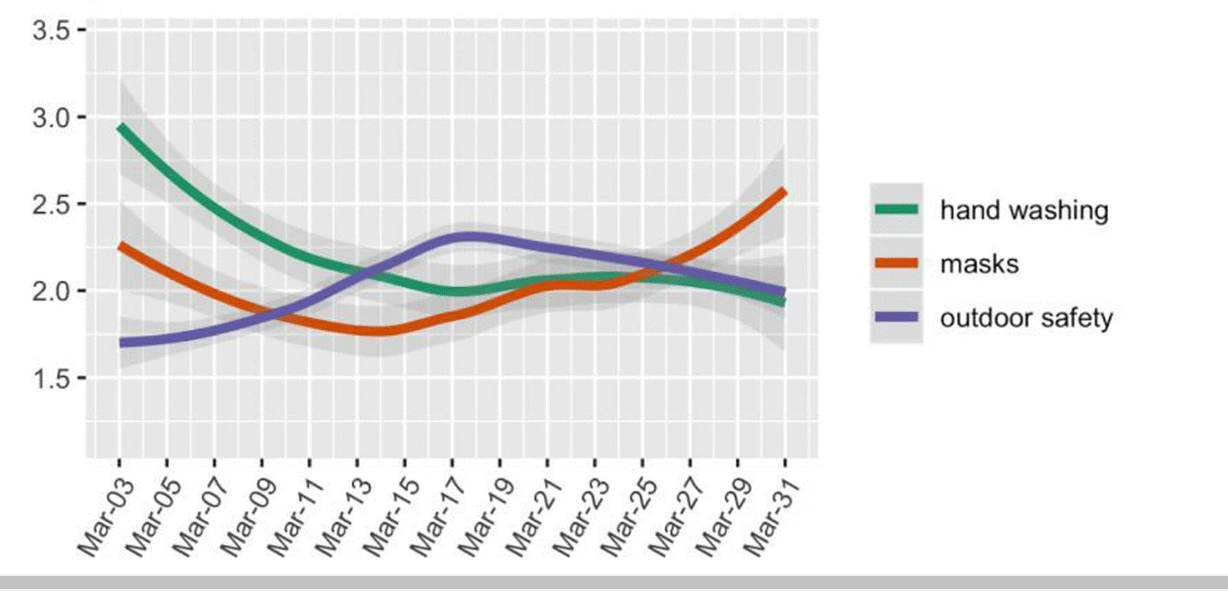
The study measured daily changes in the frequency of topics of discussion across 94,467 COVID-19-related comments on Reddit* in March, 2020 to test the following hypotheses:

  • The pandemic has been accompanied by an “infodemic,” an overabundance of information and misinformation.
  • Public response to the pandemic and infodemic is important, but undermeasured.
  • Real-time analysis of public response could lead to earlier recognition of changing public priorities, fluctuations in wellness, and uptake of public health measures, all of which carry implications for individual- and population-level health.
*Reddit is the 19th most popular website in the world with 420 million monthly active users.

The study identified topics that fell into three categories of interest, tracking daily variations in the average prevalence of topics across all comments.

  1. response to public health measures
  2. impact on daily life
  3. sense of pandemic severity.

Results

52f4e2e4-bbe0-4b90-912b-461f135817ae

This analysis indicates that longitudinal topic modeling of Reddit content is effective in identifying patterns of public dialogue and could be used to guide targeted interventions.

Early recognition of this reality could have led to more specific information dissemination campaigns and earlier public acknowledgment of disease severity.

Questions about safely spending time outdoors peaked in mid-March, representing a missed opportunity for public guidance.

Tracking and responding proactively to common questions, such as what material is best used for a homemade mask, may minimize the spread of misinformation.

Notably missing from these Reddit topics were discussions of contact tracing, a growing area of public concern.

Stokes, D.C., Andy, A., Guntuku, S.C. et al. Public Priorities and Concerns Regarding COVID-19 in an Online Discussion Forum: Longitudinal Topic Modeling. J GEN INTERN MED (2020). https://doi.org/10.1007/s11606-020-05889-w

Notes

Limitations of this study include that Reddit users are not representative of all segments of the population, and that Reddit data is not associated with a geographic location. Real-time monitoring of online COVID-19 dialogue holds promise for more dynamically understanding and responding to needs in public health emergencies.

Further Reading  

Infodemic investigation: Facebook is biggest source of false claims about coronavirus

NUI Galway Study Finds the Sharing of COVID-19 Misinformation linked to Social Media Overload and Trust in Online Information

Disinformation, Misinformation and Inequality-Driven Mistrust in the Time of COVID-19: Lessons Unlearned from AIDS Denialism


Posted in #HCSM

Do Online Health Seekers Trust Social Media?

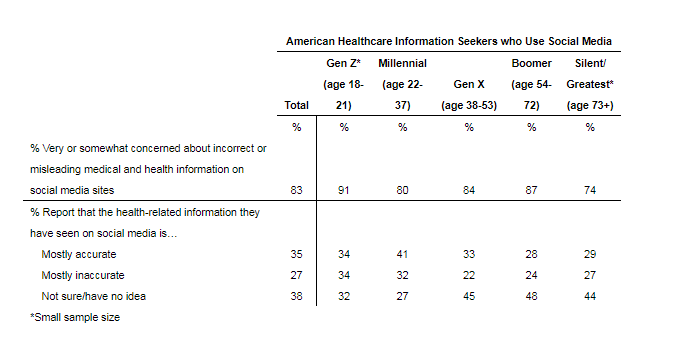
A survey profiling how American adults access, use and feel about health-related information finds that most Americans who regularly seek health information are concerned about incorrect or misleading medical information on social media, and few have found health information on social media to be accurate.

These findings are consistent across generations. The survey, The Great American Search for Healthcare Information, was conducted among 1,700 Americans 18 years of age and older. It was commissioned by global communications and marketing services firm Weber Shandwick in partnership with KRC Research.

I find the results of this survey very interesting for a number of reasons. 

Firstly, it’s interesting to learn that the majority of online health seekers are concerned about incorrect or misleading medical information. This reassures me in a way because it means that, contrary to the pervasive belief that the public believes everything they read online, people are actually far more discerning.

It also underscores for me that patients aren’t looking to supplant knowledge from healthcare professionals with the information they find online. They still look to their healthcare providers as the source of credible health information.

1.jpg

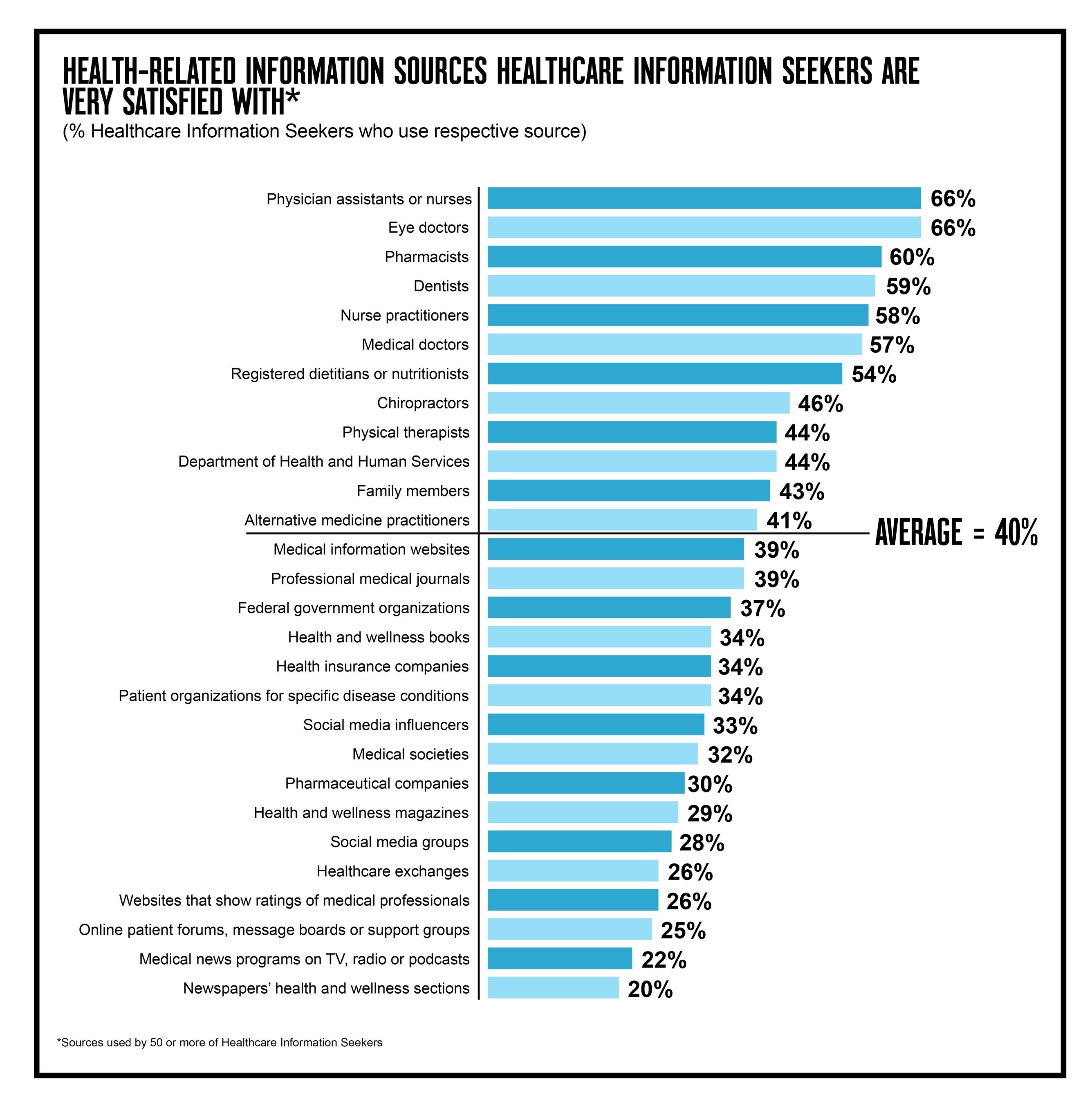
Note that nurses, pharmacists, and eye doctors score higher than medical doctors in terms of satisfaction. This finding surprised me. The survey suggests that physicians may have a millennial problem.

The Millennial generation is least likely to be very satisfied with the information provided by medical doctors. In evaluating other attitudes toward physicians, the study suggests that doctors may be contending with a Millennial trust challenge. In addition to their lower satisfaction levels with information from doctors (on a basis relative to other generations), Millennials are the least likely generation to say they always listen to their doctor(s), the most likely to believe that online health-related information is as reliable as that from medical professionals and the most likely to say they trust their peers more than medical professionals.

download (26)

Secondly, I find it disheartening that survey respondents are not finding accurate health information online. We know for a fact that accurate health information does exist online, so why are people not rating it higher?  Medical information websites fall just below average in terms of satisfaction (39 percent).

Finally, I’m a little surprised to learn that concerns about the accuracy of social health information are consistent across generations, including digital natives.

Gen Z, is just as likely to be concerned about incorrect or misleading information as the much older Boomer generation (91 percent and 87 percent, respectively). This suggests that social media comfort and proficiency do not have a bearing on perceptions of legitimacy, leading to the conclusion that it is the content or channel that is the challenge for health-related information communicators.

All of this adds up to a trust and credibility problem we need to urgently address.

A Wake-up Call for Healthcare Professionals

The healthcare industry is still lagging behind in delivering credible and relevant information to patients when and where they need it most.  Healthcare has much to learn from other industries that are adept at mapping the customer journey and providing relevant and timely information at each stage of the journey.

Earning Trust From Online Health Information Seekers

Within each problem lies its solution. To address the trust gap, the authors suggest the following fixes:

Prove your online credibility from the outset

  • information should be cited by a medical professional
  • it should cite a scientific study
  • it should be associated with a trusted brand
  • it should be cited by a trusted school or research organization

Design your content for discovery

By building content that is discoverable across multiple channels – online and offline – you can intersect your customers across their journey and ensure that they find the credible information they’re looking for.

Use succinct, clear and plain language in your communications.

Recognise that people are swimming in information and overwhelmed by the volume, creating confusion and perceptions of conflicting facts.

I would add to this list that it’s important to talk to patients in your offices about the information they find online. For more on this read What’s the Influence of Patients’ Internet Health Information-Seeking Behaviour on the Patient-Physician Relationship?

A Wake-up Call for Healthcare Professionals

In a post published in Physician’s Weekly, primary care physician Mikhail Varshavski, DO, is unequivocal that healthcare professionals’ failure to influence social media is responsible for the rise of misinformation online.

I used to consider the absence of quality physicians online merely a problem of missed opportunity. Now I’ve realized it is much more than that. If misinformation has the power to call in to question the validity of something as grand as an American presidential election, it certainly has the power to influence our patients’ everyday health decisions. The healthcare industry as a whole needs to advocate for more education and focus on this burgeoning global communication platform.


According to a 2017 survey by PM360 Online, only 9% of physicians engage with patients and other health care providers — this includes physicians who reply to comments, join group discussions or share helpful information and links on social media platforms – and as low as 1% of all health care professionals use social media to be content creators — publishing original content via blogs, forums, and websites.

Click here for the full The Great American Search for Healthcare Information report and presentation. It includes additional findings such as the types of health information Americans seek, their use of new digital health services and apps and attitudes about the concerns vs. advantages of the state of healthcare information today.


You might also like to read 

Protecting the Value of Medical Science in the Age of Social Media and “Fake News”

An Opportunity To Build Patient Loyalty In An Era Of Social Media And Fake News